

Etruscan Phrases
Translation of Short Inscriptions (continued)
Section "c"
Scripts: GA, MR, MM, OU, VG, VA, CH,
MG, MH, LM, DP, DQ, DR, DS, DF,
by
Mel Copeland
(from a work published in 1981)
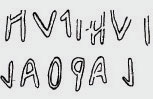 Script
GA - This inscription dating from the 2nd to 1st c.
B.C., was discovered in a tomb of the necropolis of
Gouraya, ancient Gunugu, 150 km west from Algiers on
the Mediterranean coast, in modern Algeria. It was
written on a small bronze disk, 7 cm in diameter,
and was recorded by specialists in African
antiquities StéphaneGsell in1906, PierreWuillemier
in1928, Marcel Le Glay in1956, Jehan Desanges in1980
and was not noticed by specialists of ancient
Etruria. It is located in the Musée National des
Antiquités of Algiers. The script has been
translated as "Pumpun Larthal" interpreted to mean,
"Pumpun, son of Larth."
Script
GA - This inscription dating from the 2nd to 1st c.
B.C., was discovered in a tomb of the necropolis of
Gouraya, ancient Gunugu, 150 km west from Algiers on
the Mediterranean coast, in modern Algeria. It was
written on a small bronze disk, 7 cm in diameter,
and was recorded by specialists in African
antiquities StéphaneGsell in1906, PierreWuillemier
in1928, Marcel Le Glay in1956, Jehan Desanges in1980
and was not noticed by specialists of ancient
Etruria. It is located in the Musée National des
Antiquités of Algiers. The script has been
translated as "Pumpun Larthal" interpreted to mean,
"Pumpun, son of Larth."
The disk is significant because it
testifies to trade between Punic Africa and Etruria.
Abundant pottery of the so-called Campana B ware of
the 2nd to 1st c. B.C., apparently produced in
Etruria, were also found in the Acropolis. Another
script, the gold tablets of Pyrgi, written
in Punic and Etruscan, testifies to the links
between the Etruscans and Phonecians /
Carthaginians. ["A
neglected Etruscan inscription," by Dominique
Briquel, Etruscan News, Newsletter of the
American Section of the Institute for Etruscan and
Italic Studies, Winter 2006]
The script reads as follows, following the "Etruscan
Phrases" Glossary:
GA-1
IOMPON or IOM PON (IVM PVN) [Translation: name, Iom,
possibly Ion (L. Io, Ion -us, an Argive girl loved
by Jupiter and changed into a cow) PVN, the
Carthaginian (L. puniceus-a-um, Punic, Carthaginian;
L. Poeni-orum, the Carthaginians; sing. Poenus-i);
See also PONIG (PVNIb) Tavola
Eugubine, N160. ]
GA-2 LAR RAL [Translation: of the houshould godess
(L. Lar, laris) Ral. RAL, RALNA, a consort of the
god Tinia, is the mother of Helen of Troy, as seen
in the Divine_Mirror.html,
Script DM and LAR RAL is also in the Perugia Cippus, K59]
Script
MR - Etruscan mirror in the Musée Royale de
Mariemont, Belgium (Image from http://bcs.fltr.ucl.ac.be/FE/02/Miroirs.html).
The names on the mirror are the following:
MR-1 HERCLE (Hercules) - Hercules, Heracles is a
popular character on Etruscan Mirrors, found in the
Divine_Mirror.html
Script DM, and the Volterra mirror, Uni Suckling
Heracles.html, Script AH.
MR-2 MENRFA - Minerva, goddess of wisdom and
patroness of arts and sceinces (L. Minerva-ae; Gr.
Athena). She appears on several mirrors and perhaps
on the Magliano Disk, Script M13.
There are variant spellings of her name: MANRIFA,
M13, MANFRA?, Mirror #696, British Museum, and the
Oberlin University Museum, _ _NRFA, Script OB-1 (See the Divine_Mirror.html;
Script OB, Etruscan (Corneto or Tarquinia)
Hand Mirror with the Judgment of Paris, ca. 300 -
150 B.C. Oberlin University, Allen Memorial
Art Museum.
MR-3 ERIS - Eris is the Greek goddess of discord and
strife (L. Discordia-ae). Note the Greek spelling of
her name on this mirror. This mirror is believed to
be of three Greek goddesses, Eris, Athena (L. Minerva)
and Thetis, the Neried (sea nymph) impregnated by
Zeus, mother of the hero Achilles. The spelling of
Thetis on this mirror is unusual.
MR-4 THETHIS ( EIS) -
Normally this would be read as RERIS ( the "O" = "R") assuming the
transliteration is as shown in this image. For
images from Greek vases of Thetis and a background
on her see http://www.fjkluth.com/thetis.html.
She is normally shown with a crown with prongs or
leaves (the trident symbol?), a shell and rides on a
EIS) -
Normally this would be read as RERIS ( the "O" = "R") assuming the
transliteration is as shown in this image. For
images from Greek vases of Thetis and a background
on her see http://www.fjkluth.com/thetis.html.
She is normally shown with a crown with prongs or
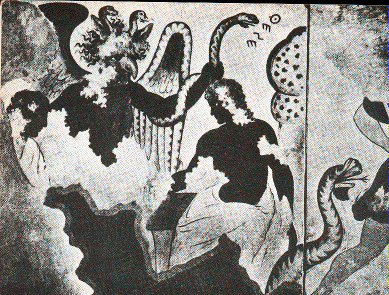
leaves (the trident symbol?), a shell and rides on a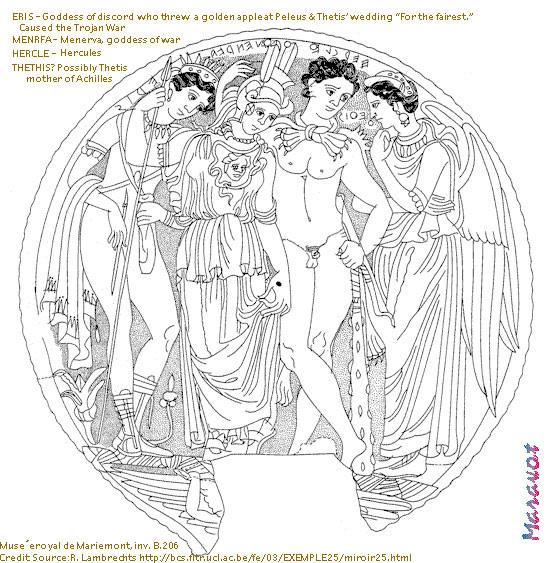 hippocampus (sea serpent with a horses head, popular
in Etruscan tombs and on Phoenician coins). She
delivered the shield and armor to her son, Achilles,
during the Trojan War, flying from the forge of
Hephaestus under Mt. Aetna to Troy. Earlier Thetis
had saved Hephaestus when Hera threw him out of
Heaven after she bore him. He was lame and disgusted
his mother. Hephaestus was married to the Grace
Aglaea or Aphrodite.
hippocampus (sea serpent with a horses head, popular
in Etruscan tombs and on Phoenician coins). She
delivered the shield and armor to her son, Achilles,
during the Trojan War, flying from the forge of
Hephaestus under Mt. Aetna to Troy. Earlier Thetis
had saved Hephaestus when Hera threw him out of
Heaven after she bore him. He was lame and disgusted
his mother. Hephaestus was married to the Grace
Aglaea or Aphrodite.
The Etruscan "TH" had a dot within a circle
"target," following the Greek character, theta. This
transcription does not show the target, but a closer
examination of the original mirror may clear up this
discrepancy. Notethe distinct form of the Etruscan
"theta" in the name of These (Theseus) as he is
being tormented by Tuchulcha in Hades. Not shown in
the image is the name TVKVLKA above the demon's
head.
Unlike
Minerva and Eris, Thetis is shown here with wings.
Thetis was a shape changer and did fly, so the wings
are appropriate in this image. If this is Thetis,
the mirror is recalling the story of Thetis' wedding
and the cause of the Trojan War. The Trojan War is a
popular theme on the Etruscan mirrors.
Eris, the goddess of discord, is a little more than
a personification of strife, except in the familiar
tale of the golden apple. Because of her
disagreeable nature she was the only one of the gods
not to receive an invitation to the wedding of
Peleus and Thetis. She came anyway and was refused
admittance. Furious, she threw a golden apple,
inscribed "For the fairest," among the guests. Three
goddesses claimed it and Paris was asked to judge
among them. The ultimate result was the Trojan War.*
The judgment of Paris (See Script OB on the Divine_Mirror.html)
involved Aphrodite (L. Venus, Etr. Turan), Hera (L.
Juno, Etr. Uni), Athena (L. Minerva) and Alexander /
Paris (L. Alexander-dri, Etr. varied spellings:
ELCHINTRE, DM-6, and ELACHSNTRE, OB-4).
Hera, the sister of Zeus and his favorite wife, was
the mother of Ares (L. Mars, Martis [old form
Mavors]), Hebe and Eileithya. Zeus produced a
daughter, Athena, but not by Hera, who was born out
of his head or hip. Hera became jealous over Athena
and Zeus' affairs with six other goddesses made the
problem worse. One of the affairs involved Thetis,
but Hera was the personification of jealousy and spent much of her time persecuting her
husband's mistresses and their children. One of
these children persecuted by Hera was Heracles,
pursuing him from the crib all his life, even
through his 12 labors. Heracles' mother was married
to Amphtryon, son of Perseus' son Alcaeus. When
Amphitryon killed his father-in-law, Electryon, King
of Tiryns, he was exiled by Electryon's brother,
Stheneleus. Alcmene fled with her husband to Thebes,
where they were welcomed by King Creon. She refused,
however, to lie with her husband until he had
avenged the murder of her brothers by Taphian
pirates. While Amphitryon led an expedition against
the pirates Zeus disguised himself as Amphitryon and
shared Alcmene's bed, when Amphitryon returned home
she was somewhat aloof and thought it odd that he
was telling her the tales from the expedition which
she had heard the night before (from Zeus). The seer
Teresias cleared up the matter and everyone
anxiously awaited the birth, including Hera. She had
long suffered from her husband's philandering, and
her implacable hostility toward the sons that Zeus
had fathered on mortal women was notorious (Thetis'
son Achilles was by Zeus). Nine months after his
visit to Alcmene, Zeus boasted before the other gods
on Olympus that on that day a son would be born of
his lineage who would rule over all the land about
him. Hera, pretending not to believe her husband,
made him swear that it would be as he had declared.
Zeus had no sooner made his unwary vow than Hera
sent Eileithyia, the goddess of childbirth, to delay
the hour of Alcmene's delivery at Thebes. She
herself saw to it that a son was born immediately at
Tiryns to the wife of Stheneleus, who had usurped
the throne that should have belonged to Amphitryon.
As a grandson of Zeus' son Perseus, this boy,
Eurystheus, was guaranteed by Zeus' vow the rule of
Tiryns and Mycennae. Zeus was furious at Hera, but
could not revoke his oath.
Alcmene, meanwhile, might have died in childbirth if
one of her attendants, Galanthis, had not found a
way to trick Eileithyia. The goddess was sitting
outside Alcmene's bedroom with legs and fingers
tightly crossed as a charm to hold back the
delivery. Galanthis rushed from the room crying out
joyfully that the child was born. The startled
goddess, forgetting the charm, leaped up. In that
moment Alcmene was delivered, giving birth to twin
sons, Alcaeus, or Heracles, and Iphicles. According
to Diodorus Siculus (4.91-4.10.1), Alcmene exposed
the baby Heracles for fear of Hera's anger. Athena
found him and persuaded the unsuspecting Hera to
suckle him. Hera did so until he bit her. Other
versions of this incident claim that Zeus put the
baby to the sleeping Hera's breast. When she awoke,
the spilled milk became the Milky Way. Another
mirror, the Volterra Mirror, Uni_Suckling_Heracles.html,
shows a bearded Heracles suckling at Uni's breast.*
This appears to be the background story behind this
curious mirror showing Eris, Minerva (Gr. Athena),
Heracles and Thetis together. However, the
appearance of Hercules with these women seems out of
context and there may be another myth held among the
Etruscans that would directly explain the
connection. In short, Heracles in this scene seems
to include too obtuse of a connection.
Script
MM - Mirror in the Metropolitan Museum of Art, New
York, Acc. # 21.88.28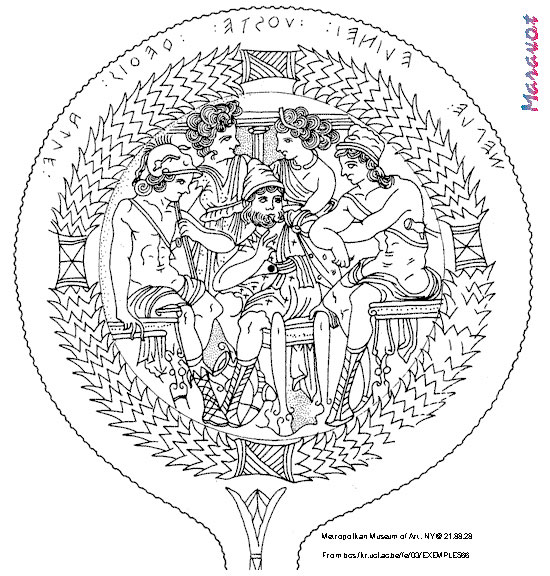 (Image from
http://bcs.fltr.ucl.ac.be/FE/02/Miroirs.html)
(Image from
http://bcs.fltr.ucl.ac.be/FE/02/Miroirs.html)
Names on this mirror are interesting.
Two of the three male figures are holding up two
fingers. The older, bearded man seated in the center
of the scene is wearing a cloak with a star pattern
on it, suggesting royalty, as in the royal
characters of the Divine_Mirror.html, Script DM,
such as Agamemnon. He seems to be instructing the
two men who are armed, with knives slung on their
sides. The one on the left either has a spear or a
staff. There are two women standing behind the old
man in this scene.
The names on this mirror are probably MENLE (Menelaus), his wife, ELINEI (Helen), ORSTE (Orestes), THETHIS (Thetis) and ACHLE (Achilles). The arrangement of the names on the mirror should be over the heads of the characters to whom they apply, and following this arrangement the center figure would be VRSTE (Orestes) and the two women behind him would be ELINEI (Helen) and THETHIS (Thetis). The two young men on either side would thus be ACHLE (Achilles) and MENLE (Menelaus). We earlier thought MENLE was NEPLE (Achilles son Neoptolemus), but the first character in the name appears to be a partially written "M" and the third character a partially written "N." MENLE appears also in the Divine Mirror: http://www.maravot.com/Divine_Mirror.html
Thus, MM-1: MENLE, Menelaus or NEPLE,
Neoptolemus
MM-2: ELINEI, Helen of Troy
MM-3: VRSTE, Orestes
MM-4: THETHIS , Thetis
MM-5: ACHLE, (A↓LE) Achilles
We find in other Etruscan mirrors rather complex
stories, and the one in this mirror appears to be
just as complex as the others. Because Orestes is
the seated figure who is central to the scene, with
Helen, the sister of his mother upon whom Orestes
will commit a revenge-murder, we may conclude that
the subject has to do with revenge murders. Orestes
would revenge the murder of his father, Agamemnon,
by his mother Clytemnestra and her cuckold.
Neoptolemus, the son of Achilles, murdered King
Priam in revenge for killing his father Achilles.
Helen is also the object of the revenge story, since
she was abducted by Priam's son, Alexander.
Menelaus was, of course, married to Helen and
her abduction caused Menelaos and Agamemnon to
launch a thousand ships to redeem her from Troy,
where Alexander (Paris) had taken her and untold
riches from Menelaos' palace in Sparta.
THETHIS (Thetis) accompanies her son
AKLE (Achilles). The marriage of Thetis was the
cause of the abduction of Helen and the Trojan War,
in as much as Eris, the goddess of discord, was not
invited to the wedding. In spite Eris threw a golden
apple into the wedding ceremony with the words "for
the fairest" inscribed upon it. Orestes' role was to
take revenge on his mother, Clytemnestra, who,
together with her lover, Aegisthus, murdered his
father, King Agamemnon, on his return from the
Trojan War.
ACHLE appears in several texts: ACHLE, MM-2, CG-1,
DP-1, LM-4, ACHL or ACHLA, CH-2, ACHVLE, CQ-2.
General description:
ELINEI would be Helen's name and the
cause of the war, as she was abducted by Prince
Alexander (Paris) who was promised the hand of the
married Helen of Sparta because he named Aphrodite
(Turan) as the fairest woman in the "Judgment of
Paris," leaving Hera and Athena furious that Paris
had not picked them. Helen's name is spelled with an
"ai" case in Script DM, "Divine Mirror.html." The
"ei" declension seen here would be, in Latin, the
5th Declension singular Dative cases. The case "ai"
does not exist as a declension in Latin. However, as
can be seen at "Etruscan Grammar-3.html" the
following Etruscan words decline with the "ai"
suffix:
ARAS, ARAI ( ARAS, Scripts K-31, PQ-11; ARAI, Script S-40)
CROTHAI (Script BM-2)
AECAI (name of Aesecus, son of Priam who prophesied Alexander would be the cause of Troy's destruction (Script DM-6)
RONAI (name of a woman in a mural, Script BS-6)
SIFAI (name,? Script S-15, S30, S40)
CRAI (name? Script AM-2)
TFA, TFAI (L. duo-as-o? TFA, Script AH-3, K152; TFAI, Script VG-5)
ARMAI (L. arma-orum?, Script S-37)
PERAEM, PERIAI (Perae-arum, Roman port?; PERAE, Script R314, R325; PERAEUM, Script Q500)
TIR, TIRO?, TIRI, TIRAI (TIR, Scripts Z969, Z1789, K58, TC46; TIRI, Script L-38; TIRO, Script F-11; TIRAI, Script AM-2)
If NEPLE is intended in this mirror, he was the son of Achilles. Neoptolemus who took revenge upon his father's death by killing King Priam on the altar of Zeus at Troy and throwing Hector's youngest son, Astyanax, over the walls of Troy. In addition he sacrificed Priam's daugher Polyzena on Priam's grave. He was reported as being every bit the ferocious warrior his father had been. He also was awarded Hector's wife, Andromache, as a concubine. He alone seems to be connected to the other characters in this mirror, since Helen was the aunt of Orestes (sister of Clytemnestra) and the daughter of Helen and Menelaus, Hermione, was given to him by Menelaos after the war, though Menelaus had previously promised her to Orestes. Like Orestes he went to Delphi to demand redress from Apollo, who had guided Paris' hand when he killed Achilles at Troy. Some say that he even stole the votive offerings and set fire to the god's temple. The horrified Delphians killed him for this outrage, mercilessly cutting him down at the altar of Apollo -- just as he had cut down Priam on the altar of Zeus -- according to one story. From this act came the sense of poetic justice called "the punishment of Neoptolemus." Hermione, who feared her husband's anger at her cruel treatment of Andromache, is reported to have supported Orestes in spreading rumors at Delphi, warning of Neoptolemus' evil intentions.
In this mirror NEPLE is a young,
armed man seated in the company of ACHLE (Achilles),
THETHIS (Thetis, the mother of Achilles, who is
looking towards Helen) ELINEI (Helen of Troy) and in
the center, as an older man, is ORSTES (Orestes, the
son of Agamemnon and Clytemnestra, nephew of Helen).
Both Achilles and Orestes are holding up two
fingers, no doubt signifying an agreement to kill
both Clytemnestra and her lover, Aegisthus.
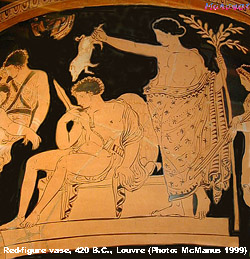 |
| Red-figure
vase of Apollo purifying Orestes with the
blood of a pig, (from vroma.org) Note the star pattern of Apollo's robe matches that of Thetis and the dress of Orestes. |
Orestes' killing of both his mother
and her lover was ordered by Apollo, when Orestes
went to Delphi to obtain direction on how to handle
the matter, when Clytemnestra and Aegisthus murdered
Agamemnon. Orestes balked at the idea of having to
kill both of them and made much to do about it.
After he killed them, aided by his companion
Pylades, he was haunted by the Erinyes of his
mother, and these drove him mad. He then went back
to Delphi to seek help for his madness. Apollo sent
him to Athens where he was tried by the Areopagus
and would have been convicted there were it not for
the goddess Athena's deciding vote to acquit him.
Although appeased to some degree, the Erinyes still
continued to persecute Orestes. Seeking the Delphian
oracle again, Orestes was told by Apollo that he
would regain his sanity if he stole the wooden
statue of Artemis that had fallen from heaven in the
land of the Taurians —
a barbaric Scythian tribe —
and brought it to Attica. On his return Orestes
became king of Mycenae.
ACHLE (Achilles) would thus be the name of the armed
young man with the spear or staff. In this scene
Achilles would have to be a shade, as he had been
killed at Troy when an arrow shot from Paris upon
the walls of Troy struck him in his heel. The wound
festered and caused his death. After the war, when
Agamemnon and the fleet returned from Troy to their
homes, Agamemnon discovered that his wife was having
an affair with Aegisthus. The two murdered Agamemnon
when he was in his bath. After the murder the child
Orestes was sent away for safety to Phocis by his
sister Electra or by an old retainer. There he was
reared by the old king Strophius, who had married
Agamemnon's sister, Anaxibia or Astyoche. Orestes
and Strophius' son, Pylades, became loyal friends,
and Pylades accompanied Orestes in nearly all of his
adventures. Electra is also believed to have urged
Orestes to kill their mother and her lover. Electra
may even have aided in the murder, together with
Pylades.
ACHLE is looking towards VRSTE and his mother,
THETHIS, appears to be addressing ELINEI. ORSTE is
holding up his two fingers, looking at NEPLE. Thus,
VRSTE appears to be seeking council of the shade of
AKLE and his mother, with ELENEI in agreement with
them, that he must kill both Clytemnestra and
Aegisthus. If the final vote is in NEPLE's hands, we
don't see him holding two fingers up in his right
hand, as is the case with VRSTE and ACHLE. Naupulis
would not likely be consulted in this scenario,
since he attempted to wreck Agamemnon's ships and
encouraged Orestes' mother to cuckhold his father,
Agamemnon. So NEPLE must be another, probably
Neoptolemus, the son of Achilles (AKLE).
Achilles mother, the sea nymph Thetis (THETHIS),
feared that Achilles would fight in a war with Troy
and be killed. To avert this end she had Achilles
secreted away and reared at the court of Lycomedes,
king of the Aegean island of Scyrus. To further
avoid his turning into a warrior, Thetis had him
dressed as a girl. Though dressed and reared like a
girl, Achilles had an affair with Lycomedes'
daughter, Deidameia, who bore a son. The child was
called Pyrrhus. After Achilles death at Troy the
Greeks learned from Helenus, the captured Trojan
seer —
brother of Hector —
that Troy was not fated to be taken unless three
events occurred: the bones of Pelops must be brought
to Troy; and both Philoctetes, who owned the bow and
arrows of Heracles, and the son of Achilles must
fight on the Greek side. All three events occurred,
and it is said to have been old Phoenix, Achilles'
tutor, who renamed Pyrrhus "Neoptolemus" (Young
Soldier) because either Achilles or the youth
himself had joined the war at so early an age.
Neoptolemus distinguished himself at Troy, being one
of the men in the Trojan Horse, and among his many
deeds —
some describe him as a cruel warrior —
he killed many Trojans, including Cassandra's
Phrygian suitor Coroebus and Antenor. It was
Neoptolemus who killed Priam at the altar of Zeus of
the Courtyard, and when Achilles' ghost demanded the
blood of Priam's daughter Polyxena, Neoptolemus
sacrificed her on his father's grave. Some say it
was he, not Odysseus, who killed Hector's little
son, Astyanax, flinging him from the city walls.
Andromache, Hector's widow, was awarded to
Neoptolemus as a concubine.
Some say that after the war, Thetis told Neoptolemus
to wait two days, so to avoid returning with the
fleet that ended up getting wrecked; others say he
returned home via an overland route. He then
returned to his home, Epeirus, and became king.
Leaving his three sons by Andromache, Molossus,
Pielus, and Pergamus, in the charge of Helenus,
Neoptolemus took to wife Hermione, the daughter of
Menelaus and Helen. Neoptolemus' descendants ruled
Epeirus for many generations, down to Olympias, the
mother of Alexander the Great. Thus, taking all of
this into consideration, with VRSTE (Orestes)
looking towards NEPLE, no doubt seeking his
concurrence, there would be a strong connection in
the context of revenge. Neoptolemus took revenge on
the killing of his father by Priam's son, Paris, by
killing Priam on the altar of Zeus. Then he killed
Priam's grandchildren by Hector. (Achilles, the
champion of the Greeks, had killed Hector, the
champion of the Trojans).
By his marriage to Hermione, Neoptolemus was also a
son-in-law to Helen of Troy who also was his aunt,
as the sister of Clytemnestra, his mother. In a
sense we can see a family gathering discussing
revenge. Helen must have concurred with the murder
of Clytemnestra - according to this mirror - and by
the history of the matter of giving her daughter
Hermione in marriage to Neoptolemus, who also would
inherit the throne of Sparta.
An odd picture is presented in this mirror, if NEPLE
is Neoptolemus, since Menelaus had previously
promised his daughter Hermione in marriage to
Orestes when Orestes was a boy and at the time he
was leaving for Troy. Somehow at Troy Menelaus
changed his mind and promised his daughter in
marriage to the champion and general Neoptolemus.
When Menelaus kept his word to Neoptolemus, he
raised the ire of Orestes. It is said that when
Neoptolemus went to Delphi to demand recompense from
Apollo for his father's death at Troy, Orestes
either killed him or arranged to have him killed.
Some say that the Delphians killed him for rifling
the shrines, distraught over Apollo's role in his
father's death. In any event, once Hermione's
husband was out of the way , Orestes married her and
she bore him a son, Tisamenus, who eventually
succeeded his father as king of Sparta and Argos
(Mycenae).
Orestes may have killed Aletes, the son of Aegisthus
and Clytemnestra, who was believed to have occupied
the throne of Mycenae. He might have killed Aletes'
sister, Erigone as well, but Artemis saved her by
carrying her off to Attica to be her priestess. Some
say that Erigone had a son, Penthilus, by Orestes.
There are differing stories about Orestes' death and
burial place. His bones were believed to have been
in a coffin under a forge in Tegea, after which the
bones were moved to Sparta.
Script
OU, 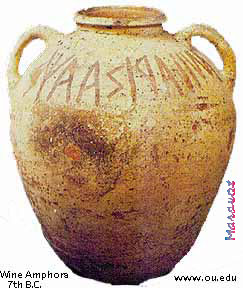 Wine Amphora,
7th c. B.C. (Image from University of Oklahoma, www.ou.edu)
Wine Amphora,
7th c. B.C. (Image from University of Oklahoma, www.ou.edu)
OU-1 MI - My, mine (L. mei, mehi, me)
OU-2 LARISA (Name, Larisa?)
OU-3 AKS,
probably vinegar (L. acetum-i; Gr. aksos; It.
aceto). Note that the character  has been written with
a "foot" as in Script CH below.
has been written with
a "foot" as in Script CH below.
Script VG, Bucchero amphora, ~600 B.C., from Formello, near Veii. Museum of the Villa Giulia, Rome (Image: "The Etruscans," by Raymond Block, 1969)
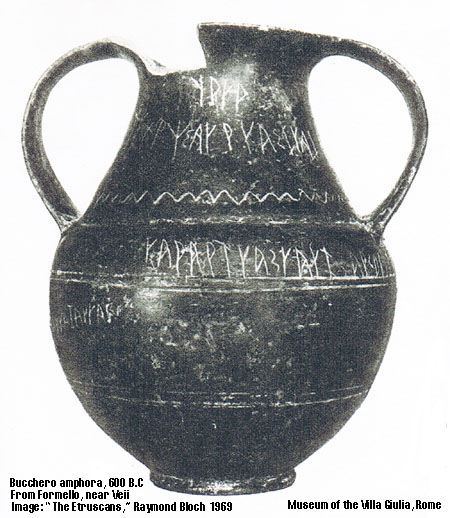
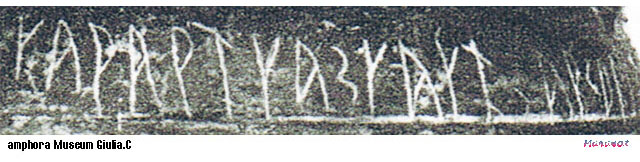
VG-8 VARAR TVASVA VT ARCAS
[Translation: to vary. change (L. vario-are; It.
variare, Fr. varier; Sanskrit, vihara) you watched
over (L. tueo-are) how! in whatever way (L. ut) you
lead, command? (Gr. archo, to command, rule; archon,
leader)
VG-1
VRVR [Translation: he, it speaks, entreats (L.
oro-are; 3rd. person sing. indic. pres.)]
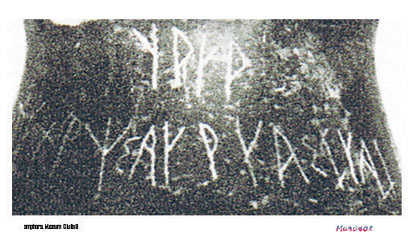 VG-2
XX RaCHSA VRVAS TVAI [Translation: XX (twenty)
Rachsa, Rigsa, bunches of grapes? (L. racemus-i,
cluster of grapes) a unit of measure? of the dawns
(L. aurora-ae) two (L. duo-ae); two solstices?]
Note: As presented in the Banquet.html,
the early Indo-Europeans in particular worshipped at
dawn and the two solstices would be the main "dawns"
in which to worship. As an example we have Herodotus
recounting Xerxes' dawn worship at the Hellespont,
before crossing into Europe, where he threw two
golden bowls and a sword into the waters.
VG-2
XX RaCHSA VRVAS TVAI [Translation: XX (twenty)
Rachsa, Rigsa, bunches of grapes? (L. racemus-i,
cluster of grapes) a unit of measure? of the dawns
(L. aurora-ae) two (L. duo-ae); two solstices?]
Note: As presented in the Banquet.html,
the early Indo-Europeans in particular worshipped at
dawn and the two solstices would be the main "dawns"
in which to worship. As an example we have Herodotus
recounting Xerxes' dawn worship at the Hellespont,
before crossing into Europe, where he threw two
golden bowls and a sword into the waters.
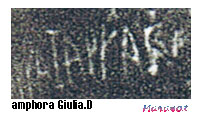
VG-6
SATARV
AST [Translation: satisfied (L. satio-are,
satur-ura-orum, sated, rich, copious; It. saziare;
Fr. satisfaire, to satisfy) I stand by (L.
adsto-star )
Script
VA, Wine-bowl, red-figured chalice from Vulci,
Bibliothèque Nationale, Paris. (Image: "The
Etruscans," by Raymond Bloch.
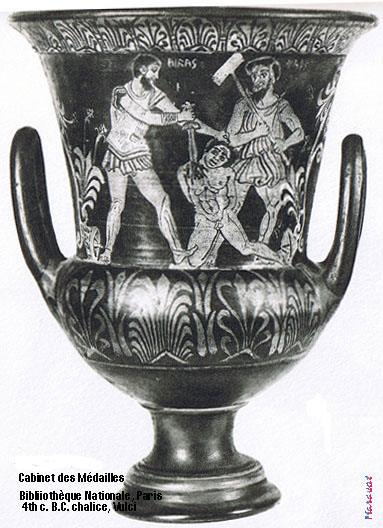
VA-1
AIFAS - Ajax (L. Aiax-acis, name of two Homeric
heroes, sons of Telamon and of Oileus). Here we see
Ajax (Etr. AIFAS) cutting the throat of a Trojan
prisoner while the Ferryman of the Styx, Charon,
looks on. The Greek name of Ajax is the clue to the
Etruscan spelling of the name: AIFAS. When Heracles
prayed to Zeus to send a brave son to his friend
Telamon, an eagle (Gr. aietos) appeared, signaling
the god's assent. The son who was born was named
Ajax (Aias) for the eagle. The word for a bird in
Latin is avis-is, often meaning a bird of omen and
in general an omen.
VA-2 CHARON ( ARVN)
ARVN)
Both of the heroes
named Ajax fought in the Trojan War, often
side-by-side. One of them, the son of Telamon, was a
head higher and stronger than other Greek warriors
and was one of the men sent to Achilles to persuade
him to join them in battle. Achilles had taken a
beutiful Lyarnessan girl, Briseis, as his concubine.
Some time later Agamemnon was forced by the
insistance of Achilles and the other leaders to give
up his own concubine, Chryseis, to save the Greeks
from plague. Enraged, he took Briseis from Achilles.
Achilles surrendered her but refused to fight any
longer or to allow his troops to do so. His mother,
Thetis, appealed to Zeus to give the Trojans victory
so that the Greeks should be forced to heap honors
on Achilles in order to win his help. Zeus
consented. As a result, the Greeks were gradually
beaten back to their ships in an assault led by
Hector. Agamemnon sent old Phoenix, together with
Odysseus and Ajax, to offer not only Briseis but a
great deal of treasure as well if Achilles would
rejoin the fighting. Achilles refused, and kept
Phoenix with him. Shortly thereafter Patroclus,
seeing the Trojans threatening to burn the Greek
ships, begged to be allowed to wear Achilles'' armor
into battle. Achilles consented. Patroclus, after
distinguishing hemself in a spectacular manner, was
killed by Hector.
Filled with grief and rage, Achilles turned back the
Trojans with a shout and rejoined the fighting. In a
fury and with vengeance he killed dozens of Trojans,
including Hector, whom he chased several times
around the walls of Troy. He drug the body of Hector
back to his camp, desecrated it, and refused to give
it up for burial until Hector's father, King Priam,
came alone to the Greek camp to plead with him.
Achilles finally allowed the old man to ransom the
corpse. He was later killed by Paris, aided by
Apollo, who shot him with an arrow from the safety
of the Trojan walls. Achilles' ashes were placed in
a golden urn, mixed with those of Patroclos, buried
under a great barrow. Games were held around the
barrow for about a week, involving events
traditional to the later Olympic games. Before the
barrow was thrown up the Greeks were sent into the
nearby mountains to collect trees for a funeral pyre
for Patroclus. Achilles conducted a sacrifice of
horses, treasures, and twleve Trojan captives before
the huge stack of trees that formed the pyre.*
We know that this scene does not involve the "Lesser
Ajax," son of Oileus, a Locrian king. He was known
as fine spearman and the fastest runner of the
Greeks except Achilles. He was expecially successful
at the capture of fleeing enemies. Ajax became one
of tghe most respected of Greek warriors, but
brought disaster on the whole force after the fall
of Trou by alienating their chief patroness, Athena.
This he did by dragging Cassandra from Athena's
shrine in order to rape her. Odysseus wanted Ajax
stoned for angering the gods (Some say Athena's
statue was knocked down, others say that its eyes
looked up in heaven in horror). Ajax clung to the
image he desecrated and Athena enlisted the aid of
Zeus and Poseidon to avenge the outrage. Together
they caused the Greek fleet to be wrecked off Cape
Caphareus, in southern Euboea. Some say that Athena
struck Ajax dead with a thunderbolt, others that
Poseidon let him swim in safety to a huge rock
called Gyrae. There the rash man boasted that he had
saved himself in spite of any god. Poseidon
thereupon struck the rock with a thunderbolt,
causing Ajax to drown.
It is curious that the Etruscan artist placed the
name of Ajax above the warrior who is plunging his
sword into the chest of the captive. This is part of
an overall pattern, however, that we have seen in
the Etruscan myths recorded on mirrors, where there
is a peculiar slant to the story not passed down to
us by the Romans and Greeks.
The Illiad can be read online at http://darkwing.uoregon.edu/~joelja/iliad.html.
Another scene of the sacrifice of the Trojan
captives is at Etruscan Phrases Murals: http://www.maravot.com/Etruscan_mural_francois.gif
Script
CH, Bronze mirror from Vulci, Vatican Museum.
Mirror with image of Calchas, a seer attached to the
Greek forces during the Trojan War. Calchas, a son
of Thestor, enjoyed such a reputation before the war
broke out that Agamemnon came in person to his home
in Megara to persuade him to accompany the army. The
seer is said to have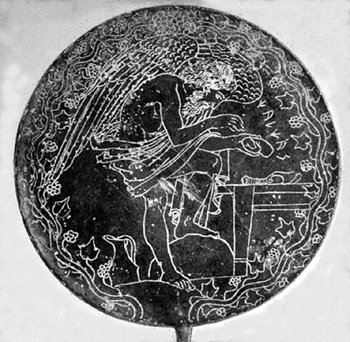 predicted when Achilles was only nine years old that
Troy could not be taken without his aid. Calchas
also prophesied while the ships of Agamemnon were
becalmed as they prepared to leave Aulis. Calchas
then divined that Agamemnon had offended Artemis
with a careless boast, no doubt when Agamemnon had
earlier built a temple to Artemis. Calchas announced
that the goddess would send favorable winds only if
Agamemnon were to sacrifice to her his daughter
Iphigeneia. Iphigeneia was the sister of Orestes and
in some accounts was a priestess among the Taurians
(Scythians) when Orestes was captured by them. She
saved the life of him and his crew.
predicted when Achilles was only nine years old that
Troy could not be taken without his aid. Calchas
also prophesied while the ships of Agamemnon were
becalmed as they prepared to leave Aulis. Calchas
then divined that Agamemnon had offended Artemis
with a careless boast, no doubt when Agamemnon had
earlier built a temple to Artemis. Calchas announced
that the goddess would send favorable winds only if
Agamemnon were to sacrifice to her his daughter
Iphigeneia. Iphigeneia was the sister of Orestes and
in some accounts was a priestess among the Taurians
(Scythians) when Orestes was captured by them. She
saved the life of him and his crew.
CH-1 CHALCHAS (↓AL↓AS) —
Calchas. Note the initial character is written like
the character on the vase at OU-3.
Script MG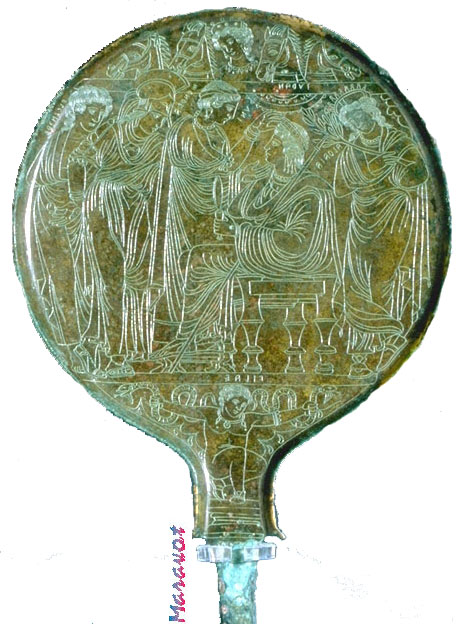 -
Mirror "Judgment of Paris before Rhaea" 4th c.
B.C. Bloomington, Indiana University Art Museum
(Image: "The Etruscans," Federica Borrelli and
Maria Cristina Targia, The J. Paul Getty Museum,
2004)
-
Mirror "Judgment of Paris before Rhaea" 4th c.
B.C. Bloomington, Indiana University Art Museum
(Image: "The Etruscans," Federica Borrelli and
Maria Cristina Targia, The J. Paul Getty Museum,
2004)
MG-1 AL RAIA?)
[Translation: a goddess, probably the Titaness
Rhea or Rheia (L. Ops), mother of Zeus, Hera and
Tethys. Here the text would thus read: to her, it
(It. al) Rheia.
Rheia was also identified with the Phrygian
goddess, Cybele. The key to the scene should be in
the word, FILAE, L. filia-ae, daughter(s). We know
that Hera (VNI, Juno) was the daughter of Rheia.
Athena (Minerva) was born to Zeus by Zeus' first
wife, the Oceanid Metis, as follows: Zeus was
warned by Ge and Uranus that if Metis bore a
second son he would rule over heaven. Zeus, who
had overthrown his own father and did not want to
suffer a similar fate, circumvented this threat by
swallowing Metis. As Metis' time for delivery drew
near, Zeus began to have second thoughts about his
predicament and sought either the Titan Prometheus
or craftsman-god Hephaestus to extricate him from
his predicament. One or the other solved the
problem by striking Zeus on the head with an axe.
Out popped Athena in full armor from his head.
Aphrodite (L. Venus, Etr. Turan) is believed to
have been the daughter of Zeus and Dione, but
Hesiod declared that she sprang from the sea foam
that gathered about the severed genitals of
Uranus, as they floated through the sea towards
Cyprus. Aphrodite's name comes from Gr. Aphros,
"sea-foam.")
Another possibility of ALOAIA would be ALTHAIA,
but this connection doesn't fit. Firstly, to be a
"th" the character "O" would be a , with a dot in the center. As for
Althia, Althaea was a daughter of Thestius and
Eurythemis. She married her uncle Oeneus, king of
Calydon. She bore him two daughters, Gorge and
Deianeira, and several sons, the most famous of
whom was Meleager. In the "Calydonian Boar Hunt"
Meleager killed some or all of his mother's
brothers. Althaea either cursed him for it or
caused his death by burning a magical charred
brand, knowing that her son would die when it is
consumed. Stricken with guilt, she hanged or
stabbed herself.
MG-2 UNI (VNI) -
the goddess Uni, (L. Juno, Gr. Hera) wife
of Tinia (L. Jupiter; Gr. Zeus)
MG-3 MENRFA -
Minerva, goddess of wisdom and patroness of arts
and sciences (L. Minerva-ae; Gr. Athena)
MG-4 ELCINTRE (Alexander) - Note: See Script
DM, Divine
Mirror.html for the spelling of Alexander's
name as ELKINTRE.
MG-5 TVRAN -
Turan, goddess of love (L. Venus ; Gr. Aphrodite)
MG-6 FILAE -
daughters (L. filia-ae)
Note: This appears to be a celebration among the
daughters of Rhea the Judgment of Paris, awarding
Aphrodite as "the fairest," assuming it is Turan
(Aphrodite) who is seated on the throne, with
Rheia wafting the branch over her head. If it is
Rheia seated on the throne (which seems most
likely) it may be that the judgment of Paris as to
"who is the fairest" is being referred to Rheia.
The context shown by the female with the word
"FILAE" over her head suggests that this scene is
about the "daughters." Only VNI (Hera) is directly
a daughter of Rheia. Turan (Aphrodite) emerged
from the sea in the foam of Uranus's genitels -
cut off by his son Zeus; MENRFA (Athena) sprouted
from the head of Zeus after Zeus had swallowed his
pregnant wife Metis. Since ELCINTRE (Alexander -
meaning savior of man) is in the scene, we can
assume that the event involves his decision to
name Aphrodite as "the fairest."
C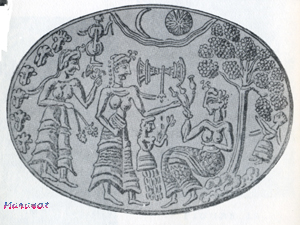 uriously,
the female in the handle with the inscription
"FILAE" is holding two snakes in her hand. This
recalls the Minoan snake goddess who is identified
with child bearing. For a good discussion on the
snake goddess see Christopher L. C. Whitcombe's
page, "Minoan Snake Goddess."
Votive statues of this goddess, dating ca 1600
B.C., who holds two snakes in her hands similarly
to the character in the handle of this mirror, is
also seen with a tower-like crown or a cat or lion
in her crown. These attributes of the statues
suggest a relationship to the Phrygian mother
goddess, Cybele, who drives a chariot pulled by
two lions and has a crown in the shape of a city
or castle tower. (See phrygian.html for a
discussion on Cybele and her relationship to the
mother-goddess on Minoan cylinder seals who is
often seated between two lions, with a palm tree
behind her and beneath her throne flows a stream
of water.
uriously,
the female in the handle with the inscription
"FILAE" is holding two snakes in her hand. This
recalls the Minoan snake goddess who is identified
with child bearing. For a good discussion on the
snake goddess see Christopher L. C. Whitcombe's
page, "Minoan Snake Goddess."
Votive statues of this goddess, dating ca 1600
B.C., who holds two snakes in her hands similarly
to the character in the handle of this mirror, is
also seen with a tower-like crown or a cat or lion
in her crown. These attributes of the statues
suggest a relationship to the Phrygian mother
goddess, Cybele, who drives a chariot pulled by
two lions and has a crown in the shape of a city
or castle tower. (See phrygian.html for a
discussion on Cybele and her relationship to the
mother-goddess on Minoan cylinder seals who is
often seated between two lions, with a palm tree
behind her and beneath her throne flows a stream
of water.
The wafting of the branch in this scene also
recalls a scene on the Minoan cylinder seal (left)
with the seated mother-goddess being attended by
three ladies, one of whom is wafting a branch. Two
of the women are offering gifts and a fourth woman
in the background is picking fruit.
Script
MH -
Mirror with Minerva and Heracles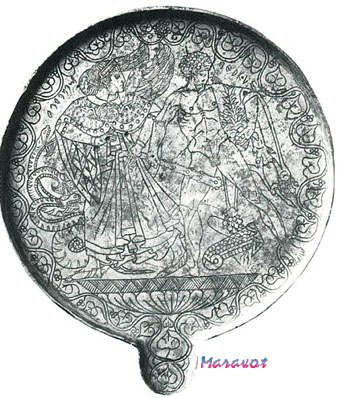 .
.
MH-1 MENERFA - Minerva,
goddess of wisdom and patroness of arts and
sciences (L. Minerva-ae; Gr. Athena)
MH-2 HERKLE -
Hercules, Heracles is a popular character on
Etruscan Mirrors.
Here Heracles appears to be engaged in his
eleventh labor, exacted by King Eurystheus, to
bring to the king the apples of the Hesperides.
Many accounts call this the final labor, saying
that it followed the capture of Cerberus, the
three-headed dog guarding Hades.
The golden fruit, which Ge had once given as a
wedding present to Hera, grew in a grove somewhere
at the ends of the earth. There they were tended
by nymphs, the Hesperides, with the aid of a
hundred-headed snake named Ladon. Heracles did not
know where to find the sacred grove, so he visited
certain nymphs, daughters of Zeus and Themis, who
lived on the Eridanus River. They told him where
to find the old sea-god Nereus asleep. Heracles
captured Nereus and held him tightly in spite of
the many transformations that the god underwent.
Finally Nerus returned to his normal form and told
his captor where to find the garden. This
information was evidently not passed on to ancient
writers, for they have recorded many locations:
beyond the river Oceanus or the north wind, or
somewhere in the farthest reaches of Libya near
the mountains where the Titan Atlas supported the
sky on his shoulders. All of these places were in
the far west, where one might expect the
Hesperides (Daughters of the Evening) to live.
On his way to the garden, moving westward,
Heracles had several adventures, freeing
Prometheus from his bonds, where an eagle fed on
his liver, he then killed King Emathion of Arabia,
and came to Egypt where he allowed King Busiris to
place him on an altar for sacrifice. As the king
and his son began to prepare Heracles, Heracles
broke his bonds and killed both the king and his
son, Amphidamas, who had until then made it a
practice to sacrifice all strangers coming into
their land. Moving westward Heracles encountered
the Libyan King Antaeus, who required all
strangers to wrestle with him and then killed
them. Heracles disposed of the son of the earth by
holding him up above the earth and crushing him
with a bear hug. Next, Heracles came upon the
Titan Atlas who was holding up the earth. Heracles
offered to relieve the Titan of his burden if he
would retrieve the golden apples from the nearby
garden. Thinking to take the apples and deliver
them to King Eurystheus himself, Atlas shrugged
and transferred the burden of the earth onto the
shoulders of Heracles. Heracles was then faced
with the problem when Atlas returned with the
golden apples of tricking Atlas to resume his
burden of the earth. Heracles persuaded Atlas to
take over the burden for just a moment, while he
placed a pad on his head to cushion the weight of
the earth. As Atlas took the weight on his
shoulders, Heracles sped on his way with the
golden apples. Another account, which coincides
with the illustration on this Etruscan mirror, is
that Heracles himself stole the apples from the
garden, after killing Ladon. After turning the
apples over to King Eurystheus, the king quickly
gave them back. Heracles then gave the golden
apples to Athena, presumably by dedicating them at
her shrine and Athena returned them to their
original guardians, the Hesperides, for it was not
proper that the fruit should remain in anyone
else's keeping. This mirror also shows Athena
(Minerva) engaged with Heracles in retrieving the
apples from the many-headed, claw-footed monster.
Held in Heracles' left arm is a plant, and in this
image he has stolen the entire tree.*
Script LM, Badishes
Landesmuseum, 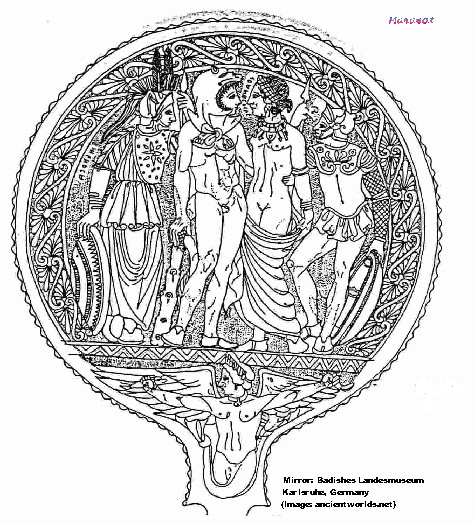 Karlsruhe, Germany,
Mirror of "Minerva, Hercules and companions." The
illustration on this mirror is hard to read, but
it can be read. Heracles is dressed in the skin of
either the Cithaeronian lion which he killed when
he was about seventeen years of age. Apollodorus
says that the young man's first adventure was to
persue a lion which had been roaming Mount
Cithaeron and eating the flocks of both Amphitryon
and Thespius, king of Thespiae.
Karlsruhe, Germany,
Mirror of "Minerva, Hercules and companions." The
illustration on this mirror is hard to read, but
it can be read. Heracles is dressed in the skin of
either the Cithaeronian lion which he killed when
he was about seventeen years of age. Apollodorus
says that the young man's first adventure was to
persue a lion which had been roaming Mount
Cithaeron and eating the flocks of both Amphitryon
and Thespius, king of Thespiae.
The king's interest in the prowess of Hercules
extended well beyond the hunt. He entertained the
youth for fifty nights before bringing up the
subject of the lion. Each night he sent another of
his fifty daughters to Heracles' bed – unless, as
some insist, he sent all fifty in one night.
According to at least one writer, Heracles,
perhaps a little befuddled by the king's wine, was
unaware of the traffic in his bedroom and imagined
that he was indebted to only one daughter as his
partner in the night's marathon. After his
eventful stay at the palace of Thespius, Heracles
went to Mount Cithaeron, killed the lion, and
thereafter wore its skin as a cloak. (The lion of
Nemea is believed to be by some as the cloak worn
by Heracles).
Pausanias records with disbelief the tradition
that one of Thespius' daughters refused to sleep
with the guest and was condemned by him to remain
forever a virgin priestess in his temple. The
writer points out that Heracles had no temple and
that, at least so early in his career, he had no
expectation of having one. He adds, somewhat less
convincingly, that Heracles was too modest to
conceive of such a punishment. (Pausanias 9.27.6-7, 9.29.9 — ~160A.D.)
The soldier -
possibly Thespius - appears to be
giving the girl to Heracles. If he is giving the
girl to the hero, then it would properly be the
father of the girl, i.e., Thespius. Between
Heracles and the girl are the words:
LM-1 VRAN HERCLE [Translation: They speak (L.
oro-are, orant) of Heracles] Note: VRAN may be
TVRAN ("T" missing)
LM-3 MENRFA
LM-4 A_ _ _ (ACHL?) Achilles. The shield
is a clue that the warrior is Achilles.
The mirror may be playing with the thought that
Heracles was known as one who did not want a
temple, yet he receives the daughter of Thespius
as a virgin for his temple. She is undressing,
however, and no doubt offering herself to him,
witnessed by Minerva (Athena) the virgin goddess
of arts, crafts and war. However, there seems to
be a name above the warrior on the right. The
shield suggests it is ACHL or ACHLE (Achilles). It
is curious that HERCLE is in the Divine Mirror,
Script DM, next to TVRAN and raising up a cherub
(EPE VR) to TINIA . Heracles had nothing to do
with the Trojan War, as far as represented in the
Iliad. So we wondered what Heracles was doing in
the story of Helen of Troy represented in the
Divine Mirror. If it is TVRAN represented in
mirror Script LM, we are given a clue that
Heracles and Tvran (Aphrodite) had a relationship
heretofore unknown and certainly not remembered in
Greco-Roman mythology. The arrangement of Athena,
Heracles, Aphrodite and Achilles together in this
scene is mysterious.
Script DP, Achilles and Pelion
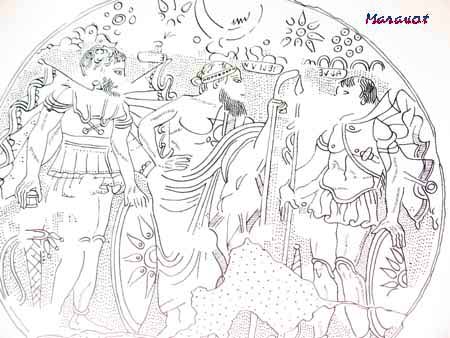
DP-1 - ACHLE (A
LE) [Translation:
Achilles, son of Peleus and Thetis]DP-2 PELION (PELIVN) [Peleus, father of Achilles]
DP-3 E_ _ _ _ (probably EIFAS) [Translation: Ajax. Ajax was the largest of the Greek warriors, being taller by a head than his comrads. See text CN-1 which describes him in more detail. He was among the delegation sent to Achilles to persuade him to rejoin the battle, during the Trojan War. He carried the dead Achilles from the field, while Odysseus fended off the Trojans, and though he claimed the armor of Achilles he failed to win it, losing it to Odysseus. He went mad over the incident and ended up committing suicide with the sword that Hector had given him.
Peleus lived long after his son, Achilles, and friend Ajax died. The horned moon above his head would suggest a resurrection or heavenly scene. Peleus had been hidden away as a child on Mt. Pelion and later distinguished himself as a young man by killing more game on Mt. Pelion than his companions in the hunt. Mt. Pelion is also the place where the Centaurs, born from Ixion's mating with Hera, or, as Zeus planned, Ixion had mated with a "cloud" substituted in Hera's bed by Zeus which produced the first Centaur. See Script CR, Peleus abducting Thetis. Artemis is associated with the moon and may be implied here.
Script DQ, Apollo and Artemis
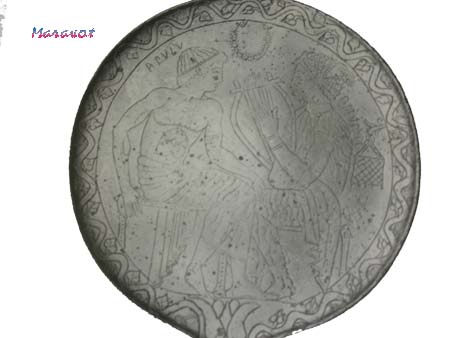
DQ-2 ARTUMIS (ARTVMIS) - Artemis was the daughter of Zeus and Leto and sister of Apollo. According to some accounts both sister and brother were born on the island of Delos. Other accounts have Artemis being born on the island of Ortygia. Shortly after her birth she assisted her mother with the birth of her brother Apollo. Apollo and Artemis often hunted together and Apollo vigorously defended her virginity. He saw that she had fallen for the hunter Orion and when he saw Orion swimming in the sea nearby he wagered with Artemis that she could not hit the black object in the sea. She put an arrow through her suitor's head. The goddess was so horrified when she was his body wash ashore she tried to make amends by putting him as a constellation in the sky. She was very jealous of the honors given to her and punished Agamemnon, among many, for his father's failure to show her proper honor. In spite of Artemis' familiar reputation in both art and literature as a chaste huntress, most scholars agree that she was originally far from a virginal goddess, and certainly not Greek. In cult she was a patroness of all living things, animal or human. At Ephesus, where her great temple was one of the "seven wonders of the world," she was depicted with many breasts.
Apollo was recognized as the god of prophecy, with his oracle, Pythia — after a python that he killed in the temple — at Delphi, was known as a healer, named Smintheus (referring to being a god of mice, preventing the plague or the town of Sminthe in the Troad). He is also identified with the sun god, Helius, and the god of music, often represented as playing the lyre. He bought the lyre from his baby brother, Hermes. In this scene Artemis is playing the lyre, entertaining Apollo. Note that ARTVMIS is usually spelled ARTVMES.
Script DR, Snenar, Turan and Adonis
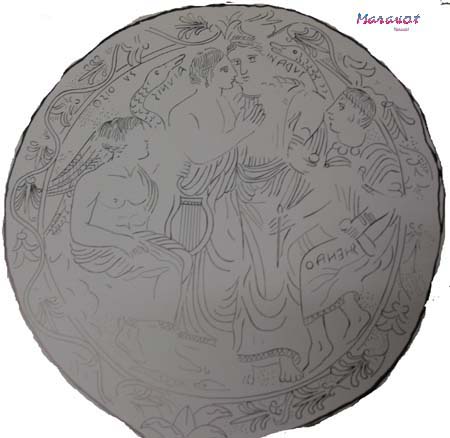 DR-1
SNENAR, SHENAR or SNENAO [Translation: unknown
goddess] This goddess may be one of the Semnai
Theai or Semnai (Venerable goddesses) worshipped
in a cave on the Areopagus at Athens. They were
identified with the Erinyes, who had retributive
functions, by Aaeschylus and others. She holds a
wand of prophesy and what appears to be an unguent
bottle, as LASA THIMRAE in the Divine_Mirror.html.
She has a neclace around her neck and robes
suggesting she is a queen. It is probable that she
is Myrrha (also called Smyrna), mother of Adonis.
SHENAR may be the Etruscan version of her name,
based upon the most prominent feature in Lebanon,
Mt. Senir (Hermon). It is a place that had ritual
significance among the ancient Canaanites. The
principal female diety of the Phoenicians was
Ashtoreth (meaning star); the Ishtar of the
Assyrians, and Astarte of the Greeks and Romans.
The Chrisitian festival of Easter apparently
replaced one that had earlier been attributed to
Ishtar.
DR-1
SNENAR, SHENAR or SNENAO [Translation: unknown
goddess] This goddess may be one of the Semnai
Theai or Semnai (Venerable goddesses) worshipped
in a cave on the Areopagus at Athens. They were
identified with the Erinyes, who had retributive
functions, by Aaeschylus and others. She holds a
wand of prophesy and what appears to be an unguent
bottle, as LASA THIMRAE in the Divine_Mirror.html.
She has a neclace around her neck and robes
suggesting she is a queen. It is probable that she
is Myrrha (also called Smyrna), mother of Adonis.
SHENAR may be the Etruscan version of her name,
based upon the most prominent feature in Lebanon,
Mt. Senir (Hermon). It is a place that had ritual
significance among the ancient Canaanites. The
principal female diety of the Phoenicians was
Ashtoreth (meaning star); the Ishtar of the
Assyrians, and Astarte of the Greeks and Romans.
The Chrisitian festival of Easter apparently
replaced one that had earlier been attributed to
Ishtar.
There was a more ancient Heracles called the
Tyrian Heracles and two temples stood near Tyre
that were built for Heracles and Astarte,
according to the historian Menander. Another name
for this god was Melkart (See wikipedia.org). See also wikipedia.org
on Canaanite gods. The Etruscan nuances on
Heracles may reflect the Canaanite Heracles
(Melkart).
An interesting discussion on the development of Cypriote religion is at
greek-history.suite101.com. Aphrodite was
born in the sea off Cyprus. and Cyprus is a place
where Greek and Canaanite cultures met, including
also an Egyptian presence there. Currently the
island is divided between the Greeks and the
Turks. Suite101.com says:
"A great sanctuary to Aphrodite was built in Palaepaphos, not far from her birthplace. Aphrodite was not represented in human form here, but as a conical stone idol (like the sacred pillars of Canaanite peoples), which was anointed with oil during festivities. Rulers of the Kinyras dynasty served as kings and high priests until the Ptolemaic era. After catastrophic earthquakes a new city and temple were built further west — Nea Paphos.
As the Achaean Greek settlements became more powerful, resentful Paphians migrated east to settle in Amathus taking Aphrodite with them. A magnificent sanctuary was built on the acropolis. Alexander Hislop in "The Two Babylons" mentions a colossal stone vase from this temple, decorated with fertility symbols, which was taken to the Louvre in 1865. In 22CE the Roman Senate established the right of asylum for Aphrodite's principal sanctuaries in Paphos and Amathus. Phoenician traders from the east settled mainly in Kition (SE). The Phoenician Astarte absorbed the Cyprian fertility goddess. Cypriot deities now had Phoenician names. Shrines to Aphrodite-Astarte and Melkart-Baal were built in Palaepaphos.
Myrrha was the daughter of Cinyras
(Cenchreis) or Theias, king of Assyria. Either
because Cenchreis boasted that her daughter was
more beautiful than Aphrodite (Turan) or because
Myrrha herself did not honor the goddess properly,
Aphrodite punished the girl with an incestuous
infatuation with her father. When her father
discovered that she was pregnant, he chased her
with a sword. She prayed to the gods and they
changed her into a myrrh tree. Her tears became
the precious gum of the tree. After nine months
the tree split open and an infant boy, Adonis, was
revealed inside. Adonis is believed to be the
Assyrian Tammuz or Dimuzzi. Since the story of
Adonis and Aphrodite involves Asiatic origin it is
possible that the character here is Senir
(meaning, glistening), the Amorite name of Mt.
Hermon. It was called Sirion by the Sidonians. Mt.
Hermon is the source of the Jordan River and forms
the Anti-Lebanon range. The Etruscans traded with
the Phoenicians (Lebanon) and the Phoenician
hippocampus is a popular image painted in Etruscan
tombs.
It is possible that the seated person is SHENAR or
SENAR, also known as Mt. Hermon / Senir. It is
actually three mountain peaks with seasonal snow
along the Israel-Lebanon border.
Of interest is the connection of a mountain with
the Asiatic versions of Adonis, Tammuz or Dimuzzi.
(See mystae.com for Tammuz / Dimuzzi
and pantheon.org: The Akkadian
vegetation-god, counterpart of the Sumerian Damuzi
and the symbol of death and rebirth in nature. He
is the son of Ea and husband of Ishtar. Each year
he dies in the hot summer (in the month Tammus,
June/July) and his soul is taken by the Gallu
demons to the underworld. Woe and desolation fall
upon the earth, and Ishtar leads the world in
lamentation. She then descends to the nether
world, ruled by Ereshkigal, and after many trials
succeeds in bringing him back, as a result of
which fertility and joy return to the earth. In
Syria he was identified with Adonis.
Myrrh is from a small tree that can grow up to 5
meters (16 feet) high with light bark and knotted
branches, few leaves and small white flowers. It
is native to Somalia, Arabia and Yemen. When the
bark is cut, the gum resin exudes as a pale yellow
liquid, which dries into reddish-brown lumps the
size of a walnut from which the oil is distilled.
Myrrh was very popular in the ancient world and
was used as a medicine by the Chinese and
Egyptians, and as part of the Egyptian
sun-worshipping ritual and mummification. It was
used in cosmetics, while Greek soldiers took a
phial of Myrrh oil with them into battle, to stop
bleeding wounds. (essentialoils.co.za).
DR-2 TURAN (TVRAN) [Translation: goddess of love,
Gr. Aphrodite, Roman Venus.
DR-3 ATONIS (ATVNIS)
DR-4 SU (SV) OISO [Translation: bird (L. Avis, Fr.
oiseau, m.; It. ucello)] Note: The swan was the
symbol of Turan / Aphrodite and she is seen in Script OB (See the
Divine_Mirror.html). There are two swans in
this mirror. The use of the "O" omega is rare and
may be a late usage, before the introduction of
the Latin alphabet. Note: There is another version
of this mirror that carries the letters SVP OISO
(SOPRISeR?) This may be, himself, herself, itself,
themselves ( L. se, sese, sibi) RISeR (L.
rixor-ari, to complain, quarrel).
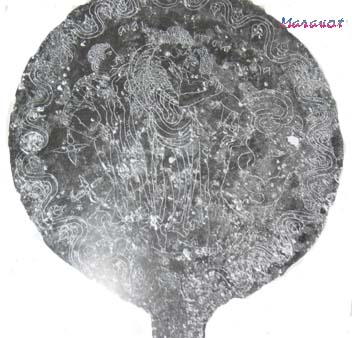
Script DS, Turan, Adonis and Lasa
DS-1 ATONIS (ATVNIS)
DS-2 TURAN (TVRAN)
DS-3 LASA
Note: Lasa appears with a wand and unguent bottle
in the Divine_Mirror.html. In Script DR we see a
seated goddess SNENAR or SNENAO observing the two
lovers, Adonis and Aphrodite (ATVNIS and TVRAN).
Script PF- Funerary
stele from Fiesole, Florence Archeological
museum, c. 520 B.C. Height 4' x 7" 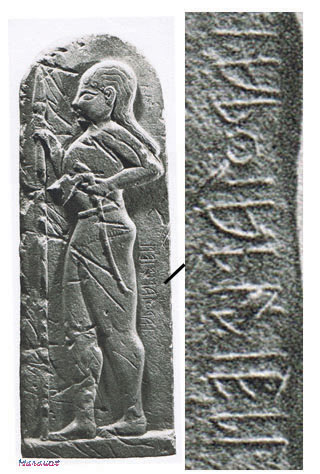
PF-1 PARTHIAM (PARIAM) of Parthia
(L. Parthi-orum, 1st Decl. Acc. singl. -am)
PF-2 IEPI Jepi Note: This word
declines, Jepie, Jepo (Script "L")
Note: This warrior probably came from Parthia, a
nation in Illyria, according to Polybius. The
Parthini were a people in Illyria, according to
Polybius. Alternatively, the warrior may
have been involved in wars of the Parthians in the
Middle East. The Parthian empire reigned over
Persia from 247 B.C - 228 A.D. They defeated
Alexandar the Great's succesors, the Seleucids.
After the Scythian-Parni nomads (Assyrians called
them Ashkuz) had settled in Parthia and had built
a small independent kingdom, they rose to power
under king Mithridates the Great (171-138 BCE).
The end of this long-lasted empire came in 224 CE,
when the empire was loosely organized and the last
king was defeated by one of the empire's vassals,
the Persians of the Sassanid dynasty. Herodotus
tells us that the Persians wore long hair. In his
description of the invasion of the Persian Xerxes
(485-465 B.C.), Herodotus provides information on
the dress and equipment of the host that crossed
the Hellespont. He says:
Book VII.61 Now these were the nations that took part in this expedition. The Persians, who wore on their heads the soft hat called the tiara, and about their bodies, tunics with sleeves, of divers colours, having iron scales upon them like the scales of a fish. Their legs were protected by trousers, and they bore wicker shields for bucklers; their quivers hanging at their backs, and their arms being a short spear, a bow of uncommon size, and arrows of reed. They had likewise daggers hanging at their backs, and their right thighs. Otanes, the father of Xerxes' wife, Amestris, was their leader. This people was known to the Greeks in ancient times by the name of Cephenians; but they called themselves, and were called by their neighbors, Artaeans...
Book VII.62 The Medes had exactly the same equipment as the Persians; and indeed the dress common to both is not so much Persian as Median. They had for commander Tigranes, of the race of the Achaemenids. These Medes were called anciently by all the people Arians, but when Medea, the Cochian, came to them from Athens, they changed their name...
Book VII.64 The Bactrians went to the war wearing a head-dress very like the Median, but armed with bows of cane, after the custom of their country, and with short spears.
The Sacae, or Scyths, were clad in trousers, and had on their heads tall stiff caps rising to a point. They bore the bow of the country and the dagger: besides which they carried the battle-axe, or sagaris. They were in truth Amyrgian Scythians, but the Persians called them Sacae, since that is the name they give to all Scythians. The Bactrians and the Sacae had for leader Hystaspes, the son of Darius and of Atossa, the daughter of Cyrus.
VII.66 The Arians carried Median bows, but in other respects were equipped like the Bactrians. Their commander was Sisamnes the son of Hydarnes. The Parthians and Chorasmians, with the Sogdians, the Gandarians, and the Dadicae, had the Bactrian equipment in all respects. The Parthians and Chorasmians were commanded by Artabazus the son of Pharnaces...
In this stele we can see that the
warrior has a hand-axe and the spear's length is
about the height of the man (a short spear?). The
man is wearing a tunic and appears to be wearing
short pants, suggested by the knee-length hem. If
the date of the stele is near 483 B.C when Xerxes
invaded Greece, it may be that this warrior was
one of the invading force of the Persian army, or
possibly part of the earlier invasion of Darius (
549 B.C.– 486/485 B.C.). 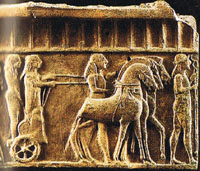
We also note that a tile in the National Museum,
Naples, Italy shows Etruscan warriors wearing long
hair and holding a spear about head height. Many
sarcophagi show Etruscan men with long, straight
hair as well.
Note:
* Strabo lists a tribe of the Illyrians who are
called "Parthini" :
Strabo: ...But the Illyrian tribes which are near
the southern part
of the mountainous country and those which are
above the Ionian Gulf are
intermingled with these peoples; for above
Epidamnus and
Apollonia as far as the Ceraunian Mountains dwell
the Bylliones, the
Taulantii, the Parthini, and the Brygi (the
forerunners of the
Phrygians).
The warrior from Fiosole may have served in a war
against the Parthini or was one of them.
See also Script L65 for the warrior "IEPIE" and
L-15, L-59 for IEPV (Jepo). This may be "thrower"
(L. iaculator).
Notes:
*From Edward Tripp,
The Meridian Handbook of Classical Mythology,
1970.


—
email: mel2@maravot.com
Launched 11.20.06
Upadated:
11.22.06; 11.23.06; 11.24.06; 11.29.06;
11.30.06; 1.05.07; 1.22.07; 1.31.07; 2.01.07;
4.15.07; 4.17.07; 4.30.07; 3.21.09; 3.22.09;
5.23.09; 5.26.09; 7.24.09; 8.20.09; 5.02.12
Update 3.21-22.09 - removed the discussion of
Pheris. The character is THETHIS (Thetis). AKLE
is Achilles, son of Thetis. NEPLE is either
Achilles' son, Neoptolemus or Menle, Menelaus.
Copyright
© 1981-2012 Maravot. All rights reserved.
Copyright © 1981-2012 Mel Copeland. All rights
reserved.