  |

by Mel West
 |
|
|
"Peace in Jerusalem" letter to President Obama.

To Palestine...
I spent some time in Palestine and the Middle East and know from direct experience that the way Palestinians are treated by the State of Israel is not consistent with Israel's Declaration of Independence and the Covenant between the Jews and the United Nations. Nor are the Biblical terms the Torah and its prophets being honored, seen herein.
We addressed this to the Palestinians because their fate is held by a hand upon the center of the world. Because their fate is now beinga ffected by Jewish Law, the application of the Torah and the prophets apply. And because the Koran was written to confirm these scriptures, it follows recognizing that two cannot walk together except they be agreed that the Koran also applies in the determination of the fate of the Palestinians.
We addressed this to the Palestinians because we know that there are many who have been prejudiced against them. Many maintain their prejudice against Palestinians using the Bible; others, namely the Jews, use the Torah and the Prophets; and finally, there are still others, who have absolutely no system of values of any kind, who are repulsed by references of scripturewhether contained in International Law or otherwise and yet support by their ambivalence the persecution of Palestinians in Palestine. Many atheists, many people who manipulate scriptures to their own benefit, and others who simply cannot differentiate one law from another, are hurting the people of this book. To all these who are prejudiced against the Palestinians and the Holy Book of Books as the Israeli Declaration of Independence referred to it, we must say up front not to open this document. For we need wise men to help establish the Peace of Jerusalem and wise men explore the issues. The consequences of less than wise men handling this issue have been well demonstrated during the past 20 years.
We addressed this to the Palestinians for yet another reason. Most of them treasure the T emple Mount of Jerusalem. It is they who seem to be in charge of the mount, and it is they who have the ability to plead for certain rights pertaining to the mount and Jerusalem which now are being denied. They hold the key to the Gates of Righteousness, as it were, as will be explained.
One Gate which we know only they can unlock is the Golden Gate, and we hope that when they have seen this argument it will be opened; and when the Golden Gate is opened so too will be the opening to Peace in Jerusalem.
Long ago a son of Abraham, Esau by name, was given an unusual Promise: When thou hold the dominion, that thou shalt break his [Jacob's] yoke from off thy neck. [Genesis 27.40]. This seems to apply today, since many of the Palestinians are from the territory once held by Esau and Palestinians hold the dominion of God that is to say, his Temple Mount. Then again there was another Promise which affected the Palestinians, which says, Philistia, triumph thou because of me. It came from David, Psalm 60.8.
If you have a mind for fairness equity, justice, etc. and are true to it, whoever you are, open and be satisfied... Mel West
July 4, 1993
Berkeley, Ca.
page 2
Introduction
page 3
The Ambivalent and Unmerciful
The Fields of Evil
Wars over the divine blessings have changed the borders of most of the world's nations, drenching the earth with blood in the process, over the past two thousand years; and those who thought to be bystanders, ambivalent to the goings on in any case, as was Freud, usually themselves become victims in time.
In the middle of all this controversy are the Jews and the Palestinians
Chapter 1
Roots and Orders
Roots and Orders
The Contract
Implicit in the contract with Israel comes the question about the inhabitants
The question was addressed in the same Biblical and UN Covenants mentioned above. It seems that the contract provided not for a wholesale slaughter and displacement of the inhabitants of the land to make room for the Jews (as the Jews seemed to have supposed in the past few years), but, to the contrary, the contract provided a means by which the Palestinians and the Jews could live together in peace on the same land.
Beulah, the Promised Land of Peace
Updating the point of view a bit further we can witness how odd it is that even Moslems and Christians can live together peacefully in Philadelphia but not in Bosnia, where old troubles between the Islamic and Christian worlds are again raising their horrifying heads. Just a generation ago we had the wholesale slaughter of the Jews under the Nazi terror, also initiated by justifications of religious origin. In a tract A.D. 1543 A.D. Martin Luther asked:
What shall we Christians do with this damned, rejected race of Jews?..Let me give you my honest advice:
1. To set fire to their synagogues or schools and to bury and cover with dirt whatever will not burn. So that no man will ever again see a stone or cinder of them. This is to be done in honor of our Lord.
2-7. I advise that their houses also be razed and destroyed..
..that safe-conduct on the highways be abolished completely for the Jews..all cash and treasure of silver and gold be taken from them..I recommend putting a flail, an ax, an hoe, a spade, a distaff, or a spindle into the hand of young, strong Jews and Jewesses and letting them earn their bread in the sweat of their brow.
On the other side of the coin we can see how the Jews, having claimed their redemption, use similar misunderstandings of the Contract to persecute Palestinians. And now in Bosnia and Southeastern Europe towns are under siege by similar bigotry; and the world
Who will honor all the Terms of the Contract
Holy People
In the vehicle of this contract is the provision of a Holy People who are first separated unto God and then scattered to all the nations of the world; and through their punishment in exile all men will be introduced to God and, thus, joined to Him in Holiness. This is what Zionism is all about.
At the time the Jews are redeemed the following promise takes effect:
Isaiah 4.2 In that day shall the Branch of the Lord be beautiful and glorious, and the fruit of the earth shall be excellent and comely for them that are escaped of Israel.
4.3 And it shall come to pass that He that is left in Zion, and He that remaineth in Jerusalem, shall be called Holy, even every one that is written among the living in Jerusalem.
4.4 When the Lord shall have washed away the filth of the daughters of Zion, and shall have purged the blood of Jerusalem from the midst thereof by the Spirit of Judgment and by the Spirit of Burning.
Chapter 2
Applying the United Nations Covenant
Applying the United Nations Covenant
Because the claim of the Jews for their restoration or redemption to the land was based upon the Biblical Covenants, and because the United Nations granted that claim, it follows that the Resolution of 1947 which created the state of Israel applies within the context of the Biblical Covenant. So two laws — — the Bible and UN Law apply in adjudicating a just settlement of the disputes over the Holy Land.
that the land be renamed to Beulah, according to the Covenant that all people in the land be recognized as Holy unto the God of Abraham that Jerusalem be restored to its lawful owner, the United Nations, pending any further UN dispositions of that Mandate Territory.
The Corpus Separatum of Jerusalem
Roots of Palestine and Palestinians
For reasons beyond my grasp, the author of the Bible in any event decided to set his Seat in the middle of Canaan [Palestine]. He calls Himself many names, including Adonai or Baal, meaning Lord; Elohim, a plural form of El, God, and YHVH, meaning I Am).
Around 1700-1500 B.C. a group of Indo-Europeans called the Hittites descended out of the steppes of Russia, settled their capital near Ankara, Turkey, and established an empire stretching through the land of Canaan to Egypt; and their threat of world conquest set off one of the first Middle-Eastern wars: between the Hattia (the Hittites) and Egypt. Palestine became the battleground of this first of the world's "world" wars
Lured into a Battleground
Within the city of Sodom, Abrahm's nephew, Lot, took residence but moved at the behest of God, and whose son, Amon, settled the city called Amaan, Jordan, the seat of the Amorites. Jordan is today principally composed of Palestinians. The sons of Amon were followers of the God of Abraham and now probably are Moslems, assuming they are now extant.
When we discuss Palestinians, we mean to describe a group of people who practice Islam, most of whose lineage may come from the original inhabitants of Canaan, or Abraham, his nephew Lot, or the Philistines, from whom Palestine derives its name.
Philistines
The Children of Abraham
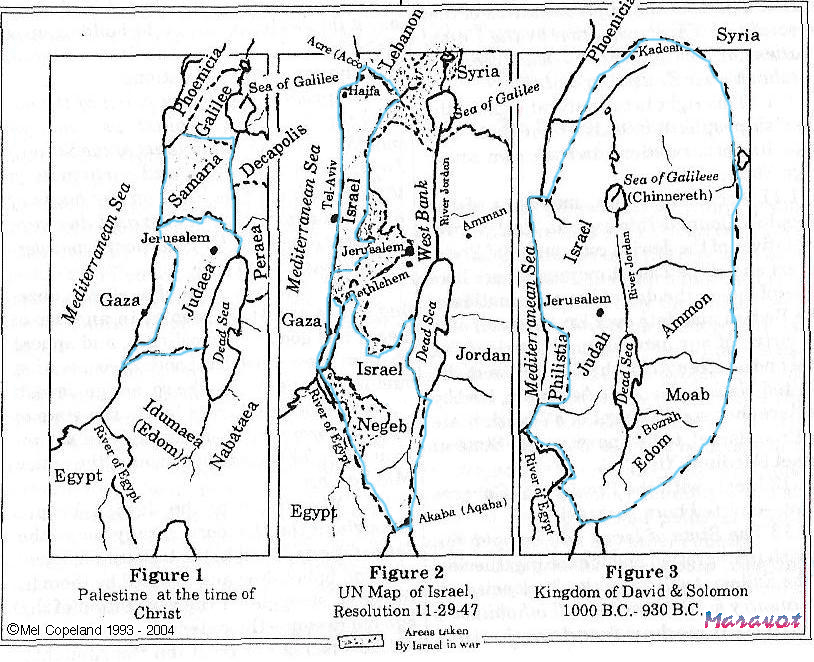 |
In 1948, the Children of Israel
Repeating Struggles
Alexander the Great, the son of Philip of Macedon, defeated the Persians and extended his Macedonian- Greek Empire from Greece to the Indus River and across Africa to the Atlas mountains and Rock of Gibraltar [Pillars of Hercules]. This was ca. 350 B.C.
Then came the Romans who occupied the Greek [Selucid] Empire over Palestine about 70 B.C. and extended the Roman Empire even further than Alexander's, into Europe as far as the Rhine River and Great Britain, to Hadrian's Wall. In 70 A.D. the Jews rose up against the Roman occupation (this was not their first rebellion; Judas Maccabeus (circa. 175 B.C.) led a revolt against the Greeks earlier). In any event, the Roman Emperor, Vespasian, and his son Titus gave the Jews the most punishing defeat in history during Passover 70 A.D. Jerusalem and its Temple were destroyed, the Jews were taken into captivity and sent off as slaves to all places in the empire, and later, because of continuing Jewish insurrections, about 135 A.D., Jews were forbidden by edict to get so close as to cast an eye on Jerusalem. About this time a General by the name of Turbo was ordered to make a clean swathe throughout Judaea and Samaria (the principal Roman provincial names for Palestine) to clear it of all Jews. Thus began the first world-wide persecution of the Jews.
The Philistines continued in the land, but by then, because their original cities were on the coast, they had become during the Greek times Hellenized and under Rome Romanized, whatever these things may imply. We speak here of those who had not converted to Judaism under the Dominion of Judaea, beginning with King David.
Then came the Arabs
Then came the Croats and Serbs who undermined their Avar and Magyar overlords and settled the Balkans beginning in the seventh Century.
Also then came the Arabs. While the Gauls challenged the Western Roman Empire and the Bulgars, Slavs, Croats, Serbs, and Magyars challenged the Eastern (Byzantine) Roman Empire, an Arab from Mecca sprang up holding the Recital [Koran] in his hand and under its banner, beginning with their first Holy War (Jihad ) in 624 B.C., Mohammed and his followers took the lands from the Pillars of Hercules to Persia. And then, through the Camel Caravans from the Caspian Sea to China and Mongolia, and ships across the Indian Ocean to India and the Spice Islands of Indonesia, the religion and dominion of the Koran (called Islam) raged as wildfire from the Mediterranean littoral to the Eastern Pacific Rim.
Then came the Turks who ruled through the Arab potentates. The Arab Empire, which held dominion ultimately from Spain to Persia (modern Iran) and into Eastern Europe for about 800 years, succumbed to the Turks, when these people who occupied the Southern steppes of Russia, from Central Mongolia to the Caspian Sea, moved into what was left of the weakened Roman Byzantine Empire in 1453 B.C., when Columbus was in hot pursuit of gold in America. They had an advance guard, we must admit, in the form of the Mongols who came from outer Mongolia and penetrated Eastern Europe and, under the leadership of Hulagu, conquered Baghdad in 1258 A.D. Their Mongolian Empire did not last in the West, in any case, making it easier for the Turks to gain the dominion, who eventually established their new Western Capital in Ankara, Turkey. They expanded their dominion over much of the old Arab Empire, from Bosnia and the borders of Poland to Egypt and across Africa to the Gates of Hercules. The Turkish, or Ottoman Empire, adopted Islam and ruled over four hundred years through the Arab Caliphates (spiritual leaders of Islam) until 1917, and the end of the First World War.
Palestine: the Bridge of Empires
The Gate of Jerusalem
Chapter 3
Confirming the Torah for Peace
Confirming the Torah
Mohammed's noble blood line and its effect on Jerusalem

The Tabaristan Sherifs,
The Imams of The Yemen,
The Sherifs of Sus,
The Filali and the Bani Sa'ad Sherifs of Morocco,
Bani Ukhaidhr of Mecca,
The recently deposed King of Iraq,
The Hamudites and Idrisids of North Africa.
Dividing the Arabs through King Saud and King Adullah
While the British negotiated through the United Nations the foundation of Israel in 1946-1948, they also created the nations of the Middle East as we see them today, whose power centers are Iran, Iraq, Saudi Arabia and Jordan (originally TransJordan ) and Egypt. Central to the stability of the area, they believed at that time, was the reestablishment of the Caliphates of Mohammed. To do this they had to redraw some lines of inheritance which trace back to the World War I era, when certain Arab factions assisted the British and the French in throwing out the Ottoman Turks
Faisal, being a principal Arabic leader active in the revolt against the Ottomans, was awarded the Caliphate of Damascus, Syria in October 1918 but was thrown out by the French two years later. He moved to Baghdad and set up his throne there under British protection. His regency lasted until his grandson, King Faisal, was thrown out of Iraq in 1958, after which in 1968 a rival socialist party, called the Baath, led by Saddam Hussein (no relative to the Hashimites ) took over and rules until now.
Shortly after Israel's independence, Jordan annexed the West Bank Territory and Jerusalem but lost the West Bank Territory and the Old City of Jerusalem in 1967, during the six day war of Israel against the allied forces of Egypt, Jordan, Syria, Lebanon, Saudi Arabia, and Iraq. The Territory of Jerusalem belonged officially to the United Nations under the UN Resolution of 1947 and is still legally a UN Mandate (until the UN formally releases the Mandate).
Mohammed's Last Ride
Chapter 4
Understanding Zionism
Understanding Zionism
The views of these men and others arguing in the years before World War II and the Nazi Holocaust [meaning burnt offering] of the Jews, varied but all counted on the Promise originally given to Abraham about the eventual redemption of the Children of Israel to the Holy Land. These conversations on Zionism, of course, disturbed the Arabs and their kings above mentioned, since the movement of the Jews back to the Holy Land involved the displacement of Palestinians (mainly Arabs but including some Christians, as also in Lebanon) from their traditional heritage. The UN Resolution in 1947 took these fears into account and negotiated what they thought would be a peaceful course of action by granting thrones to the Hashimites, King Abdullah in particular. When called to England to discuss the proposal to establish a Jewish Homeland in Palestine (which was then a British UN Mandate Territory called Palestine), King Abdullah at first thought he would be recognized as King over all the Holy Land but ended up settling for the Kingdom of TransJordan, recognizing the UN Corpus Separatum of Jerusalem. He, of course, was the key to a successful accomplishment of the redemption of the Jewish state of Israel. No doubt involved in those discussions was the idea Martin Buber surveys in his work On Zion, that the redemption of the Jews to the Holy Land equates to the Redemption of all men to God. This is the underlying thesis of Zionism. The Jews are a symbol of redemption, but the day they are rejoined to the Holy Land, say their Scriptures and their rabbis, all men will be joined to God centered in Jerusalem.
Following the argument, the United Nations felt it prudent to grant the Territory of Jerusalem to the United Nations [sic. the world]. In point of fact the United Nations created a legal instrument honoring the very Promise of the Scriptures when it created the Corpus Separatum of Jerusalem. This follows the promise in Isaiah 4.3, of all people in Jerusalem being Holy unto God
Why the Jews occupied Jerusalem
Who broke the covenant between the Jews and the United Nations
Jordan responded with the first act of war by taking Jerusalem into its possession, only to lose it nineteen years later in 1967. The UN seems powerless over what has been happening here in any event
After swallowing up Jerusalem and the other territories of Gaza, Golan Heights, and the West Bank, Israel was now a threat to be reckoned with by the surrounding Arab states. Behind Israel was the support of the United States.
Fears stretching to the Euphrates River
Chapter 5
The Basic Contract subsumed to UN Law
The Basic Contract subsumed to UN Law
Genesis 12.1...Get thee out of thy country, and from thy kindred, and from thy father's house, unto a land that I will shew thee;
12.2 And I will make of thee a great nation, and I will bless thee, and make thy name great; and thou shalt be a blessing:
12.3 And I will bless them that bless thee, and curse him that curseth thee: and in thee shall all families of the earth be blessed.
 Please beam me back to where I was in the Light.html.
Genesis 15.1..Fear not, Abram: I am thy shield, and thy exceeding great reward.
15.2 And Abram said, Lord God, what wilt thou give me, seeing I go childless, and the steward of my house is this Eliezer of Damascus?
15.3 And Abram said, Behold, to me thou hast given no seed: and, lo, one born in my house is mine heir.
15.4 And, behold, the word of the Lord came unto him, saying, This shall not be thine heir; but he that shall come forth out of thine own bowels shall be thine heir.
15.5 And he brought him forth abroad, and said, Look now toward heaven, and tell the stars, if thou be able to number them: and he said unto him, So shall thy seed be.
15.6 And he believed in the Lord; and he counted it to him for righteousness.
15.7 And he said unto him, I am the Lord that brought thee out of Ur of the Chaldees, to give thee this land to inherit it.
15.8 And he said, Lord God, whereby shall I know that I shall inherit it?
15.12..and when the sun was going down, a deep sleep fell upon Abram; and, lo, an horror of great darkness fell upon him.
15.13 And he said unto Abram, Know of a surety that thy seed shall be a stranger in a land that is not theirs, and shall serve them; and they shall afflict them four hundred years;
15.14 And also that nation, whom they shall serve, will I judge: and afterward shall they come out with great substance.
15.18 In the same day the Lord made a covenant with Abram, saying, Unto thy seed have I given this land, from the river of Egypt unto the great river, the river Euphrates...
page 20
Deut. 1.5 On this side Jordan, in the land of Moab, began Moses to declare this law, saying,
1.7 ...Turn you, and take your journey, and go to the mount of the Amorites, and unto all the places nigh there unto, in the plain, in the hills, and in the vale, and in the south, and by the sea side, to the land of the Canaanites, and unto Lebanon, unto the great river, the river Euphrates.
1.8 .. go in and possess the land which the Lord sware unto your fathers, Abraham, Isaac, and Jacob, to give unto them and to their seed after them.
11.22 For if ye shall diligently keep all these commandments which I command you, to do them, to love the LORD your God, to walk in all his ways, and to cleave unto him;
11.23 Then will the LORD drive out all these nations from before you, and ye shall possess greater nations and mightier than yourselves.
11.24 Every place whereon the soles of your feet shall tread shall be yours: from the wilderness and Lebanon, from the river, the river Euphrates, even unto the uttermost sea shall your coast be.
11.26 Behold, I set before you this day a blessing and a curse;
11.27 A blessing, if ye obey the commandments of the LORD your God, which I command you this day;
11.28 And a curse, if ye will not obey the commandments of the LORD your God...
Blessing and the curse:
Deut. 28.58 If thou wilt not observe to do all the words of this law that are written in this book, that thou mayest fear this glorious and fearful name, the Lord thy God;
28.59 Then the Lord will make thy plagues wonderful, and the plagues of thy seed, even great plagues, and of long continuance, and...the Lord shall scatter thee among all people, from the one end of the earth even unto the other..and thy life shall hang in doubt before thee, and thou shalt fear day and night...
Genesis 17.2..As for me, behold, my covenant is with thee, and thou shalt be a father of many nations.
17.3 Neither shall thy name and more be called Abram, but thy name shall be Abraham, for a father of many nations have I made thee.
17.7 And I will establish my covenant between me and thee, and thy seed after thee in their generations, for an everlasting covenant, to be a God unto thee, and to thy seed after thee.
17.8 And I will give unto thee, and to thy seed after thee, the land wherein thou art a stranger, all the land of Canaan, for an everlasting possession; and I will be their God [see also Genesis 22.11-18 ed. note].
Genesis 26.3 Sojourn in this land, and I will be with thee, and will bless thee; for unto thee, and unto thy seed, I will give all these countries, and I will perform the oath which I sware unto Abraham thy father;
26.4 And I will make thy seed to multiply as the stars of heaven, and will give unto thy seed all these countries; and in thy seed shall all the nations of the earth be blessed;
26.5 Because that Abraham obeyed my voice, and kept my charge, my commandments, my statutes, and my laws.
Genesis 27.28 Therefore God give thee of the dew of heaven, and the fatness of the earth, and plenty of corn and wine:
27.29 Let people serve thee, and nations bow down to thee..cursed be every one that curseth thee, and blessed be he that blesseth thee.
28.4 And give thee the blessing of Abraham, to thee, and to thy seed with thee; that thou mayest inherit the land wherein thou art a stranger, which God gave unto Abraham.
28.14..And thy seed shall be as the dust of the earth..and in thee and in thy seed shall all the families of the earth be blessed.
28.15 And, behold, I am with thee, and will keep thee in all places whither thou goest, and will bring thee again into this land; for I will not leave thee, until I have done that which I have spoken to thee of.
Genesis 35.11 And God said unto him, I am God almighty: be fruitful and multiply; a nation and a company of nations shall be of thee, and kings shall come out of thy loins.
35.12 And the land which I gave Abraham and Isaac, to thee I will give it, and to thy seed after thee will I give the land.
Genesis 49.10 The scepter shall not depart from Judah, nor a lawgiver from between his feet, until Shiloh come; and unto him shall the gathering of the people be.
Deut. 18.18 I will raise them up a prophet from among their brethren, like unto thee, and will put my words in his mouth; and he shall speak unto them all that I shall command him.
18.19 And it shall come to pass, that whosoever will not hearken unto my words which he shall speak in my name, I will require it of him.
Deut. 5.27 Go thou near, and hear all that the LORD our God shall say: and speak thou unto us all that the LORD our God shall speak unto thee; and we will hear it, and do it.
5.28 ..and the LORD said unto me, I have heard the voice of the words of this people, which they have spoken unto thee: they have well said all that they have spoken.
5.33..Ye shall walk in all the ways which the LORD your God hath commanded you, that ye may live, and that it may be well with you, and that ye may prolong your days in the land which ye shall possess.
Deuteronomy 30.1 And it shall come to pass, when all these things are come upon thee, the blessing and the curse, which I have set before thee, and thou shalt call them to mind among all the nations, whither the LORD thy God hath driven thee,
30.2 And shalt return unto the LORD thy God, and shalt obey his voice according to all that I command thee this day, thou and thy children, with all thine heart, and with all thy soul;
30.3 That then the LORD thy God will turn thy captivity, and have compassion upon thee, and will return and gather thee from all the nations, whether the LORD thy God hath scattered thee.
30.5..and the LORD thy God will bring thee into the land which thy fathers possessed, and thou shalt possess it; and he will do thee good, and multiply thee above thy fathers.
30.6 And the Lord thy God will circumcise thine heart, and the heart of thy seed, to love the LORD thy God with all thine heart, and with all thy soul, that thou mayest live.
30.7 And the LORD thy God will put all these curses upon thine enemies, and on them that hate thee, which persecuted thee.
30.18..I denounce unto you .. ye shall surely perish, and that ye shall not prolong your days upon the land, whither thou passest over Jordan to go to possess it [if you break this covenant-- ed. note].
30.19 I call heaven and earth to record this day against you, that I have set before you life and death, blessing and cursing: therefore choose life, that both thou and thy seed may live..that thou mayest dwell in the land which the LORD sware unto thy fathers, to Abraham, to Isaac, and to Jacob, to give them.
Chapter 6
Satisfying the Contract
Satisfying the Contract
Amos 9.9 I will sift the house of Israel among all the nations, as corn is sifted in a sieve.
Before all be fulfilled, the people of God must be first dispersed into all places and countries of the world. ( Manasseh b. Israel, A Declaration to the Commonwealth of England, 1655 , ed. L. Wolf, 1901)
Canaan is too small for God's children. The Land of Israel will spread through all lands! (Peretz, Der Dichter, 1910)
With the dispersion of the Jews all over the world, the universal mission of Judaism began. (Philipson, Reform Movement in Judaism, 1907)
We were dispersed to all the ends of the earth in order that we may learn from the nations their best, while we may teach them the fundamentals of our pure, illuminating, ancient faith. (Rapoport, letter to S.D. Luzzatto, April 28, 1841)
As the world cannot be without the four cardinal points, so the nations cannot be without Israel. (Zohar, Exodus., 5b on Zech.2.10)
Zech. 2.10 Sing and rejoice, O daughter of Zion: for, lo, I come, and I will dwell in the midst of thee, saith the Lord. [I will dwell, understood, Messiah, the King, the Branch, will dwell; ed. note]
2.11 And many nations shall be joined to the LORD in that day, and shall be my people: and I will dwell in the midst of thee, and thou shalt know that the LORD of hosts hath sent me unto thee.
Joining the Nations in Light!
— Apocrypha: II Baruch, 1.4 I will scatter this people among the Gentiles that they may do good to the Gentiles (also Zohar, Gen. 244a).
God scattered Israel among the nations for the sole purpose that proselytes should be numerous among them. (Eleazar b. Pedat. Talmud: Pesahim, 87b)
Ye shall suffice for the world, to furnish every land with inhabitants sprung from your race. (Josephus, Antiquities, 4.6.4)
The salvation of Israel is the salvation of the Holy One. (Abbahu. Leviticus R. 9.3)
For the sake of Torah and Israel, let the world be saved! (Judah b. Simon Leviticus R., 23.3)
The Unity of Man is to the Jew an article of faith (Fleg, Why I am a Jew, 1929)
The chain which ...makes us one is to honor the one God. (Philo, Special Laws, I.9)
When man is at one, God is at one (Zohar, Life of Moses)
These follow:
Joel 3.1 I will pour out my spirit upon all flesh.
Isaiah 60.1 Arise, shine; for thy light is come, and the glory of the LORD is risen upon thee.
60.2 For, behold, the darkness shall cover the earth, and gross darkness the people: but the LORD shall arise upon thee, and his glory shall be seen upon thee.
60.3 And the Gentiles [nations] shall come to thy light, and kings to the brightness of thy rising.
60.14..The sons also of them that afflicted thee shall come bending unto thee; and all they that despised thee shall bow themselves down at the soles of thy feet; and they shall call thee, TheCity of the Lord, the Zion of the Holy One of Israel .
61.6 But ye shall be named the Priests of the Lord: men shall call you the Ministers of our God: ye shall eat the riches of the Gentiles, and in their glory shall ye boast yourselves.
62.1 For Zion's sake will I not hold my peace, and for Jerusalem's sake, I will not rest, until the righteousness thereof go forth as brightness, and the salvation thereof as a lamp that burneth.
62.2 And the Gentiles shall see thy righteousness, and all kings thy glory: and thou shalt be called by a new name, which the mouth of the Lord shall name.
62.4 Thou shalt no more be termed forsaken; neither shall thy land any more be termed Desolate: but thou shalt be called Hephzibah, and thy land Beulah: for the Lord delighteth in thee, and thy land shall be married.
62.6 I have set watchmen upon thy walls, O Jerusalem, which shall never hold their peace day nor night: ye that make mention of the LORD, keep not silence,
62.7 And give him no rest, till he establish, andtill he make Jerusalem a praise in the earth .
Isaiah 11.9 The earth shall be full of the knowledge of the Lord as the waters cover the sea.
Chapter 7
See the Light?
See the Light?
Malachi 3.16 T hen they that feared the LORD spake often one to another: and the LORD hearkened, and heard it, and a book of remembrance was written before him for them that feared the LORD, and that thought upon his name.
3.18 Then shall ye return, and discern between the righteous and the wicked, between him that serveth God and him that serveth him not.
Isaiah 4.2 In that day shall the Branch of the LORD be beautiful and glorious, and the fruit of the earth shall be excellent and comely for them that are escaped of Israel.
4.3 And it shall come to pass, that he that is left in Zion, and he that remaineth in Jerusalem, shall be called Holy, even every one that is written among the living in Jerusalem:
4.4 When the Lord shall have washed away the filth of the daughters of Zion, and shall have purged the blood of Jerusalem from the midst thereof by the spirit of judgment and by the spirit of burning.
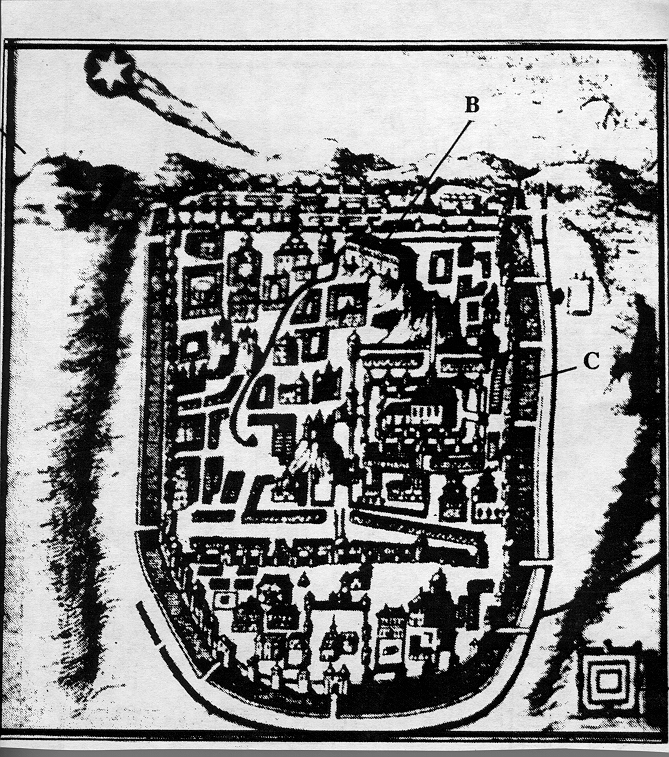
4.6 And there shall be a tabernacle for a shadow in the daytime from the heat, and for a place of refuge, and for a cover from storm and from rain (see Acceptable_Day_of_the_Lord.html for plans of the Tabernacle).
Zechariah 6.12 ..Thus speaketh the Lord of hosts, saying, Behold, the man whose name is The Branch; and he shall grow up out of his place, and he shall build the temple of the LORD:
6.13 Even he shall build the temple of the LORD; and he shall bear the glory, and shall sit and rule upon his throne; and he shall be a priest upon his throne: and the counsel of peace shall be between them both.
6.15 And they that are far off shall come and build in the temple of the LORD, and ye shall know that the LORD of hosts hath sent me unto you. And this shall come to pass, if ye will diligently obey the voice of the LORD your God.
 |
|
|
34.25 And I will make with them a covenant of peace, and will cause the evil beast to cease out of the land..
36.22 ..I do not this for your sakes, O House of Israel, but for mine Holy Name's sake, which ye have profaned among the heathen..
36.23 And I will sanctify my great name, which was profaned among the heathen..and the heathen shall know that I am the LORD, saith the LORD God, when I shall be sanctified in you before their eyes.
37.27 My tabernacle also shall be with them: yea, I will be their God, and they shall be my people.
Jeremiah 23.3 And I will gather the remnant of my flock out of all countries whither I have driven them, and will bring them again to their folds; and they shall be fruitful and increase.
23.4 Behold, the days come, saith the LORD, that I will raise unto David a Righteous Branch, and a King shall reign and prosper, and shall execute judgment and justice in the earth.
23.6 In his days, Judah shall be saved, and Israel shall dwell safely: and this is his name whereby he shall be called: The Lord our Righteousness.
Chapter 8
Bringing forth Righteousness
Bringing forth Righteousness
— The ancient Jewish people gave the world a vision of eternal peace, of universal disarmament, of abolishing the teaching and the learning of war.
Two prophets, Yishayahu Benamotz [Isaiah] and Micah Hamorashti [Micah] having foreseen the spiritual unity of man under God, with these words coming forth from Jerusalem, gave the nations of the world the following visionexpressed in identical terms — "And they shall beat their swords into plowshares and their spears into pruninghooks; nations shall not lift up sword against nation, neither shall they learn war any more."
Despite the tragedies and disappointments of the past, we must never forsake that vision, that human dream, that unshakable faith...
...Pursuing peace is the only avenue which is compatible with our culture and creed.
Let there be no more wars or bloodshed between Arabs and Israelis. Let there be no more wars of bloodshed between Arabs and Israelis. Let there be no more suffering or denial of rights. Let there be no more despair or loss of faith. Let no mother lament the loss of her child. Let no young man waste his life on a conflict from which no one benefits. Let us work together until the day comes when they beat their swords into plowshares and their spears into pruninghooks. And God does call to the abode of peace, He does guide whom he pleases to His Way.
Chapter 9
God guides whom He Pleases
God guides whom He Pleases
Koran, The Cow: And now that a Book confirming their own book has come to them from Allah [Allah is translated as an expression of amazement; ed. note], they deny it, although they know it to be the truth and have long prayed for help against the unbelievers...when it is said to them, "Believe in what Allah has revealed," they reply, "We believe in what was revealed to us." But they deny what has since been revealed, although it is the truth, corroborating their own scriptures.
Koran, The Creator 35:24 Your only duty is to give warning..What we have revealed to you in the book is the truth confirming previous scriptures.
Koran, Kneeling 45:16 We gave the Scriptures to the Israelites and bestowed on them wisdom and prophethood.
Koran, AL-AHQAF 46:12 Yet, before it the Book of Moses [Torah, ed. note] was revealed, a guide and a blessing to all men. This Book confirms it.
Koran, Women 4:47 You, to whom the Scriptures were given! Believe in that which we have revealed, confirming your own scriptures...
Koran, The Cow 2: 116 The Jews say the Christians are misguided, and the Christians say it is the Jews who are misguided. Yet they both read the Scriptures. And the pagans say the same of both. Allah will judge their disputes on the Day of Resurrection.
Chapter 10
Judgment
Judgment
Default
Those who follow the Koran have nothing to lose in any case. Mohammed was quite right when he said that God would judge the disputes between the Moslems, Christians, and Jews. The Koran was on a sure footing in this regard, because it had envisioned itself as an umbrella religion, bringing Jew and Christian together, in one religion of God, exactly as the prophets expressed it.
Furthermore, the Koran saw itself as the Watchman of the Scriptures who would see eye to eye (Isaiah 52.8) with the Messiah when the LORD shall bring again Zion (as did the composers of the Dead Sea Scrolls, who were called the Sons of Zadok); and, adding to this, we can see in the Koran those who would never hold their peace day nor night (Isaiah 62.6), thus, evidenced in the Mullahs calling the faithful to prayer from their towers.
The "we are better than thou" attitude
The end purpose, even as understood by the rabbis over time, was to join Abraham to God and through his Covenant with Abraham join a people to God and through his Covenant with those people join the entire world [nations] to God. Not a bad idea, huh? He'd give the Jews some light, scatter them to the four corners of the world and bathe the world with that light. Then, when he'd draw the Jews back to the Holy Land, He'd draw the world to Jerusalem with them. All the while the Koran took the author at His word and set Watchmen upon the walls. You can see them on the Temple mount, day and night. They're locals. Palestinians, we mean.
Chapter 11
The Question of Jesus the table of the Lord
The Question of Jesus
The other part of the table of the LORD as expressed by the Essenes and other early Jews was the setting of the Wine. The Bread and the Wine were the providence of God. Jesus adapted this to Himself, interestingly enough, and asked his disciples to remember him when they partake of the Bread and the Wine during Passover. Passover is to Christians Easter and to Jews the time when God sent plagues upon Egypt the night before he brought the Children of Israel out of Egypt, shepherded by his Lawgiver Moses. Every Jewish household was instructed to bake unleavened bread and prepare a lamb for the next day's journey. The unleavened bread was chosen because the people were warned that they would be leaving in a hurry and have no time to wait for it to leaven. The blood of the lamb, they were told, was to be painted on the lintels over their doors, to set them apart, that they were not Egyptians but Children of Israel.
Unity – Feeding on the Messiah
Koran, The Table 5:44 ...After those prophets we sent forth Jesus, the son of Mary, confirming the Torah already revealed, and gave him the Gospel, in which there is guidance and light, corroborating that which was revealed before it in the Torah, a guide and an admonition to the righteous.
Koran, IMRANS 3:45 The angels said to Mary: "Allah bids you to rejoice in a Word from Him. His name is the Messiah, Jesus the son of Mary..."
Remember the Poor of Jerusalem
Messianists
The earliest Messiahs were Moses and Joshua [Jesus in Greek], followed by Saul and then King David, who slew Goliath. Bar Kochba (circa. 135 A.D.) was one of the last [fake] Messiahs after the temple was destroyed. Jesus of Nazareth was not one of the first men to claim being one of the Messiahs, in any event. Let it be known that the Koran accepts Him as the Messiah of the Scriptures. The Koran was wise enough to leave the definition of the Messiah to the Scriptures. Who
Chapter 12
Back to Truth
Back to Truth
The idea behind the scriptures is to present Truth, and they say that you will know it
Two Natures of Truth
Chapter 13
The Children of God
The Children of God
New Name for the Peace of Jerusalem
This is further augmented in the Israeli Declaration of Independence of May 14, 1948. For there they pledged to the United Nations which created their state to provide full equity to all people of the Holy Land, which is another thing in which they are in default.
Chapter 14
Declarations of Law before God
Declarations of Law before God
The Columbus platform, 1937
E xcerpts pertaining to views of American Rabbis
1. Nature of Judaism. Judaism is the historical religious experience of the Jewish people. Though growing out of Jewish life, its message is universal, aiming at the union and perfection of mankind under the sovereignty of God.
8. ..In the rehabilitation of Palestine, the land hallowed by memories and hopes, we behold the promise of renewed life for many of our brethren. We affirm the obligation of all Jewry to aid in its upbuilding as a Jewish homeland by endeavor to make it not only a haven of refuge of the oppressed but also a centre of Jewish culture and spiritual life.
9. Throughout the ages it has been Israel's mission to witness to the Divine in the face of every form of paganism and materialism. We regard it as our historic task to cooperate with all men in the establishment of the Kingdom of God, of universal brotherhood, justice, truth and peace on earth. This is our Messianic goal.
B. Ethics
10. Ethics and Religion. In Judaism religion and morality blend into one indissoluble unity. Seeking God means to strive after holiness, righteousness and goodness. The love of God is incomplete without the love of one's fellowmen. Judaism emphasizes the kinship of the human race, the sanctity and worth of human life and personality and the right of the individual to freedom and to the pursuit of his chosen vocation. Justice to all, irrespective of race, sect or class is the inalienable right and the inescapable obligation of all. The state and organized government exist in order to further these ends.
12. Peace. Judaism, from the days of the prophets, has proclaimed to mankind the ideal of universal peace. The spiritual and physical disarmament of all nations has been one of its essential teachings. It abhors all violence and relies upon moral education, love and sympathy to secure human progress. It regards justice as the foundation of the well-being of nations and the condition of enduring peace. It urges organized international action for disarmament, collective security and world peace.
1.2 After being forcibly exiled from their land, the people kept faith with it throughout their dispersion and never ceased to pray and hope for their return to it and for the restoration in it of their political freedom.
1.3 Impelled by this historic and traditional attachment, Jews strove in every successive generation to re-establish themselves in their ancient homeland. In recent decades they returned in their masses. Pioneers, ma'pilim [immigrants coming to Eretz Israel in defiance of restrictive legislation] and defenders, they made the deserts bloom, revived the Hebrew language, built villages and towns, and created a thriving community, controlling its own economy and culture, loving peace but knowing how to defend itself, bringing the blessings of progress to all the country's inhabitants, and aspiring towards independent nationhood.
1.4 In the year 1897, at the summons of the spiritual father of the Jewish State, Theodor Herzl, the First Zionist Congress convened and proclaimed the right of the Jewish people to national rebirth in its own country.
1.5 This right was recognized in the Balfour Declaration on the 2nd November, 1917, and reaffirmed in the Mandate of the League of Nations which, in particular, gave international sanction to the historic connections between the Jewish people and Eretz-Israel and to the right of the Jewish people to rebuild its National Home.
1.6 The catastrophe which recently befell the Jewish people – the massacre of millions of Jews in Europe – was another clear demonstration of the urgency of solving the problem of its homelessness by re-establishing in Eretz-Israel the Jewish State, which would open the gates of the homeland wide to every Jew and confer upon the Jewish people the status of a full privileged member of the comity of nations.
1.7 In the Second World War the Jewish community of this country contributed its full share to the struggle of the freedom and peace-loving nations against the forces of Nazi wickedness and, by the blood of its soldiers and its war effort, gained the right to be reckoned among the peoples who founded the United Nations.
1.8 On the 29th November, 1947, the United Nations General Assembly passed a resolution calling for the establishment of a Jewish State in Eretz-Israel; the General Assembly required the inhabitants of Eretz-Israel to take such steps as were necessary on their part for the implementation of that resolution. This recognition by the United Nations of the right of the Jewish people to establish their State is irrevocable.
1. 10 This right is the natural right of the Jewish people to be masters of their own fate, like other nations, in their own sovereign State.
1.12 [deals with the Provisional Government – omitted here for brevity]
1.13 The State of Israel will be open for Jewish immigration and for the ingathering of the Exiles; it will foster the development of the country for the benefit of all inhabitants; it will be based on freedom, justice and peace as envisaged by the prophets of Israel; it will ensure complete equality of social and political rights to all its inhabitants irrespective of religion, race or sex; it will guarantee freedom of religion, conscience, language, education and culture; it will safeguard the Holy Places of all religions; and it will be faithful to the principles of the Charter of the United Nations.
1.14 The State of Israel is prepared to cooperate with the agencies and representative of the United Nations in implementing the resolution of the General Assembly of the 29th November, 1947, and will take steps to bring about the economic union of the whole of Eretz-Israel.
1.15 We appeal to the United Nations to assist the Jewish people in the building up of its State and to receive the State of Israel into the community of nations.
We appeal--in the very midst of the onslaught launched against us now for months – to Arab inhabitants of the State of Israel to preserve peace and participate in the upbuilding of the State on the basis of full and equal citizenship and due representation in all its provisional and permanent institutions.
1.16 We extend our hand to all neighboring states and their peoples in an offer of peace and good neighborliness, and appeal to them to establish the bonds of cooperation and mutual help with the sovereign Jewish people settled in its own land. The state of Israel is prepared to do its share in a common effort for the advancement of the entire Middle East.
1.17 We appeal to the Jewish People throughout the Diaspora to rally round the Jews of Eretz-Israel in the tasks of immigration and upbuilding and to stand by them in the great struggle for the realization of the age-old dream – the redemption of Israel.
1.18 Placing our trust in the Almighty [be-Zur Yisra'el], we affix our signatures to this Proclamation at this session of the Provisional Council of State, on the soil of the homeland, in the city of Tel-Aviv, on this Sabbath eve, the 5th day of Iyar, 5708 (14th May, 1948).
The Partition of Palestine:
Resolution of the United Nations General Assembly
(excerpts) November 29, 1947
Resolution of the United Nations General Assembly
(excerpts) November 29, 1947
[the part having to do with the Corpus Separatum of Jerusalem follows--ed. note]:
City of Jerusalem
A. Special Regime
The City of Jerusalem shall be established as a Corpus Separatum under a special international regime and shall be administered by the United Nations. The Trusteeship Council shall be designated to discharge the responsibilities of the Administering Authority on behalf of the United Nations.
B. Boundaries of the City
The City of Jerusalem shall include the present municipality of Jerusalem plus the surrounding villages and towns, the most eastern of which shall be Abu Dis; the most southern, Bethlehem; the most western, Ein Karim, (including also the built-up area of Motsa); and the most northern Shu'fat, as indicated on the attached sketch-map (Annex B). [see facsimile, page 27, ed. note]
C. Statute of the City
9. Relations with the Arab and Jewish States. Representatives of the Arab and Jewish States shall be accredited to the Governor of the City and charged with the protection of the interests of their States and nationals in connection with the international administration of the City.
10. Official Languages. Arabic and Hebrew shall be the official languages of the city. This will not preclude the adoption of one or more additional working languages, as may be required.
11. Citizenship. All the residents shall become ipso facto citizens of the City of Jerusalem unless they opt for citizenship of the State of which they have been citizens, or, if Arabs or Jews, have filed notice of intention to become citizens of the Arab or Jewish State respectively, according to part I, section B, paragraph 9, of this plan.
The Trusteeship Council shall make arrangements for consular protection of the citizens of the City outside its territory.
The Balfour Declaration
November 2, 1917
November 2, 1917
US Congress Endorses the Balfour Declaration:
Public Resolution No. 73,
67th Congress, Second Session
September 21, 1922
Public Resolution No. 73,
67th Congress, Second Session
September 21, 1922
Resolution:
Reforming the Holy Land
per the Jew's and the World's Covenants
Reforming the Holy Land
per the Jew's and the World's Covenants
We are resolved, when Abram was renamed Abraham, father of nations, the Covenant was reaffirmed. Abraham then passed his covenant with God down to Isaac who passed it to Jacob, who was renamed Israel. Israel divided the Covenant among his eleven children and the two sons of Joseph; but gave the Scepter and the Lawgiver to Judah until Shiloh comes, and to him shall the gathering of the people be (Genesis 49.10).
We are resolved that the conditional word, until, makes a distinction between the Scepter and the Lawgiver which are given to Judah and the function of Shiloh. Shiloh's origin is undefined and can be presumed separate from Judah because of the conditional word, "until." The later prophets, however, define the King-Messiah (actually two Messiahs are defined) as being a true Son of David.
We are resolved that the Declaration of Independence of the State Israel was duly initiated and signed by the seed of Judah (the Jews); therefore subgrogating their Covenant to the Shiloh condition of Genesis 49.10.
We are resolved when the people of the Exodus from Egypt were gathered at Mt. Sinai, they reconfirmed the covenant of Abraham and agreed to abide by all the conditions given to them by Moses. They and all their children thereafter were bound by this covenant.
We are resolved that to the rabbis the Word of God, through the Torah and its prophets, is inviolable. This also is reflected in the Thirteen Principals of Maimonides, Sa'adiah Gaon, and other great Jewish leaders, too numerous to mention here. All further agree that Israel is the First fruits of the Lord's Increase. This comes from Jeremiah:
Jeremiah 2.3 Israel is sacredness unto the Lord, the first-fruits of his increase.
The world is God's field, the peoples His plantation, Israel his First-Fruits. Just as the tree offers him the giver of the land, the first-fruits every year, so Israel must offer itself to Him as the first-fruits of his World Harvest.
It is the very same Rabbis, so often disparaged for their alleged particularism, who point out that when the prophets and poets predict a glorious new day for humanity they say nothing about priests, Levites, and Israelites, but speak only of 'the righteous,' 'the just,' and the 'honest,' and so the righteous, the just and the honest of all peoples are included in the most glorious blessing. And in the darkest hours when the frenzied mob destroyed the Jewish synagogues and tore up the Jewish books, the persecuted, derided Jew was always turned to his God and consoled himself by looking forward to the time when even this frenzy would disappear and the name of the one and only God would have implanted justice, truth and peace in every human breast.
We are resolved then, that the Redemption of the Jews to their Homeland meant a day when all men would be implanted with the ideas of justice, truth and peace called for in the Scriptures, and where the Children of Israel would cease to carry a "separate identity" as a peculiar and a chosen people of God. All men would be equally Holy in the eyes of God. This is reflected in Isaiah 4.3 mentioned above, where even every one that is written among the living in Jerusalem shall be called Holy, etc.
The Columbus Platform in 1937 invokes these preconditions and agreements from the patriarchs and rabbis of past eons to modern Judaic thinking.
The Declaration of the State of Israel restated the redemption of the Jewish people to the Holy Land according to the same terms previously elucidated. Based upon all these agreements by the leaders of Israel, on behalf of whom the Jews made their 1948 Declaration of Independence, the below minimum terms and conditions for the Holy Land must be applied:
Terms & Conditions for the Holy Land
2.0 Basic Law of the Land is the Torah and its Prophets. The declarations noted above and the Declaration of Independence for the State of Israel acknowledge the Holy Scriptures as their foundation of statehood.
3.0 Equity for all inhabitants of the Land. The Declaration of Independence affirms equal rights for all people on the land.
4.0 Restore the Temple and particularly the Tabernacle of Moses (Click on image for larger view):
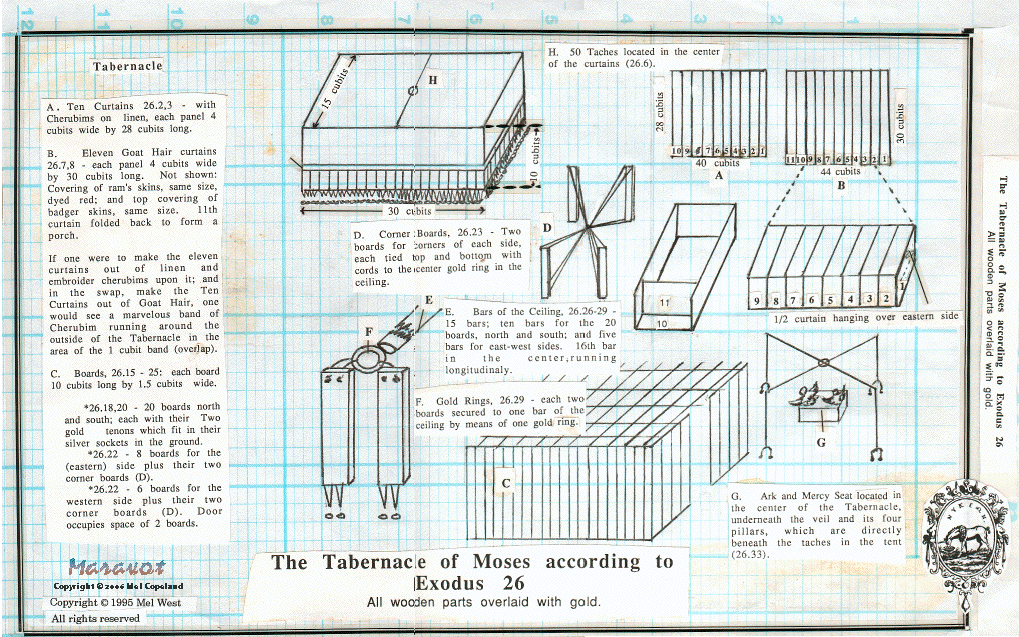
Psalm 51.17 The sacrifices of God are a broken spirit: a broken and a contrite heart, O God, thou wilt not despise
5.0 All people in Jerusalem shall be called Holy and be examples of such.
6.0 Invitation to all people between the "river of Egypt" and the Euphrates River to join the union of the State of Beulah.
7.0 The terms of the Declaration of Independence of 1948, which invoke both the Scriptures and the UN Charter and its subsumed International Covenants apply.
8.0 Agreement to restore the Corpus Separatum of Jerusalem to the United Nations pending UN disposition of that Territory; that the capitol of the State of Beulah may be maintained in Jerusalem.
9.0 Agreement to open the Golden Gate to allow all peoples access to the Temple Mount through its Promised Gate of Righteousness. The graves blocking the entrance should be arranged on either side of the entrance of the gate in new tombs which we recommend be constructed out of the stones now sealing the Golden Gate.
10.0 Agreement to honor the Jubilee Law. Agreement to establish the State of Beulah for the Jubilee of the Redemption of Israel, which is 1998, according to the Torah's Law that every 50th year shall be a Jubilee year, where debts are forgiven and lands are restored to their rightful owners. [ed. note 11.04.04. 2048 would be the next Jubilee year]
If the above terms are honored the Palestinians and Jews and all others
Until now we prayed for the Peace of Jerusalem as stated in the Psalms of David. The conditions prevail whereby law
al-M
7.4.93; 8.94
Please beam me back up to Maravot's Homepage
Please send me over to check out the Acceptable Day of the Lord
Please send me over to check out the Mehl Commentary, an explanation of Hidden Pavilions and Philistia Triumph thou..
Please send me over to check out Hidden Pavilions, a mystical work
Please send me over to check out Light.html
Please send me over to check out Repentance.html
Please send me over to check out Judgment.html
Please send me over to check out Duty and Profit.html
Please send me over to check out On the Breakage of the Holy Catholic Church.html
Please send me over to check out Immoral Coercion.html.
Please send me over to check out Quest for Human Dignity.html.
Please send me over to check out Liberating the Poor.html.
Please send me over to check out Light of the Gentile's Day.html:
a collection of scriptures which identify what the Messiah, Light of the Gentile, looks like and must do,
and what his day is like, when Israel is restored to the map again.
Please send me over to check out a related page, The Miracle of Zer Anpin.html.
Please send me over to check out a related page: Four Parables and a Prayer.html
Please send me over to check out a related page: Opening to the Divine.html, teachings of Jesus on the
Keys of Knowledge:
how the Keys of Knowledge and the Keys to the Kingdom are one and the same.
Please send me over to check out related precepts
from the Upanishads, Lao Tzu, Confucius, and Buddha: The Tapestry of One.html.
Please send me over to check out The String of Pearls.
Please send me over to check out My Father is Greater than I.
Media: C. Wearn, Multimedia, Inc., William L. Honeysett, Tribune Publishing Co.; S. R. Cook, Tribune Co.; David Tennant Bryan, Media General, Inc.; John Buzzetta, DTH Media Inc.; Andrew E. Barnes, Times Publishing Co.; Franklin D. Schurz, Jr., Schurz Communications, Inc.; Sephen Rogers, The Times-Mail Herald Co.; Robert F. Erburu, The Times Mirror Co.; Thomas Curley, Gannett Co., Inc.; R. H. Searby, The News Corp. Ltd.; Henry H. Bradley, NewsPress and Gazeete, Co.; Lord Stevens, United Newspapers Plc.; Katherine Graham, Washington Post Co.; Stanley Grinstead, Reed International Plc.; J. Richard Munro, Times Warner Inc.; Kenneth R. Thomson, Thomson Newspapers, Ltd.; Donald W. Reynolds, Donrey Media Group; Robert H. Smith, Maxwell Communication Corporation; Edwin Warfield II, The Daily Record Co.; Thomas Murphy, Capital Cities/ABC Inc.; Donald G. Campbell, MacLean Hunter Ltd; Malcolm A. Borg, Macromedia Inc.; Director General A.D.G. Milne, BBC; Director General Al-Majali, Hashemite Kingdom Broadcasting Service; William Randolph Hearst Jr., Hearst Corporation.
Magazines and Syndicates: Diana L. Drake, United Media; Rev. Dr. John Stapert, The Church Herald; Don Michel, Los Angels Times Syndicate; George M. Daniels, New World Outlook; B. Russel Holt, Signs of the Times; Henry Lexau, Catholic Digest; Cheryl Romo, Common Cause Magazine; Jane Scully, Environment; William G. Hyland, Foreign Affairs; Kass Dotterweich, Marriage & Family Living; William Whitworth, The Atlantic Monthly; Martin Pomerance, Palm Beach Jewish World; Gary Rosenblatt, Baltimore Jewish Times. Alden Mills, A Critique of America; Lee Ranck, Christian Social Action; Terry Muck, Leadership; Alan Capps, Journal of Defense & Diplomacy; Van Varner, Guideposts Magazine; Morton A. Kaplan, The World & I; Elie Faust-Levi, ORT Reporter; Joe Weinberg, Union of American Hebrew Congregations; James Weinstein, In These times; Walter Anderson, Parade Publications;
Others & Editorial: William C. Moyer; A. M. Rosenthal, New York Times; Mrs George Bush, First Lady of the United States of America; MacNeil/Lehrer; Melvin Belli, Sr.;
US Senators: P. Galbraith, N. Kassebaum, L. Pressler, F. Murkowski, G. Humphrey, C. Pell, J. Biden, P. Sarbanes, A. Cranston, C. Dodd, P. Simon, T. Sanford, John Heinz, C. Levin, S. Thurmond, W. Cohen, E. Hollings, W. Durdman, D. Boren, S. Nunn, D. DeConcini, H. Metzenbaum, O. Hatch, A. Specter, H. Kohl;
UN Officials: UN Secretary General Javier Pérez de Cuéllar; Director General Antoine Blanca, Undersecretary General, Chef de Cabinet, Virendcra Dayal; Undersecretary General Marrack Goulding; Undersecretary Abdulrahim A. Farah; Executive Secretary Abdel Jaber; Commisioner General Giorgio Giacomelli;
Leaders sent Brief # 3 et al.: Executive Secretary to the UN, Abdel Jaber (Jordan); UN Director General for Development.. Antoine Blanca; UN Undersecretary General, Chef de Cabinet Virendra Dayal (India); Undersecretary General Marrack Goulding (UK); Undersecretary for Special Politcal Questions...Abdulrahim A. Farah (Somalia); Assistant Administrator...for Arab States and Europe Mohamed Nour (Sudan); Commisioner General of UN Relief and Works ..For Palestine..Giorgio Giacomelli (Italy); Representative to the United Nations Thomas R. Pickering (US); UN Secretary General Javier Pérez de Cuéllar; UN Representative Yoram Aridor (Israel); President Jimmy Carter; Stephan Petranek, Washington Post; Bureau of International Organizations; President Gorbachev of the Soviet Union.
Leaders sent Brief # 4 et al.: President Bush of the United States; President Gorbachev of the Soviet Union; Linton Weeks, The Washington Post, Mary Zupan, Reason Magazine; Phyliss Malamud, Newsweek Magazine; Secretary General Pérez de Cuéllar of the United Nations; Comissioner General of UN Relief and Works Agency for Palesitine Refugees, Giorgio Giacomelli; Executive Secretary of the Economic and Social Commission for Western Asia, Abdel Jaber; Undersecretary General de Cabinet, Viendra Dayal; Karen Gellen, The Guardian.
Leaders sent Brief # 5 et al.: Secretary-General Javier Pérez de Cuéllar; President Bush; Undersecretary General, Chef de Cabinet, Viendra Dayal; Executive Secretary Abdel Jaber; Commissioner General Giorgio Giacomelli; Linton Weeks, Editor; Samir Shehabi (Saudi Arabia), President of the UN General Assembly.
Leaders sent Brief #6 et al.: N. David Gross, The Jerusalem Post; Midstream, a Monthly Jewish Review; Peter Jennings, ABC News; Tony Benn, Member of Parliment, United Kingdom; Charlene Hunter-Galt, MacNeil/Lehrer.
Leaders sent Brief # 8 et al.: Joe Weinberg, Editor Union of American Hebrew Congregations; Martin Pomerance, Editor Palm Beach Jewish World; Gary Rosenblatt, Editor Baltimore Jewish Times; Jacob Neusner, Brown University.
Leaders sent Brief # 10 et al: Midstream Magazine; N. David Gross, Editor Jerusalem Post; Joe Weinberg, Union of American Hebrew Congregations; Jacob Neusner, Brown University.
Leaders sent Brief # 11 et al: Jacob Neusner, Brown University; David Gross, Editor Jerusalem Post; Joe Weinberg, Union of American Hebrew Congregations ; Gary Rosenblatt, Editor, Baltimore Jewish Times.
Leaders sent Brief # 12: et al.Joseph Brooks; Edward Styles, American Enterprise Institute for Public Policy Research; Secretary General Burtros Butros Ghali, United Nations.
Leaders sent Brief #13 et al: Edward Styles, American Enterprise Institute for Public Policy Research; Secretary-General Butros Butros Ghali, United Nations; Ahmad Jabbari, Mazda Publishers.
Leaders sent Brief #14 et al: Jacob Neusner, Brown University; N. David Gross, Editor Jerusalem Post; Joseph Weinberg, Union of American Hebrew Congregations; President George Bush, King Hussain, Hashimite Kingdom of Jordan.
Leaders sent Brief #15 et al: Jacob Neusner; N. David Gross, Jerusalem Post; Joseph Weinberg, Union of American Hebrew Congregations; President George Bush; King Hussain, Hashimite Kingdom of Jordan.