

Etruscan_Phrases
Translation of the
Mirror from Tuscania
A Lesson on Divination
by Mel Copeland
(from a work published in 1981)
About the Translation
This text carries a warning from King Tarquin, TARCHVNVS. whose name is repeated in the phrase: PAFA TARCHIE, meaning, "Fear! from the Tarchie."
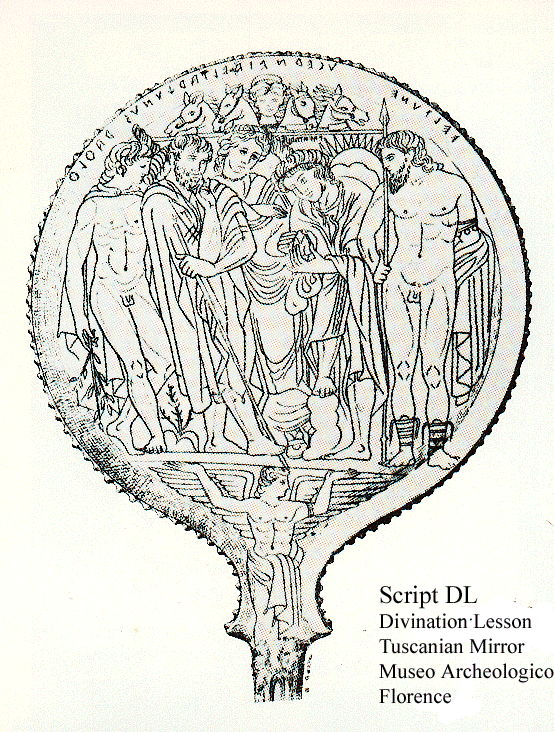
Translation:
DL-1 FELTVNE ACERN FI AFLI TARKVNVS DAOLO
the god Veltone (possibly meaning Fel,
great, an appelation preceeding names of kings and
queens), he thunders (L. tono-are-ui-itum, Conj.
Pres. 3rd Pers. singl. tonet); they
augur/divine/fortell (L. auguro-are, Ind. Pres.
3rd Pers. pl. augurant) he
produces/values (L. fio fieri factus sum, Ind.
Pres. 3rd Pers. singl. fit) the lords (L. aula-ae;
2nd Decl. Gen. singl. or Nom. pl. -i) Tarquins
(Tarchonos, 2nd Decl. Acc. pl. -os) for war (L.
bellum -i ; old form, duellum, duellicus,
duellator, 2nd Decl. Dat. singl. -o) ;
Note: the last characters are unusual. The "o" (omega) is rare in Etruscan texts, with the "V" rendering that value. The "u" is conveyed by the "F," following a vowel, such as AFLI = Auli. Also, the "d" is rare, usually conveyed by the "t" and sometimes the theta (Θ). The "O" is usually an "R," which we believe is a "double r;" another "r" is written as "P," and the penmanship on this character can vary in the hight of the shaft, sometimes with no shaft at all, appearing as a "D." The probable option would be DAOLO, duello, "for war," particularly in view of the Roman practice to read the auspices, often calling forth an Etruscan augur, before engaging in battle. Veltune is shown with a spear, which further indicates that the matter being revealed has to do with war. TARCHONOS coincides in spelling with another Greek name used in Etruscan mirrors, of Ajax Telemonos: AIFAS (See also EIFAS) TELaMONOS (TELMVNVS).
Our vocabulary comes from the Etruscan GlossaryA.xls; See also Table 1.
DL-9
PAFA TARCHIE Fear! (L.
paveo, pavere, pavi, intransit, Imper. singl. pavē ) Tarkie the Tarquins
(L. Tarquinii-orum) an Etruscan line which founded
the city of Rome. The "ie" is a common suffix, as in
PHERIE, PINIE, ACIE, ASIE, ATIE, CERNIIE,
COKIE, IOCIE (IVCIE), NANIE, NECHIE (NEKIE). If
TARKVNVS is 2nd Decl. Acc. pl. -os, then TARCHIE
would appear to be 3rd Decl. Abl. sing. -e. This
would suggest that the phrase PAFA TARCHIE reads,
"Fear! by, with, from Tarquin."
Comment: Veltune
is described by Massimo Pallottino, "The Etruscans,"
Indian University Press, 1975, p. 141 : "...Veltha
or Veltune or Voltumna (Vertumnus in its Latin form)
– a god with strange and contrasting attributes,
represented at times as a maleficient monster, at
others as a vegetation god of uncertain sex, or even
as a mighty war god. By a typical process, this
local earth spirit, worshiped in a small part of
southern Etruria, is individualized and transformed
into a superior divinity, the national god par
excellence, the deus Etruriae princpets
(Varro, De ling. lat., V, 46). In the same way, the
protecting spirits of war, represented as armed
heroes, tend to coalesce into a single deity, the
Italic Etrusco-Roman Mars, on the model of the Greek
god Ares."

 Return me to Etruscan Phrases
Index
Return me to Etruscan Phrases
Index
Launched
2.22.03
Updated: 10.12.03; 3.24.06; 5.08.06; 5.11.06;
3/28.12
Copyright © 1981-2012 Maravot. All rights reserved.
Copyright © 1981-2006 Mel Copeland. All rights
reserved.