|
Language Tools– |
|||



Contents
Book I
Introduction
What I
am trying to do with this website
Myths, mirrors and Etruscan declension
patterns
Etruscan gods and goddesses,
Etruscan_Phrases_b.html
Battle of the hero-god with the dragon:
victory of light over darkenss, Etruscan_Phrases_b.html
Unique Etruscan storylines,
Etruscan_Phrases_b.html
The Etruscan language is Indo-European,
as confirmed herein, Etruscan_Phrases_b.html
Studying the Etruscans and
their Indo-European relations through Table 1,
Etruscan_Phrases_b.html
The Etruscans and the Trojan War,
Etruscan_Phrases_c.html
Indo-European homelands and migrations,
Etruscan_Phrases_c.html
The testimony of the Iliad and its
relationship to the Indo-European saga,
Etruscan_Phrases_c.html
Breaking down the Etruscan language
through the scientific method, Etruscan_Phrases_d.html
Background on the methodology,
Etruscan_Phrases_d.html
Book II
A short history, Etruscan_Phrases_d.html
Mapping the spread of the tumuli,
Etruscan_Phrases_d.html
The Mycenean connection,
Etruscan_Phrases_d.html
On reading the scripts,
Etruscan_Phrases_d.html
What the translations are revealing,
Etruscan_Phrases_d.html
The search for the Indo-European mother
tongue, Etruscan_Phrases_e.html
Book III
Theories on the difussion of culture,
Etruscan_Phrases_e.html
Comparative Linguistics and the movement
of the Indo-Europeans, Etruscan_Phrases_e.html
Phylogenetic Chronology,
Etruscan_Phrases_e.html
Trade routes, Etruscan_Phrases_f.html
Claims as to who was first among the
Indo-Europeans, Etruscan_Phrases_f.html
Etruscan - its place in the
Indo-European sequence, Etruscan_Phrases_f.html
Links, Etruscan_Phrases_f.html
Appendixes
Etruscan_Murals.html
Etruscan_Grammar.html
&
Etruscan_GlossaryA.xls
Copeland-Etruscan-Dictionary.pdf
Banquet of the Gods: Banquet.html
Texts
&Translations
Related Books/Reports
Hittite Treaties.html |
Phrygian.html | Lydian.html
When was the Iliad and Odyssey
Created?
The Fascinating story-telling
of Etruscan mirrors
Etruscan
Murals (PDF) Acadamia.edu
Work Notes on the Etruscan
Language - A compilation of work notes
Etruscan Declension patterns as thety
relate to Latin, Greek, Sanskrit (PDF) Acadamia.edu
Accentuations
of the Etruscan language that are comparable to
Indo-European patterns (PDF) Acadamia.edu
Unique
perspectives in Etruscan mythology Rev. 1.28.13 (PDF)
Acadamia.edu
New additions of Etruscan texts on military
affairs Acadamia.edu
Etruscan GlossaryA (PDF) Acadamia.edu
Etruscan Use of Labials, F,8,V Acadamia.edu
How to use Etruscan Glossary A spreadsheet
(PDF) Acadamia.edu
Work
Notes on the Novilara Stele (PDF) Acadamia.edu
Work
Notes on the Pyrgi Gold Tablets (PDF) Acadamia.edu
Work
Notes on the Magliano Disk (PDF) Acadamia.edu
Work
Notes on the Zagreb Mummy (PDF) Acadamia.edu
Work
Notes on the Tavola Cortonensis (PDF) Acadamia.edu
Work
Notes on the Perugia Cippus (PDF) Acadamia.edu
Work Notes on Bona Dea
& the Goddess Uni-a survey of Etruscan
&Latin texts relating to the Pyrgi Gold Tablets Acadamia.edu
Work
Notes on the Tavola Eugubine (III) Script Q278-Q453
(PDF) Acadamia.edu
Work
Notes on the Tavola Eugubine IIB Script Q1-Q273 (PDF) Acadamia.edu
Work Notes on the Tavola Eugubine IV Script
Q543-Q915 Acadamia.edu
Work Notes on the Tavola Eugubine Ia Script
N462-N748 Acadamia.edu
Work Notes on the Tavola Eugubine V, Script
R1-R154
Work Notes on the Lemnos Stele, Script S Acadamia.edu
Translation of Etruscan Devotional Plates (PDF) Acadamia.edu
Translation of Etruscan
Devotional Plates II (PDF) Acadamia.edu
Translation of Etruscan Devotional Plates III
(PDF) Acadamia.edu
Work notes on Etruscan Devotional Plates among the Celts (PDF) Acadamia.edu
Work Notes on Etruscan Mirrors and Murals I
Acadamia.edu
Work Notes on Etruscan Mirrors and Murals II
Acadamia.edu
Work Notes on Etruscan Mirrors and Murals III Acadamia.edu
Work Notes on Etruscan Mirrors and Murals IV Acadamia.edu
Work Notes on Phrygian texts
Acadamia.edu
Work Notes on Thracian texts Acadamia.edu
Thracian_Glossary Acadamia.edu
Translation of Etruscan short inscriptions
(PDF) Acadamia.edu
Proof of a greater Language Family:
Indo-European, Baltic, Uralic and Kartvelian Acadamia.edu
Indo-European Table 1, Part 11, "uk" to "vre"
(PDF) Acadamia.edu
Indo-Eropean Table 1, Part 10, "ta" to "tuto" (PDF) Acadamia.edu
Indo-European Table 1, Part 9, "senata" to
"Severa" (PDF) Acadamia.edu
Indo-European Table 1, Part 8, "ri" to
"semenies" (PDF) Acadamia.edu
Indo-European Table 1, Part 7, "plak" to "rev,
revio" (PDF) Acadamia.edu
Indo-European Table1, Part 6, "mi" to "piviato"
(PDF) Acadamia.edu
Indo-European Table 1, Part 5, "la" to "meva"
(PDF) Acadamia.edu
Indo-European Table 1, Part 4, "fac" to "itis"
(PDF) Acadamia.edu
Indo-European Table1, Part 3, "chaina" to
"evalta" (PDF) Acadamia.edu
Indo-European Table 1, Part 2, "ca" to "ceto" (PDF) Acadamia.edu
Indo-European
Table 1, Part 1, "A" to "Brater" (PDF) Acadamia.edu
Indo-European Table 1, Part 1, "A" to "Brater"
(PDF) Acadamia.edu
The Triple-dot Pattern and the
Swastika in Ancient Art Acadamia.edu
English-Hittite
Dictionary.pdf. Academia.edu
English-Hittite Dictionary (word), Academia.edu
Alphabetical
Index Indo-European Table, Academia.edu
Copeland-Indo-European
Table (Parts 1-11), Academia.edu
Copeland-Akkadian-English.Dictionary.PDF.Book.I.PartI
Copeland-Akkadian-English.Dictionary.PDFBook.I.PartII
Akkadian.Word-Strings.PDF Academia.edu
Copeland-Akkadian-English.Dictionary
Book 1, Part I Academia.edu
Copeland-Akkadian-English.Dictionary Book 1,
Part II Academia.edu
Copeland-Avestan, Hurrian, Hittite, Tocharian
Dictionaries Academia.edu
Georgian
(Kartvelian),Linguistic.Connections
Eurasian
Linguistic Foundations Academia.edu
Finnish-Uralic Linguistic
Connections
Academia.edu
Armenian
Steppe Linguistic Connections Academia.edu
Introduction
When one begins
an investigation one does not know where it will lead.
Of key importance to any investigation is the way the
data are gathered and recorded; then the process by
which the information is analyzed. With diligence the
study may open new vistas and they too are important to
the work. Bear with me, now, as we explore the
fascinating, mysterious world of the Etruscans, their
neighbors, ancestors, hopes, dreams and fears. I say,
fears, since their writing includes fearsome depictions,
as can be seen for instance, in the Tomb of Orcus (who
would want to be buried with such depictions around
them?), which you may wish to view by clicking on the Etruscan_murals
link. To understand the Etruscans we have to step
into their world about ~1,200 B.C. Although that date
and the subsequent centuries are somewhat of a "Dark
Age" to us, we can see in the light from the Etruscans
and other Indo-European peoples, such as the Aryans of
India who created the Rig Veda, and the Danaäns
of the Iliad, an attempt to reconcile their
lives, their hopes and dreams, to that which is greater
than they are: the gods. What these ancient peoples, in
those ancient times, were reconciling was then even
ancient history to them.
Also described in this work are
the Celts, who have passed down a similar, though
abbreviated, Indo-European tradition that continues with
us till this day. They passed down to us the Táin Bó
Cuailnge, also called The Tain. It is
about a great battle between the two major chieftans of
Ireland, concerning a cattle-raid by Queen Medb and King
Ailill, of Connacht, with their allies, against the king
of Ulster. The hero of the story is Cúchulainn, his name
meaning "the hound of Chulainn." Though a giant of a
man, still in his youth, he is obliged to watch the
cattle that are about to be raided, because he killed
the hound that normally watched the cattle. Obviously he
is at the center of the battle that takes place and
certain warriors that are killed in the battle leave
their names to the places of Ireland where they were
killed. It follows the same pattern of story-telling as
the Iliad and the Hindu version of the "great
battle" called the Mahabharata. An Anglo-Saxon,
Danish version of the "great battle" is another
wonderful story, Beowulf, that involves the hero,
Beowulf, who destroys the monster Grendel, that
lives underground, and feeds upon the warriors of a
Danish palace. More ancient in the Indo-European
tradition, perhaps, is the Rig Veda, which tells
us of the god Indra (like the Greek god Zeus and
Etruscan god Tinia) who destroys a dragon. In Greek
mythology Zeus destroys the monster, whose legs were
serpents, Typhöeus or Typhon. In Celtic mythology the
name of this god who destroyed monsters or dragons is
probably Cernunnos, who will be discussed more in this
work. Typhöeus is a character, like many other Greek
gods, remembered in Etruscan images. Knowing this we
should be able to find in Tinia's ephitet a refrence to
Typhöeus, or the Etruscan name of that character, if
much different.
A curious turn in our
exploration of the Etruscan language has led to the
Phrygian language and its very similar grammatical
patterns that relate to the Etruscan language. Herodotus
and other ancients, particularly Strabo, provided
pointers suggesting that the Etruscans, originating in
Lydia, and the Phrygians shared a common heritage and
land. Strabo and others further point out that the
Phrygians are identical to the Mysians and Thracians. He
also compares the Thracians to the Celts. The ancient
texts that point to the Etruscan-Phrygian-Celtic
connection are at the "Etruscan Phrases" Phrygiank.html.
Strabo describes these people as being very ancient and
attributes many inventions, such as wagons, to them. He,
as well as other ancient writers, says that the
Phrygians are believed to have come from Thrace. He
further points out that the Getae and Thracians share
the same tongue. Strabo then points out that the island
of Lemnos was first settled by Thracians. Lemnos has
strong connections to the Phrygians and interestingly
the Lemnos
Stelae, Script S, written in Etruscan characters,
shows a punctuation (3-dot colon) like the Phrygian
script. While the Lemnos Script has been identified as
an Etruscan writing, it appears that it is Phrygian,
though both the Etruscans and Phrygians appear to share
the same language.
In Book X, Chapter 3.12, Strabo
gives an interesting description of the Phrygian
religion: "But as for the Berecyntes, a
tribe of Phrygians, and the Phrygians in general, and
those of the Trojans who live round Ida, they too hold
Rhea in honour and worship her with orgies, calling her
Mother of the gods and Agdistis and Phrygia the Great
Goddess, and also, from the places where she is
worshipped, Idaea and Dindymene and Sipylene and
Pessinuntis and Cybele and Cybebe. The Greeks use the
same name 'Curetes' for the ministers of the goddess.."
If the Etruscans shared the same religion worshipped
among the Trojans, then we ought to expect to find
Cybele's worship in their texts. The Etruscan mirrors
and murals, however, project Uni as the mother-goddess
(L. Juno; Gr. Hera) and on the Divine_Mirror.html
we see the consort of Tinia (L. Jupiter; Gr. Zeus) as
RALNA, who, in the Divine-Mirror, is the mother of Helen
of Troy. 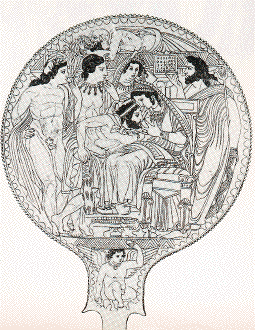 In another mirror, Script AH, Volterra_Mirror,
we see Uni suckling Heracles, accompanied by a text held
up by Tinia. Of interest in this regard is a statement
by Strabo, Book V, Chapter 4, that identifies the
Etruscan "Hera" as "Cupra." He is discussing the Italian
coast towards Naples, referring to the Etruscan Temple
of Cupra, and then reviews a place considered to be one
of the entrances to Hades which is called the
Archerusian Lake, near Cumae. A similar place is
discussed in Phrygia, possibly as Hieropolis. The
discussion leads back to Lemnos (where Hephaestos
[Latin, Vulcan] was believed to have been born) and
possible connections to the Phrygian archeological site
called Midas City which may be the Midiaeium described
by Strabo. Strabo lists Midiaeium geographically with
nearby cities such as Afyon and Gediz. In sum, the
Etruscans and Phrygians appear to be connected in many
ways, in historic background, mythology and language.
In another mirror, Script AH, Volterra_Mirror,
we see Uni suckling Heracles, accompanied by a text held
up by Tinia. Of interest in this regard is a statement
by Strabo, Book V, Chapter 4, that identifies the
Etruscan "Hera" as "Cupra." He is discussing the Italian
coast towards Naples, referring to the Etruscan Temple
of Cupra, and then reviews a place considered to be one
of the entrances to Hades which is called the
Archerusian Lake, near Cumae. A similar place is
discussed in Phrygia, possibly as Hieropolis. The
discussion leads back to Lemnos (where Hephaestos
[Latin, Vulcan] was believed to have been born) and
possible connections to the Phrygian archeological site
called Midas City which may be the Midiaeium described
by Strabo. Strabo lists Midiaeium geographically with
nearby cities such as Afyon and Gediz. In sum, the
Etruscans and Phrygians appear to be connected in many
ways, in historic background, mythology and language.
Complicating the issue is the
Aeneid by Virgil which identifies the ancestors of the
Romans with Trojan refugees who speak the same language
as the Latin tribe of Latinus who occupied Rome, where
the Trojans led by Aeneas settled. This story thus
merges with historical accounts, where apparent
grammatical affinities among the Etruscans, Phrygians
and Trojans point to a pan-Latin language group that
moved through Thessaly into Anatolia and from there to
Italy. The presence of the Latin and "Italic" tribes
preceeding the "Trojans" suggests that the migration
celebrated by Virgil was not the first migration of
Latin speaking people to Italy. Curiously, ranked with
other "Italic" languages that defy translation is "Old
Latin," as preserved in the texts of the Fibula
Praenestina, Duenos Vase, Ficorroni cista, Carmen Arvale
and Carmen Saliare. (For links to these texts see en.allexperts.com/q/Latin-2145/)
The historian of the Punic Wars, Polybius (wrote between
246-167 B.C.), reported that the first treaty between
Rome and Carthage — written in Old Latin — was difficult to
translate. Other treaties were difficult to translate,
as reported by Dionysus of Halicarnassus IV:26 and
IV:28; Plinius, "Naturalis Historia," XXXIV:14) and the
treaty between Rome and Ardea (Cicero, "Pro Balbo,"
23.53).
Polybius, "The Rise of the Roman Empire," Book III.22): "...I give below as accurate a translation as I can of this treaty, but the modern language has developed so many differences from the ancient Roman tongue that the best scholars among the Romans themselves have great difficulty in interpreting certain points, even after much study."
The "Duenos
Vase" appears to have similar words to those used in
Etruscan texts. We recognize TENOI (Etr. TENV, (Q893),
INE (BT-21?), with INAS, INNI, INV; MAROS may be L.
mare-is (3rd declension). Of interest is that Etruscan
MAREM (Z1139) agrees with Latin 3rd declension, mare-is,
sea, whereas the Old Latin MAROS (L. marus?) does not
fit in the scheme of the 3rd declension. TODAS appears
to be L. tutus-a-um, Etr. TVTA, TVTAS (N11, N41), TVTE,
TVTHI. OPETOI appears to be L. oppidum-i, fort, Etr. VPETV (R49). Following
this word is TESIA which appears to be a name because of
its "ia" suffix. A discussion on Old Latin is at wikpedia.org. An Etruscan text
that appears to be transitional to Old Latin is Script ON.
Some of these early tribes, unlike their
heroic Trojan War era cousins — of Etruscans,
Phrygians, Trojans, Lydians, etc. —shared a living
standard like the celts, typified by the tribes called
the Roxolani. Says Strabo, "the Nomads, their tents, made of felt, are
fastened on the wagons in which they spend their lives;
and round about the tents are the herds which afford the
milk, cheese, and meat on which they live; and they
follow the grazing herds, from time to time moving to
other places that have grass, living only in the
marsh-meadows about Lake Maeotis." Strabo then lists the
Iapodes who lived near Illyria (modern Croatia,
Albania): "They are indeed a war-mad people, but they
have been utterly worn out by Augustus. Their cities are
Metulum, Arupini, Monetium, and Vendo. Their lands are
poor, the people living for the most part on spelt and
millet. Their armour is Celtic, and they are tattooed
like the rest of the Illyrians and the Thracians." The
description of these Celtic relatives is very similar to
the record of Julius Caesar's "Gallic Wars" and others,
such as Gerald of Wales' description of the Welsh people
in his 1188 A.D. books, "The Journey through Wales" and
"The Description of Wales." The populations of
Celtic-Latin peoples are believed to have shared a
common language and certainly dominated Western Europe
from the time of the Trojan War.
While there is no doubt that
the Etruscan language, as shown on this site, is
Indo-European and closely related to Latin, the work is
not complete until other relationships are examined. We
need to better understand what the Etruscan scripts say,
and to do that, though we can read them, we need to be
able to understand what we are reading. This is where an
understanding of other like mythologies and languages is
important and introduced in this work. For instance, in
the "Tomb of the Lioness," in Tarquinia, a mural (See Etruscan_Murals)
shows dancers and musicians on either side of an
enormous vase or cauldron, and above them a lioness and
a leopardess. What mythology is being represented here?
Can the dance be similar to the Celtic ritual on the
Gundestrop Cauldron? As will be seen in this work, the
images from the Etruscan tombs are not just pretty
images, though many have deteriorated; they tell a
story. Our purpose ought to be to understand that story,
to hopefully find at least a piece of the story in the
extant Etruscan scripts. We need to step beyond the
efforts of the "historians" of the past.
Because so many of the Etruscan murals recall Greek
mythology — many contain names that coincide with Greek
gods and godesses — we can presume that they adopted Greek themes
to themselves, like the
Latins. The Greek Zeus is the Latin Jupiter, for
instance, and he is called Tinia by the Etruscans. We
also know from the Aeneid of Vergil (born in
Cisalpine Gaul, 70 B.C.) that the Lydian refugees with
Aeneas were able to enlist the Etruscans (Tyrrhenians)
to aid them in their war against the indigenous Latins
at Rome. Mentioned in that tale is also the fact that
nearby was a Greek colony. The Greeks did influence
Etruscan works of art, justifying the title of the
"Hellenic" period in Etruscan "history." I put the word,
history, in quotes for a reason: What is known about the
Etruscans is from archaeological data and bits and
pieces of testimonials from the Greek and Latin
historians. Here we shall attempt to put more legitimacy
to the idea of an Etruscan history, one that at least is
composed of words and images, as we can see from the
murals and mirrors, from their own hands — not others. Like the
Greek mythology, Etruscan mythology focuses on
patronymic relationships important to them. These
characters are particularly associated with actors
involved in the Trojan War and a few, like Alcestis and
Admetus, provide moral lessons and conundrums. A modern
representation of their history, from their point of
view, is carried in a mirror about King Tarquin, whose
powerful wife, Tanaquil, compelled him to move from
Tarquinia to Rome where he became king. The mirror shows
an augur warning Tarquin to beware.
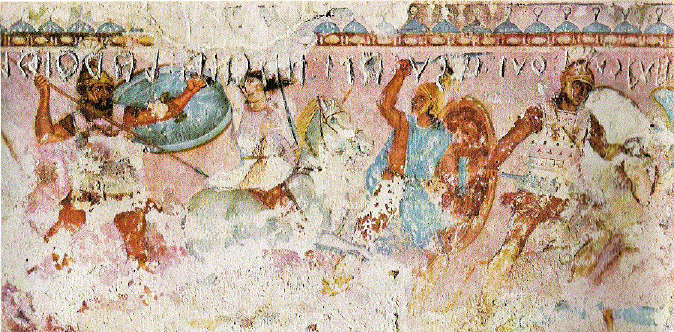 at are hard to
read. See more details in Short_Scripts.html.
at are hard to
read. See more details in Short_Scripts.html. Script "AM," a sarcophagus from Tarquinia, now in the Archeological Museum in Florence
AM-1 - HVC CRAI: RVI: ASV ATI: TIFI CNEI: LAR RIAL
Hither is (L. huc) Crai the king (L. rex, regis; It. re, Fr. roi). Aso (Asius, a Trojan ally) of the Ati (sons of Atis). He carries away (L. deveho -veheree -vexi -vectum; Ind. Pres. 3rd Pers. singl. devehit) Cnei (Hecate or Hecuba; Cyneus): the god (L. lar) royal (L. regalis).
Note: Asius was the younger brother of Hecuba and son of Dymas, king of the Phryigian tribe who lived on the Sangarius River (their father was the river god, Sangarius). Asius led that nation's forces in the Trojan War. Crai carries a genetive suffix and may have a relationship to the Titan Crius. Crius was the father of Perses and Perses was the father of Hecate (Hecuba) by Asteria. Rather than calling this scene the "Battle of the Greeks and Amazons" it appears to be "The rape of Hecuba, wife of King Priam of Troy." Trojan stories are favorites in Etruscan art.
(Continued, Myths, Mirrors & Etruscan Declension Patterns
Texts & Translations (~6000 words)
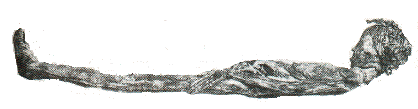
 Translation of the Zagreb Mummy, Script Z. A
mummy of a woman found in Egypt was wrapped in
linens that contains the longest Etruscan text.Translation
of tomb murals,
dedications, statue of Aule Metelis and various
texts, Miscellaneous Short
Inscriptions, Scripts A, P, AB, AD, AE, AF, AG,
AT, AJ, AK, AL, TA, AN(1), AN(2), AN(3), AP, HA,
LF, AM, T ; See also Script PH, "Phersipnei,"
above. (12.03.06) [~226 words] The orator of Script AL is Prince
Metelis who appears to be of the clan Veleres, a
name appearing in many scripts, including the
Zagreb Mummy. The text (still in work) indicates
that he holds the chair of Turin. The gens. Clensi
are mentioned in this script (CLENSI). The Clensi (K52) are associated with
Queen Sarina in the Perugia Cippus, Script K, a
stele of kings and queens. (9.23.06)
Translation of the Zagreb Mummy, Script Z. A
mummy of a woman found in Egypt was wrapped in
linens that contains the longest Etruscan text.Translation
of tomb murals,
dedications, statue of Aule Metelis and various
texts, Miscellaneous Short
Inscriptions, Scripts A, P, AB, AD, AE, AF, AG,
AT, AJ, AK, AL, TA, AN(1), AN(2), AN(3), AP, HA,
LF, AM, T ; See also Script PH, "Phersipnei,"
above. (12.03.06) [~226 words] The orator of Script AL is Prince
Metelis who appears to be of the clan Veleres, a
name appearing in many scripts, including the
Zagreb Mummy. The text (still in work) indicates
that he holds the chair of Turin. The gens. Clensi
are mentioned in this script (CLENSI). The Clensi (K52) are associated with
Queen Sarina in the Perugia Cippus, Script K, a
stele of kings and queens. (9.23.06) Translation of Devotional
Plates Scripts
J1-J24 (Etr. LEXAIE) from Massimo Pallottino excavations,
report "Il Santuario Di Portonaccio a Veio"
(1939-1940)
maravot.com/Translation_Shortscripts_g.html,
Scripts J1 through J24. Translation
of Devotional
Plates Scripts J25-J40
maravot.com/Translation_Shortscripts_h.html,
Scripts J25 through J40.
See updated pdf file Worknotes
on Devotional Plates II 11.21.13,
with addition of J41, J42, J43, J44, J45.
From Danial
F. Maras, Un'inedita iscrizione falisca
nel Museo di Cattolica, Rivista di
antichita, Anno XVIII-n.2-Luglio-Dicembre
2009, Loffredo Editore Napoli - Provided
to Academia.edu.Translation of Devotional
Plates (PA-PZ) Miscellaneous
Short Inscriptions.e.html, Scripts PA, PB, PC,
PD, PE, PG, PJ, PK, PL, PM, PN, PO, PP, PQ, PR,
PS, PT, PU, PV, PX, PY, PZTranslation
of miscellaneous tomb
murals, sarcophagi and urns, Miscellaneous Short
Inscriptions.a.html, Scripts BS, AQ, LS, FT, NC,
AR, HT, MF, V, SM, FE VD, V
[~90
words] (11.26.06)
Translation of Devotional
Plates Scripts
J1-J24 (Etr. LEXAIE) from Massimo Pallottino excavations,
report "Il Santuario Di Portonaccio a Veio"
(1939-1940)
maravot.com/Translation_Shortscripts_g.html,
Scripts J1 through J24. Translation
of Devotional
Plates Scripts J25-J40
maravot.com/Translation_Shortscripts_h.html,
Scripts J25 through J40.
See updated pdf file Worknotes
on Devotional Plates II 11.21.13,
with addition of J41, J42, J43, J44, J45.
From Danial
F. Maras, Un'inedita iscrizione falisca
nel Museo di Cattolica, Rivista di
antichita, Anno XVIII-n.2-Luglio-Dicembre
2009, Loffredo Editore Napoli - Provided
to Academia.edu.Translation of Devotional
Plates (PA-PZ) Miscellaneous
Short Inscriptions.e.html, Scripts PA, PB, PC,
PD, PE, PG, PJ, PK, PL, PM, PN, PO, PP, PQ, PR,
PS, PT, PU, PV, PX, PY, PZTranslation
of miscellaneous tomb
murals, sarcophagi and urns, Miscellaneous Short
Inscriptions.a.html, Scripts BS, AQ, LS, FT, NC,
AR, HT, MF, V, SM, FE VD, V
[~90
words] (11.26.06) 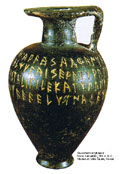 More
mirrors: Translation of Miscellaneous Short
Inscriptions.d.html, Scripts AC, BR , AV,
SC ; and
Mirrors: BM, DJ, DG, DD, DC, DB,
DA, DE, DF, DK, DN Script AC is
written around an aryballos. We need an
image detailing the other side of the
aryballos to complete a translation. It
refers to the mistress Turan (Aphrodite,
Venus). Script BR is a bowl / plate found in Rome with other
shards at the base of the Capitol. It
carries two interesting words that relate to
other declensions involving the suffix "ii,"
as in RASIIA, ANIIA and Tarquii.
More
mirrors: Translation of Miscellaneous Short
Inscriptions.d.html, Scripts AC, BR , AV,
SC ; and
Mirrors: BM, DJ, DG, DD, DC, DB,
DA, DE, DF, DK, DN Script AC is
written around an aryballos. We need an
image detailing the other side of the
aryballos to complete a translation. It
refers to the mistress Turan (Aphrodite,
Venus). Script BR is a bowl / plate found in Rome with other
shards at the base of the Capitol. It
carries two interesting words that relate to
other declensions involving the suffix "ii,"
as in RASIIA, ANIIA and Tarquii.
Script SC is a small shard from Cetamura and
indicative of the importance of a small
piece of pottery carrying text, for the text
is LAVS INI...The word, LAVS (L. laus,
laudis, praise) is used in Script TC, Tabula_Cortonensis.html,
TC-211 is in the following context: LAVS
ISA. The Cortonensis text appears to
controvert the translation of the Cetamura
shard by Dr. Nancy Thomson de Grummond,
Florida State University, who stated that
the shard contains the name of the owner:
"Lausini." (Updated 5.30.09)
More mirrors
are at Miscellaneous Short
Inscriptions.d.html: BM, DD, DC, DB, DA,
DE, DF, DG, DH, DK, DN, DO Script DF carries another complex story,
combining that of Orestes with Jason, the
leader of the Argonauts who sought the
Golden Fleece. Both stories involve the
revenge of the son of the father's murder.
Orestes took revenge upon Clytemnestra, his
mother, and her lover, over their murder of
Agamemnon. Jason, son of Aeson, took revenge
upon Pelias who had murdered his
half-brother, Aeson, for the throne of
Iolcus.
More
mirrors:
Translation of Miscellaneous
Short Inscriptions.k.html, Here
there are more mirrors from the
Speculorum Etruscum:
CBA, CBB, CBC, CBE, CBD,
CBG, CBH, CBI, CBJ, CBK, CBL, CBM,
CBN, CBO, CBP, CBR, CBS, CBT, CBU,
CBV, CBW, CBX, CBZ, CCA, CCC
Translation
of Miscellaneous
Short Inscriptions.c,html
Scripts GA, MR, MM, OU, VG,
VA, CH, MG, MH, PF, LM, DP,
DQ, DR, DS, PF Script GA
is from the necropolis of
Gouraya near Algiers, Algeria.
Script MR is a mirror containing
what appears to be the Nereid
Thetis, the goddess of wisdom,
Minerva, the goddess of discord,
Eris, and Heracles.
Translation
of Vases and Sarcophagi
- Miscellaneous Short
Inscriptions.b.html Scripts MA, RA, VP,
BT, LP, TB, FR, BB, BC, BD, BE, VC, OM, ON
[~180
words, "LP" largely unreadable; ON added
10.20.10] An
interesting script is BT, which has nail
holes on its right hand side, indicating it
was posted against a wall, like the Pyrgi
gold tablets, as opposed to the Tavola
Cortonensis, a bronze plate designed to be
hung by a lanyard. Script LP, "Laris
Pulena," is a long inscription that I have
tentatively translated. The image I have is
hard to read and when I get a better copy I
will be able to finish this translation.
Most of the words in the text are common to
the Etruscan vocabulary. The urn is in the
Museo Archeologico, Tarquinia. The text
refers to the "divine Tarquins." The
recently added text involving Dionysian
rites, ON, recalls Old Latin. Of particular
interest is ON-5, TVODEITXES (L.
duodecie(n)s?). The "O" and "D" are rare in
Etruscan.
Script VP is interesting, located in the
Museo Archeologico, Tarquinia. It dates from
circa. 480 B.C. - 320 B.C. and is of "Alisa,
of the clan Rameras, the new Cocle." Horatius
Cocles, is the Roman who defended the bridge
over the Tiber against Porsenna, after the
Romans expelled Tarquin the Proud in 510
B.C. Tarquin the Proud, also called Lucius
Tarquinius Superbus or Tarquin II, was the
7th and last king of Rome. He ruled for 24
years, from 535-510 B.C. The deposed
monarch, whose family was of Etruscan
origin, appealed to the Etruscan king, Lars
Porsena, of Clusium (now Chiusi), for
assistance in suppressing the new Roman
Republic, and Lars Porsena agreed to help.
More
mirrors:
Translation of Miscellaneous Short
Inscriptions.f.html, Scripts from
the multivolume work, "Corpus Speculorum
Etruscorum," CAA, CB, CC, CD, CF, CG,
CH, CI, CJ, CL, CM, CN, CO, CP, CQ, CR,
CS, CT, CU, CV, CX, CY, CZ, CAB, CAC, CCH. These include mirrors in
museums and private collections
published under the auspices of the
International Scientific Committe for
the Corpus of 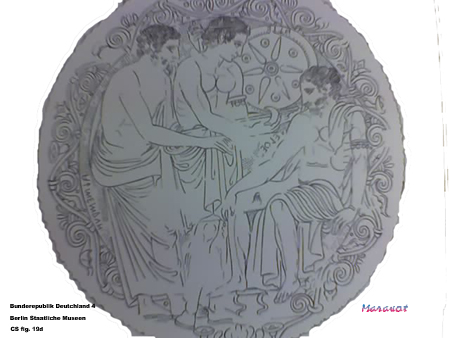 Etruscan
Mirrors. The mirrors are important since
they carry an illustration of an event
and the characters associated with the
event, including the Etruscan name of
the character. The name and words help
to reconcile declension and conjugaation
patterns of the texts on the "Etruscan
Phrases" site. We reviewed all of the
"Corpus Speculorum Etruscorum" volumes
and found only these mirrors that
contained text that could be verified. A
few mirrors were in such bad condition,
though the "Corpus" editor(s) produced a
transcription, I could not verify the
results from the image(s) supplied in
the "Corpus" and thus chose not to
include them here.
Etruscan
Mirrors. The mirrors are important since
they carry an illustration of an event
and the characters associated with the
event, including the Etruscan name of
the character. The name and words help
to reconcile declension and conjugaation
patterns of the texts on the "Etruscan
Phrases" site. We reviewed all of the
"Corpus Speculorum Etruscorum" volumes
and found only these mirrors that
contained text that could be verified. A
few mirrors were in such bad condition,
though the "Corpus" editor(s) produced a
transcription, I could not verify the
results from the image(s) supplied in
the "Corpus" and thus chose not to
include them here.
The
images produced on this site from the
volumes focus on the text of the mirror,
which explains why the reader will often
see only a portion of the mirror. We
will, of course, supply better images
when we get them. The mirrors may be
objects of art to art history buffs, but
to the Etruscans they were essential to
their daily grooming and were obviously
in high demand, with over 3,000 mirrors
extant. They were found with grave goods
intended to accompany the departed in
his / her quest for eternal life,
through the Underworld. Erebus (Etr.
Arepes?) and the throne of King Hades
(Etr. Atai) and Queen Persephone (Etr.
Phersipnei). The stories on the mirrors
were derived essentially from Greek
myths, but from the spelling of the
names, such as APVLV (Apollo) we note
that the mirrors were intended for those
who could read the Etruscan language. Of
interest with regard to this point is
the fact that the mirrors were found
throughout the western Mediterranean,
from Central France to the upper reaches
of the Black Sea.
The
Etruscans were known for their
seamanship and in the myth of Dionysus,
the god of wine, we are told that he was
kidnapped by Tyrrhenian pirates
(Etruscans), and during the episode he
cast a spell on the ship, causing it to
be invaded by wild animals, including
lions, panthers and tigers. This
frightened the pirates such that they
jumped overboard, leaving Dionysus alone
on the ship. Dionysus continued his
journey through Egypt to spread his cult
of wine around the world. It would be
informative to find a mirror that told
the Etruscan version of the pirate
story. We do have their version of the
story of Dionysus' first disciple,
Icarius, which is on the Schøyen Mirror, MS 565/2.
 exciting of the Etruscan Phrases translations.
Most of the words in the text are repeated in
other Etruscan Phrases texts, and thus, using
Table 1 Vocabulary, this text was relatively easy
to understand. The words / locaters of the liver
have been added to the glossary. The liver is read
from left to right. The right-hand side leads up
through the "eternal gods" through the "arch of
god" and to the "Net of Propitiation" which begins
with "The Law of the Sheep-fold" and salvation /
healing. Links to the correlating words and texts
are provided in Script PL (5.11.06)
exciting of the Etruscan Phrases translations.
Most of the words in the text are repeated in
other Etruscan Phrases texts, and thus, using
Table 1 Vocabulary, this text was relatively easy
to understand. The words / locaters of the liver
have been added to the glossary. The liver is read
from left to right. The right-hand side leads up
through the "eternal gods" through the "arch of
god" and to the "Net of Propitiation" which begins
with "The Law of the Sheep-fold" and salvation /
healing. Links to the correlating words and texts
are provided in Script PL (5.11.06) The Banquet scenes and
Script HT, a tile
identifying the precinct of Hermes, are shedding
considerable light on the Etrusan beliefs. In
Script For instance, Hermes plays an important
role in the burial chambers, where he is the
escort of the departed soul to the abode of the
afterlife (gods). This makes sense since Hermes
is identified as the messenger of the gods. If
he brings messages from the gods or takes
messages to the gods, it follows that he would
be the one who carries the departed soul to the
gods. A curious word, AL, ends the phrase of
Script NT, but it is common to many scripts. I
thought it was similar to Italian, al, "to the,"
but always recognized that Etruscan, as is true
with Latin, does not use the article, "the," so
"al" had to represent something else. It turns
out, if my interpretation of Script NT is
correct, "al" is Latin "alius," another and the
word preceeding AL in Script NT is FETVS (Lat.
"fetus-us," the bringing forth or hatching of
young). Hermes is involved in the bringing forth
of another birth, and we can see that the
Etruscan view of life after death was very
similar to the Egyptian and Judaic concepts, of
being reborn.
The Banquet scenes and
Script HT, a tile
identifying the precinct of Hermes, are shedding
considerable light on the Etrusan beliefs. In
Script For instance, Hermes plays an important
role in the burial chambers, where he is the
escort of the departed soul to the abode of the
afterlife (gods). This makes sense since Hermes
is identified as the messenger of the gods. If
he brings messages from the gods or takes
messages to the gods, it follows that he would
be the one who carries the departed soul to the
gods. A curious word, AL, ends the phrase of
Script NT, but it is common to many scripts. I
thought it was similar to Italian, al, "to the,"
but always recognized that Etruscan, as is true
with Latin, does not use the article, "the," so
"al" had to represent something else. It turns
out, if my interpretation of Script NT is
correct, "al" is Latin "alius," another and the
word preceeding AL in Script NT is FETVS (Lat.
"fetus-us," the bringing forth or hatching of
young). Hermes is involved in the bringing forth
of another birth, and we can see that the
Etruscan view of life after death was very
similar to the Egyptian and Judaic concepts, of
being reborn.Scripts BS-1 and BS-6 – In Banquet BS-1 there is an offering of an egg, and on the mirror where the goddess Uni is suckling Heracles a child-like angelic being (Epe?) is offering an egg. In this scene a person who appears to be the departed matron of the family is offering an egg to the man. The same man appears to be in Script BS-1, in the same tomb, and there he is offering a bowl (containing a mead-like drink?) to a younger woman, who appears to be his wife. These banquet scenes fall in the category of "Illustrated Etruscan literature" where the script should reflect the illustration. Script BS-6 contains the name of a family name, Chaneri (KANERI) who are mentioned in an earlier sarcophagus (Script VP) from Tarquinia, of the 4th- 5th century B.C. The Banquet scenes, Scripts BS, are in the "Tomb of the Shields," Tarquinia and dated the 3rd century B.C. The "Velthur Partunus" Script VP is about "Alisa of the clan Rameras and she is "to us of the Chaneri royalty.
Other, important scripts reflecting a coincidence between a scene and its script is the "Rape of Hecuba," reviewed above (1.31.06) the Volterra Mirror (2.01.06) and Script V: "Alcestis and Admetus."
 Translation: Chiusi
Fibula, Script VF, [~6 words] Villanovan,
7th Century B.C., Louvre Museum. This fibula is
interesting since it clarifies words in
Indo-European Table 1 and the Etruscan Glossary and Grammar.
It is a gold clasp / brooch with an inscription,
"my gold brooch of praise, Nasia Maximas / Nasia
the greatest." The word for gold, "ara" is
confirmed by this brooch as well as the word for
praise. (9.14.06)
Translation: Chiusi
Fibula, Script VF, [~6 words] Villanovan,
7th Century B.C., Louvre Museum. This fibula is
interesting since it clarifies words in
Indo-European Table 1 and the Etruscan Glossary and Grammar.
It is a gold clasp / brooch with an inscription,
"my gold brooch of praise, Nasia Maximas / Nasia
the greatest." The word for gold, "ara" is
confirmed by this brooch as well as the word for
praise. (9.14.06) Translation
of the Chimera_Script,
Script CA [ 3 words] (7.17.04)
Translation
of the Chimera_Script,
Script CA [ 3 words] (7.17.04)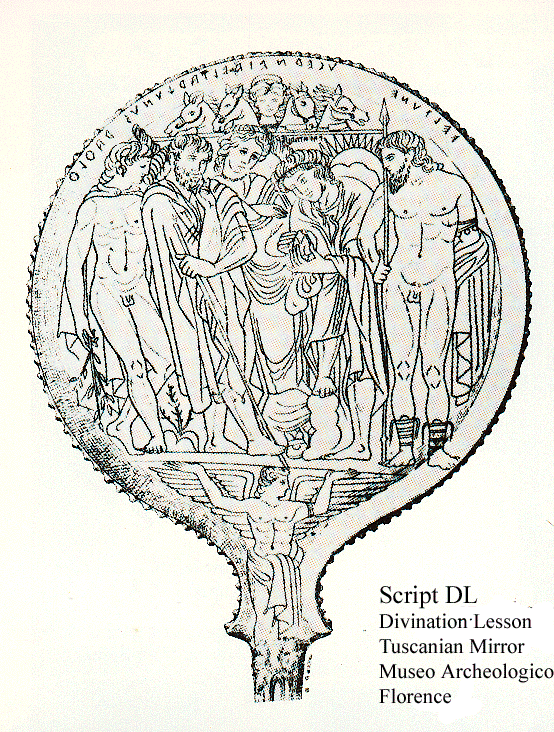 There are two other scripts that refer
to the Tarquins. Script A identifies the tomb of
Tanaqil, the wife of Tarquin the Great
(Lucius Tarquinius Priscus), 5th king of Rome. She
and her husband, Tarquin the Great, are depicted
on a mirror, Script DL, "Mirror from
Tuscania" where an augur reads a sheep's
liver in the presence of Tarquin, Tanaqil and the
god Veltune. He says, "Fear Tarquins" (Pave
Tarquii). Tanaqil was a highborn and ambitious
Etruscan woman who urged her husband to move from
Tarquinia to Rome in order to advance his
fortunes. Her training in the Etruscan art of
augury often aided her husband in his affairs. At
his death her strong-mindedness and quick thinking
assured the throne to their son-in-law, Servius
Tullius, in accordance with her husband's wishes.
The Volterra mirror, Script AH,
[~11
words] "Uni Suckling
Hercules.html" containing heroes and a script
common to the Divine_Mirror.html. (Updated
9.26.06). The Volterra mirror is another script
falling into the category, "I
There are two other scripts that refer
to the Tarquins. Script A identifies the tomb of
Tanaqil, the wife of Tarquin the Great
(Lucius Tarquinius Priscus), 5th king of Rome. She
and her husband, Tarquin the Great, are depicted
on a mirror, Script DL, "Mirror from
Tuscania" where an augur reads a sheep's
liver in the presence of Tarquin, Tanaqil and the
god Veltune. He says, "Fear Tarquins" (Pave
Tarquii). Tanaqil was a highborn and ambitious
Etruscan woman who urged her husband to move from
Tarquinia to Rome in order to advance his
fortunes. Her training in the Etruscan art of
augury often aided her husband in his affairs. At
his death her strong-mindedness and quick thinking
assured the throne to their son-in-law, Servius
Tullius, in accordance with her husband's wishes.
The Volterra mirror, Script AH,
[~11
words] "Uni Suckling
Hercules.html" containing heroes and a script
common to the Divine_Mirror.html. (Updated
9.26.06). The Volterra mirror is another script
falling into the category, "I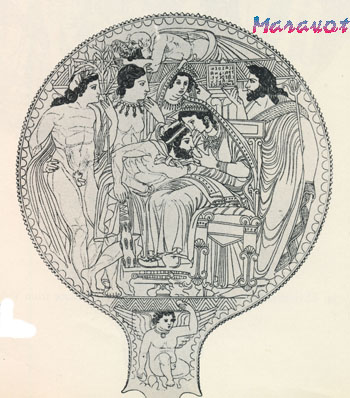 llustrated
Etruscan literature," and thus we can expect the
text to coincide with the illustration. The
genitive case of Uni, VNIA, is used in this
script, as well as Au-13. The page also contains a
mirror of Dionysus, Semele & Apollo, Script SF.
llustrated
Etruscan literature," and thus we can expect the
text to coincide with the illustration. The
genitive case of Uni, VNIA, is used in this
script, as well as Au-13. The page also contains a
mirror of Dionysus, Semele & Apollo, Script SF. Translation:
Schøyen Mirror, "Ikarius,"
Script MS, 6th Century
B.C. [~26 words]
This mirror is interesting
since it contains many words in Indo-European Table
1 and the Etruscan Glossary & Grammar.
It contains the word 8RATER, brother, that
corresponds to Latin frater-tris, with several
declensions, in the Tavola Eugubine, Scripts N, R
and G. The text can be seen to relate to the story
written on the mirror. This is, thus, the first of
the Etruscan "literature," that can be
demonstrated. The story depicted on the mirror is
of Icarius, the first disciple of Dionysus, the
god of wine. The story of Icarius is unusual since
it involves his faithful dog Maera who sets off
with him in a chariot to spread the word of wine
cultivation to the world. The first encounter they
had was with shepherds who got drunk from the wine
and thought Icarius had possessed them. They
killed the disciple of wine and left his faithful
dog wailing beside Icarius. Icarius' daughter came
out looking for her missing father and the wailing
dog led her to his burial place. She was so
bereaved over his death she hung herself in the
tree beside her father's burial. Then the dog
jumped into a nearby well. The Athenians
afterwards created a festival in honor of the
event, where young virgin girls would swing in
trees during the harvest of grapes. While the
character in the mirror could suggest Dionysus
himself, the image of the dog prancing alongside
the chariot established that the story was of
Icarius. The first word of the text is IKRA.The
story of Helen of Troy on an Etruscan Mirror, Divine_Mirror.html,
Scripts
DM and OB [~19 words/names] This mirror is one of the most
interesting and informative Etruscan texts. It has
the names of the characters in the story of Helen
of Troy and is an excellent illustration of the
Etruscan ability to tell an entire story through
graphic images. The story is told from the
Etruscan point of view, with a Lydian bias, as it
were. It is important because it defines the gods
used in the mirror in the context of the story of
the Iliad. We can see that
Translation:
Schøyen Mirror, "Ikarius,"
Script MS, 6th Century
B.C. [~26 words]
This mirror is interesting
since it contains many words in Indo-European Table
1 and the Etruscan Glossary & Grammar.
It contains the word 8RATER, brother, that
corresponds to Latin frater-tris, with several
declensions, in the Tavola Eugubine, Scripts N, R
and G. The text can be seen to relate to the story
written on the mirror. This is, thus, the first of
the Etruscan "literature," that can be
demonstrated. The story depicted on the mirror is
of Icarius, the first disciple of Dionysus, the
god of wine. The story of Icarius is unusual since
it involves his faithful dog Maera who sets off
with him in a chariot to spread the word of wine
cultivation to the world. The first encounter they
had was with shepherds who got drunk from the wine
and thought Icarius had possessed them. They
killed the disciple of wine and left his faithful
dog wailing beside Icarius. Icarius' daughter came
out looking for her missing father and the wailing
dog led her to his burial place. She was so
bereaved over his death she hung herself in the
tree beside her father's burial. Then the dog
jumped into a nearby well. The Athenians
afterwards created a festival in honor of the
event, where young virgin girls would swing in
trees during the harvest of grapes. While the
character in the mirror could suggest Dionysus
himself, the image of the dog prancing alongside
the chariot established that the story was of
Icarius. The first word of the text is IKRA.The
story of Helen of Troy on an Etruscan Mirror, Divine_Mirror.html,
Scripts
DM and OB [~19 words/names] This mirror is one of the most
interesting and informative Etruscan texts. It has
the names of the characters in the story of Helen
of Troy and is an excellent illustration of the
Etruscan ability to tell an entire story through
graphic images. The story is told from the
Etruscan point of view, with a Lydian bias, as it
were. It is important because it defines the gods
used in the mirror in the context of the story of
the Iliad. We can see that 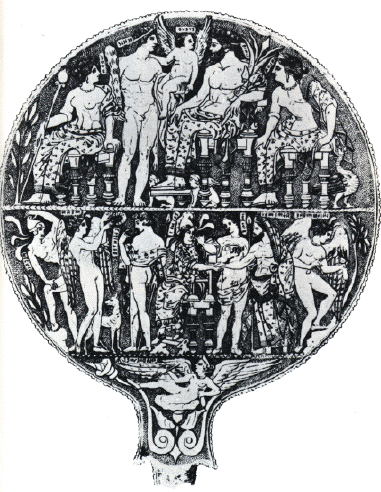 the consort of Tinia (Zeus) is
Ralna (Nemesis). There are two interesting
characters that are strictly "Lydian" : MEAN and
LASA THIMRAE. MEAN is the Roman Diana, Greek
Artemis, virgin goddess of the hunt and sister of
Apollo. She can be contrasted to the Asian,
Ephesian Artemis, who appears to be a mother
goddess, not a virgin. LASA THIMRAE appears to be
the Lydian goddess Thimrae, possibly the
prophetess Cassandra, daughter of Priam. The
Trojans worshipped at the temple of Apollo
Thymbrae. The temple name is after the river
Thymbra which empties into the Scamander river.
Cassandra got her prophetic powers when sleeping
in the temple.
the consort of Tinia (Zeus) is
Ralna (Nemesis). There are two interesting
characters that are strictly "Lydian" : MEAN and
LASA THIMRAE. MEAN is the Roman Diana, Greek
Artemis, virgin goddess of the hunt and sister of
Apollo. She can be contrasted to the Asian,
Ephesian Artemis, who appears to be a mother
goddess, not a virgin. LASA THIMRAE appears to be
the Lydian goddess Thimrae, possibly the
prophetess Cassandra, daughter of Priam. The
Trojans worshipped at the temple of Apollo
Thymbrae. The temple name is after the river
Thymbra which empties into the Scamander river.
Cassandra got her prophetic powers when sleeping
in the temple.The Divine_Mirror tells the story
of the bargain Agamemnon made with Helen for her
hand in marriage to his brother Menelaus, the
abudction of Helen by Alexander (Paris) prince
of Troy. In the Judgment of Paris, Alexander was
asked to judge between Hera, Athena and
Aphrodite, as to which was the fairest.
Alexander chose Aphrodite (Etr. TVRAN). The son
of King Priam of Troy, Aescus (Etr. Aecai)
prophesied that Alexander would be the cause of
the destruction of Troy. Cassandra also
prophesied of its destruction, but when she
received her gift of prophecy she was told that
no one would believe her. The goddess Artemis,
virgin of the hunt and sister of Apollo, was
also involved with the prophecy, since Agamemnon
had bragged that he could shoot as well as
Artemis. An anomaly exists in this mirror,
however, since the name MEAN appears above the
head of the character known as Artemis. The name
Artemis appears in many other Etruscan mirrors,
causing one to wonder why that character was
given the name MEAN in the "Divine Mirror." If
the prophet Calchas is to believed, Artemis was
so enraged over the idle boast she demanded the
sacrifice of Agamemnon's daughter, Iphigenia.
When the sacrafice was about to be made, Artemis
switched the girl for a deer and sent her off to
become a high priestess of the Taurians. In the
mirror MEAN is accompanied by a deer and is
crowning Alexander, while Agememnon shakes hands
with Helen, to the alarm of Aescus (Etr. Aecai)
while LASA THIMRAE, who carries a wand and an
unguent bottle, departs the room. The unguent
bottle is seen in many Etruscan tomb murals.
MEAN appears in other mirrors, seated before
Manerva, Aphrodite and Heracles (Script CBZ),
between Heracles and the prostitute Larentia
(Script CZ) and seated before Adonis and a
Bacchante who is shouting "euan.")
In the top panel of the mirror are four figures
of interest: TVRAN (Aphrodite) HERCLE (Heracles)
EPEVR (Epior?) TINIA (Etr. Zeus) and RALNA
(Nemesis?). Of the characters shown in the
mirror, Heracles is the most perplexing, who
holds a cherub, EPEVR, in his hand. Heracles had
no involvement in the Trojan War, to our
recollection. EPEVR or EPE VR appears to be the
son, Eros, of TVRAN (Aphrodite). Some accounts
say that Aphrodite caused her cherub-like son to
shoot his arrows of love at Helen, causing her
to fall in love with Alexander. The presentation
of EPEVR appears to suggest that Heracles is the
father of Eros by Aphrodite, an anamoly.
Aphrodite was also involved in the conception of
Helen, since she pursued Zeus, causing him to
change into a swan in his chase of Nemesis, who
had changed into a goose. Zeus caught Nemesis
who laid an egg containing the most beautiful
girl in the world, Helen. The egg was given to
Leta, the wife of KingTyndareus of Sparta, who
raised the child as her own. Aphrodite had other
lovers, such as Anchises, and gave birth to a
son by him whose name is Aeneas.
The suffix "ia" in Tinia, and "ai" in the name
of Helen, Elenai, led to the identification of
the suffixes as determinants for proper names
(genitive case?), as in the case of Atai
(Hades), Acai (Aesacus) and Phersipnei
(Persephone), the latter seen in the judgment
scene of the tomb of Orcus. Helen's name
is spelled in another declension as ELENEI on
mirror MM-1. Also on this page is
a mirror, Script OB, from Tarquinia in the
possession of Oberlin College that is of the
Judgment of Paris, containing the names, MINRFA
(Minerva), Uni, Turan and a variant spelling of
Alexandar; i.e, on DM-6, ELCHINTRE and OB-4,
ELACHSNTRE. (12.08.07)

Translation of the two
Lemnos stele, Script S [~60 words] (6.13.06) This
script is being reworked and seems quite poetic,
repeating the word eternal (L. aevus-i; Etr.
AFIS).
 Translation of the Tavola
Cortonensis, Script TC, [~284 words] the latest find of an Etruscan
script. This is a letter of demand which appears
to relate to passage money and is addresssed to
a commander of the Etruscans. Rasna, the name of
the Etruscans, is mentioned twice in the text.
The sender appears to be of the Latins. The text
is amazingly consistent with the body of the
other Etruscan texts and from it I have acquired
more vocabulary. It seems to involve a conflict
over passage through a domain that also has a
complaint regarding daughters-in-law (nuora),
thus suggesting a family alliance that has been
broken. A short introductory text is on one side
and on the reverse one finds the rest of the
message. Shades of French and Italian are strong
in this text. I am revisiting the text for the
fourth time, reconciling it to the other
scripts. (11.21.05).
Translation of the Tavola
Cortonensis, Script TC, [~284 words] the latest find of an Etruscan
script. This is a letter of demand which appears
to relate to passage money and is addresssed to
a commander of the Etruscans. Rasna, the name of
the Etruscans, is mentioned twice in the text.
The sender appears to be of the Latins. The text
is amazingly consistent with the body of the
other Etruscan texts and from it I have acquired
more vocabulary. It seems to involve a conflict
over passage through a domain that also has a
complaint regarding daughters-in-law (nuora),
thus suggesting a family alliance that has been
broken. A short introductory text is on one side
and on the reverse one finds the rest of the
message. Shades of French and Italian are strong
in this text. I am revisiting the text for the
fourth time, reconciling it to the other
scripts. (11.21.05).
 Translation of the Novilara Tablet, Script L .
[~76
words] It was found
near Pesaro and dates around the 5th to 4th
century B. C. This script uses characters common
to the Osco-Umbrian scripts. (9.10.06).
Translation of the Novilara Tablet, Script L .
[~76
words] It was found
near Pesaro and dates around the 5th to 4th
century B. C. This script uses characters common
to the Osco-Umbrian scripts. (9.10.06).
Translation
of the Siculian Tablet, Script F.
[~ 29
words] It is a
short letter from a grandson, Brutus, to his
grandfather dating around the 5th century B.C (9.11.06)
 Translation
of theMagliano Lead Disk, Script M.
[~87
words] Probably
the oldest of the texts dating from circa. 600
B.C. It is written in a spiral (labyrinth) much
like the Phaestos Disk. It uses the TH more
extensively than other scripts. This script,
like the Tavola Cortonensis, is a military
document, and it too invokes Dione, Minerva and
Tinia in the defense of its oration.(Updated 6.16.06). This script has been updated in
correspondence with our Etruscan Glossary.
Translation
of theMagliano Lead Disk, Script M.
[~87
words] Probably
the oldest of the texts dating from circa. 600
B.C. It is written in a spiral (labyrinth) much
like the Phaestos Disk. It uses the TH more
extensively than other scripts. This script,
like the Tavola Cortonensis, is a military
document, and it too invokes Dione, Minerva and
Tinia in the defense of its oration.(Updated 6.16.06). This script has been updated in
correspondence with our Etruscan Glossary.
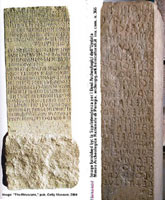 Translation of the Perugia Cippus, Script K.
[~195
words] It contains a list of
queens and refers to their power and
relationships. Much of the script seems to be a
record of a Queen Sarina. Her bust is in the
Louvre Museum. She was an extraordinarily
beautiful woman, as can be seen from the bronze
bust. The bronze has her name inscribed on its
forehead. I have updated the translation
reflecting findings from the other scripts and
reviewing a better copy of the script supplied
by the Perugia Museum. We can confirm the word,
RINA, queen, used throughout this text with a
name, like SARINA, through the bronze bust in
the Louvre. The text is unusual since it lists
queens and no king is mentioned.
Translation of the Perugia Cippus, Script K.
[~195
words] It contains a list of
queens and refers to their power and
relationships. Much of the script seems to be a
record of a Queen Sarina. Her bust is in the
Louvre Museum. She was an extraordinarily
beautiful woman, as can be seen from the bronze
bust. The bronze has her name inscribed on its
forehead. I have updated the translation
reflecting findings from the other scripts and
reviewing a better copy of the script supplied
by the Perugia Museum. We can confirm the word,
RINA, queen, used throughout this text with a
name, like SARINA, through the bronze bust in
the Louvre. The text is unusual since it lists
queens and no king is mentioned.
The cippus
is proving to be a history
and most interestingly seems to have identified
a Queen Hinera of the Valley of Fiesole (ancient
Florence) – see K65, K66 – whose name also
appears in the Zagreb Mummy's wrappings closest
to the mummy's body. This has to be verified,
but it may be that between the two documents
there is a disclosure of not only the Queen of
the Etruscan city Fiesole but also the name of
the person of the Zagreb Mummy, who died in
Egypt, Hinera, the queen of Fiesole (Florence)?
This is, thus, becoming an Etruscan history, not
from others, such as the Romans and Greeks, but
from the Etruscans themselves. K65 is the
beginning of a new section of the text,
suggesting that the previous section deals with
a dynasty of the Clensi, featuring Queen Sarina
(K45-K52). The Clensi are mentioned in the text
on the bronze statue of Prince Metelis.
So far, we have three documents being linked
together in the Perugia Cippus.
Of interest are words on the lateral side of the
cippus that seem to be more related to the
Italian language: K188 — RONCHVLeR (RVNKVLeR), to swallow up (It.
ringolare —
ringhiottire) or to recoil, fall back,
withdraw (It. rinculare; reculer; L.
recello-ere) and K194
—
CECHASI (CEKASI), (It.
checchessia, anything, everything,
chicchessia, anyone, anybody; Fr.
quelquechose). This is the more challenging
part of the text which seems to conclude: "and
indeed the gods there to swallow up, fall
back, I bind; as far as anything you inhabit."
On the front of the monument may be the name
of Perugia (Perusia) which begins with a
phrase: LERI TEVeNS (TE8eNS) TEIS, the lords divine (L.
dius-a-um; adj. divinus) of the gods RASNE SIPA AMA HENNA PER the Etruscans
(Rasne) she encloses (L. saepio, saepire,
saeps, saeptum) she loves Henna (L. Henna
[Enna], f. city of Sicily with a temple of
Ceres); through, by (L. per) XII FEL RINA RVRAS ARAS, twelve of the great
(Fel) queen (L. regina-ae, f.; It. f. regina;
Fr. reine, f.) (PE)RASCEM VLiM,
at Perusia (Perugia, Perusia, Tuscan town;
"em" suffix, accusative) at times, for a long
time now, often (L. olim). The
cippus may be the most important Etruscan text
found to date. (Updated 12.25.06).
 Partial
translation of the Capua
Tile, Script CP [~126 words that can be read
– script largely unreadable] This
script is so badly damaged only a portion of
it can be made out at the moment. I need a
better copy of the tile! It contains the name
of the goddess Aph, a partial genealogy of the
Etruscan gods which appear to have been born
out of Aph, including the god Tini and an
interesting reference to HIPA RIV, the "river
horse" which may relate to the Egyptian
goddess of fertility which had the body of a
hippopotamus with human breasts and features
of other animals. Places and boundaries,
providing somewhat of a geography lesson from
Etruscan times, are mentioned, including
rivers relating to the people of Pisa and the
Oscans. This is so far the most interesting of
the Etruscan scripts. (10.06.01).
Partial
translation of the Capua
Tile, Script CP [~126 words that can be read
– script largely unreadable] This
script is so badly damaged only a portion of
it can be made out at the moment. I need a
better copy of the tile! It contains the name
of the goddess Aph, a partial genealogy of the
Etruscan gods which appear to have been born
out of Aph, including the god Tini and an
interesting reference to HIPA RIV, the "river
horse" which may relate to the Egyptian
goddess of fertility which had the body of a
hippopotamus with human breasts and features
of other animals. Places and boundaries,
providing somewhat of a geography lesson from
Etruscan times, are mentioned, including
rivers relating to the people of Pisa and the
Oscans. This is so far the most interesting of
the Etruscan scripts. (10.06.01).
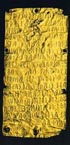 Translation of sheet
1 of the Pyrgi Gold Tablets, Script Au. [~72 words]
These gold tablets were found in the sanctuary
of Pyrgi, dating circa. 5th century B.C. This is
an oration during the Festival of Hera with
regard to a controversy (polemic) involving the
goddess Aph. The Etruscan tablets are a
dedication to Uni, the Roman Juno, and affirms
her seat as the main sigoddess of the site. She
is addressed in the two tablets both as Uni, the
Etruscan Juno, whose name may also be in the
text as IVNO. Juno is the moth and fertility
goddess of the Romans and the occasion of the
dedication is on the feast called Heraea (L.
Heraea-orum). The oration calls Uni and Janus,
the god of wisdom, to the rock together before
the Italian magistrates' seats to resolve a
controversy (polemic). The beginning of the
oration acknowledges the goddess Thia, (L.
Dia-ae), mother of Mercury (Gr. Hermes) "to you
Maia" and the god Janus. Maia was the oldest
daughter of Atlas and the Oceanid Pleione. One
of the Pleaides, Maia was shy and lived quietly
in a cave on Mount Cyllene, in Arcadia. Zeus
seduced her, from which a son, Hermes, was born.
Hermes was a precocious child and while still in
swaddling clothes stole the cattle of Apollo,
hiding them in his mother's cave. Hermes (Roman
Mercury) seems to have played a very strong role
in the Etruscan religion, and a dedication of
his feast days can be read at Script HT. Mercury seems
to have had a large presence in Celtic religion
as well.
Translation of sheet
1 of the Pyrgi Gold Tablets, Script Au. [~72 words]
These gold tablets were found in the sanctuary
of Pyrgi, dating circa. 5th century B.C. This is
an oration during the Festival of Hera with
regard to a controversy (polemic) involving the
goddess Aph. The Etruscan tablets are a
dedication to Uni, the Roman Juno, and affirms
her seat as the main sigoddess of the site. She
is addressed in the two tablets both as Uni, the
Etruscan Juno, whose name may also be in the
text as IVNO. Juno is the moth and fertility
goddess of the Romans and the occasion of the
dedication is on the feast called Heraea (L.
Heraea-orum). The oration calls Uni and Janus,
the god of wisdom, to the rock together before
the Italian magistrates' seats to resolve a
controversy (polemic). The beginning of the
oration acknowledges the goddess Thia, (L.
Dia-ae), mother of Mercury (Gr. Hermes) "to you
Maia" and the god Janus. Maia was the oldest
daughter of Atlas and the Oceanid Pleione. One
of the Pleaides, Maia was shy and lived quietly
in a cave on Mount Cyllene, in Arcadia. Zeus
seduced her, from which a son, Hermes, was born.
Hermes was a precocious child and while still in
swaddling clothes stole the cattle of Apollo,
hiding them in his mother's cave. Hermes (Roman
Mercury) seems to have played a very strong role
in the Etruscan religion, and a dedication of
his feast days can be read at Script HT. Mercury seems
to have had a large presence in Celtic religion
as well.
The Pyrgi Gold Tablets are curious from the standpoint that they are a dedication of the Festival of Hera (Heraea). The festival – games for young virgin women – in ancient times preceded the Olympic Games held for males. Both games were associated with lunar calendar dating systems, often varying among the Greek City States. The date of the games served to regulate the calendars, and sometimes the Olympiad and the Heraea conflicted in their timing, so the dates of the festivals were reset to avoid the conflict. The conflict and dates of the festivals is described by http://phoenixandturtle.net/excerptmill/harrison.htm:
We have seen that the Olympic festival was a moveable feast, and occurred alternately in Apollonios and Parthenios, which were probably the second and third months of the Elean year. This variation of the month is a strange and inconvenient arrangement. Moreover it is unique. The Pythia also were held at intervals of 50 and 49 months, but the incidence of the intercalated months of the octennial period was so arranged that the festival itself always fell in the same month (Bukatios) of the Delphic year. In the same way the Panathenaea, though penteteric, always fell in Hekatombaion. There must have been some very strong reason for the troublesome variation of months in the sole case of the most important of panhellenic gatherings.
Weniger finds the reason in the existence of an older immovable festival at the very season at which the reconstituted Games were to be fixed. Every fourth year a college called the Sixteen Women wove a robe for Hera and held games called the Heraea. The games consisted of a race between virgins, who ran in order of age, the youngest first, and the eldest last. The course was the Olympic stadium, less about one-sixth of its length (i.e. 500 instead of 600 Olympic feet). The winners received crowns of olive and a share of the cow sacrificed to Hera. ÔThey trace the origin of the games of the virgins, like those of the men, to antiquity, saying that Hippodameia, out of gratitude to Hera for her marriage with Pelops, assembled the Sixteen Women, and along with them arranged the Heraean games for the first time.Õ
It is highly probable that these games of virgins (Parthenia) gave its name to the month Parthenios, and were in honour of Hera Parthenos—Hera whose virginity was perpetually renewed after her sacred marriage with Zeus. It is also probable that they were held at the new moon, that is, on the first day of Parthenios. Further, if these games gave the month its name, in that month they must always have fallen. Thus the octennial period of the Heraea is of the usual straightforward type, which keeps always to the same month. The natural inference is that the Heraea were first in the field, and that, when the menÕs games were fixed at the same season, it was necessary to avoid this older fixed festival. At the same time, if the games of Zeus were allowed to be established regularly in the middle of the previous month Apollonios, it was obvious that the Heraea would sink into a mere appendage. Zeus, on the other hand was not inclined to yield permanent precedence to Hera. The deadlock was solved by a characteristic compromise. The octennial period for the Games of Zeus was so arranged that in alternate Olympiads they should fall fourteen days before, and fourteen days after, the Heraea (on Apollonios 14/15 and Parthenios 14/15). By this device of priestly ingenuity the honour of both divinities was satisfied, and so the inconvenient variation of months for the Olympic festival is explained.
The Heraea, then, were probably older than the reconstituted Olympia; and if they gave its name to the month Parthenios, they must have been annual before they were octennial or penteteric. They carry us back to the old lunar year, which preceded the combined sun-and-moon penteteris.
If
the reference to Maia also acknowledges the
calendar date of the Heraea held in Pyrgi, we
are tempted to postulate that the confusing,
mysterious date for the Heraea, at least among
the Etruscans, coincided with the later Roman
month of Maius. Like the old Greek lunar
calendars, the early Roman calendar involved 10
months: Martius, Aprilis, Maius, Iunius,
Quintilis, Sextilis, September, October,
November and December (September, "seventh
month," October, "eighth month," November,
"ninth month," and December, "tenth month." The
calendar was later revised to include ianuarius
and Februarius. In order to keep the calendar
year roughly aligned with the solar year, Numa,
the second king of Rome (715-673 B.C.), added an
"intercalated" month every other year at the end
of February of 22 -27 days, called the
Interclaris, or Mensis Intercalaris, sometimes
also known as Mercedonius or Mercedinus. The
leap month was added from time to time at the
end of February, which was shortened to 23 or 24
days. The resulting year was either 377 or 378
days long.
We know that the Etruscans
used "Roman numerals" in their dating system,
seen in Scripts AN, for instance. Since the
Romans received their alphabet (that which is
used for English) from the Etruscans, we can
rightfully assert that the Roman Numerals should
be called "Etruscan Numerals," setting the
heritage where it belongs. The Roman Calendar
may also owe its origin to the Etruscans, who no
doubt were influenced by the Greek calendars of
10 lunar months. As may be revealed in the Pyrgi
Gold Tablets, the Etruscan calendar may, in
fact, be influenced by the date of the Heraea
Festival, just as the Greek calendar(s) were
influenced by the Heraea and the Olympiad held
every four years. The following, which is
relevant to the date of the Pyrgi Heraea, is
from http://en.wikipedia.org/wiki/Olympiad:
An Olympiad, especially in ancient literature, was a period of four years (Polybius, Histories 9.1.1) counting inclusively (the fifth year during which the games were held was also the first year in the beginning of the new cycle), starting with the games at Olympia. The ancient Olympics, it is believed, originated from Heracles, the eldest of five brothers, who matched them in a race and crowned the winner with an olive branch. The games, in accordance with the number of brothers, were held every fifth year (Pausanias, Description of Greece (Elis 1) 5.7.6-9). By our modern calendar system (Gregorian), the first Olympiad is reckoned to the year 776 BC, which year is arrived at deductively. The first year of the common era (1 CE/AD) is equivalent to the seven-hundred and fifty-fourth year from the founding of Rome (AUC 754) according to the Varronian epoch. The founding of Rome, in turn, is testified as being April 21, in the third year of the sixth Olympiad (OL 6) (Plutarch, Romulus 23-24; Eutropius, History 1.1). So deductively speaking, the first year of the games and the start of the first Olympiad was the summer of 776 BC.
We
may conclude that the Festival of the Heraea
referred to in the Pyrgi tablets has to do with
the first month of the Etruscan year, probably
coinciding with the Elean month Parthenios. That
the mother of Mercury is addressed in the Pyrgi
dedication — both as Dia and Maia —
suggests a coincidence with the old Roman month,
Maius (May). Uni (Juno) and Ianas (Janus) are
addressed in the scripts. The month of June
(after Juno) follows May and January (named
after Janus, the god of ports and doors,
beginnings and endings, became the 11th month,
after which February was added. We may assume
for the moment that the Etruscans at Pyrgi had
only a 10 month calendar, and beginning with
Martius as the first month would celebrate
Juno's feast day, March 1, called the
Matronalia, the primary feast of Juno, the chief
Roman goddess. On this day, lambs and other
cattle were sacrificed to her. Also on this day
the Feriae Marti, the festival of Mars, the
Roman god of war, was held. March 1 is also New
Year's Day in the old Roman calendar.
Maius is the third month of the old Roman
calendar, and on May 1 a cow was sacrificed to
Maia, the mother of Mars (Gr. Ares). May 1 was
also the Celtic feast of Beltane, marking the
first day of Summer. May 15 was the festival of
the Mercuralia, the festival of Mercury, the
Roman god of merchants and travellers. April 9
was the feast of Ishtar, known today as Easter,
and April 18 was when the festival of Maia began
(see http://syrylynrainbowdragon.tripod.com/april.html).
It may be that the Etruscan Heraea was
coincident with the Feast of Ishtar then in the
6th century B.C., somehow relating to the "3rd
month," of Maius (May). Perhaps further
examination of the Pyrgi Gold Tablets will
clarify this. The third sheet is in Punic and
refers to the goddess Ishtar. Updated 9.14.06)
Translation
of
sheet 2 of the Pyrgi Gold Tablets, Script Au,
[~105
words] This page carries the
second page of the Pyrgi script. Also on the
page is a third gold tablet which is in
Phoenician, "Lamina B" script. Images of the
gold sheets are from "The Etruscans." (5)
Its translation by
Sabatino Moscati is:
To [our] Lady Ishtar. This is the holy place // which was made and donated // by TBRY WLNSH [= The faries
Velianas] who reigns on // Caere [or: on the Caerites], during the month of the sacrifice // to the Sun, as a gift
in the temple. He b//uilt an aedicula [?] because Ishtar gave in his hand [or: raised him with her hand] // to
reign for three years in the m//onth of KRR [=Kerer], in the day of the burying // of the divinity. And the years
of the statue of the divinity // in his temple [might be ? are ?] as many years as these stars.
The
Etruscan scripts largely coincide with the
Phoenician. There are some corrections, however.
Velianas is Fel Ianus (the great Janus).
Fel is a term meaning "great" used frequently in
the Etruscan scripts on this site. The name
Caere is read as "heart" in the context of
getting to the heart or kernel of the matter
which concludes acknowledging the polemic
involving the goddess Aph. Updated (9.14.06)
 The
Tavola Eugubine Script N is
being updated based upon better images of the
tablets. [~755
words] A general note on the
Tavola Eugubine should be listed here. The
vocabulary is consistent with the vocabulary
used in the other Etruscan scripts on this
website. To translate an entire
corpus of scripts, using common grammatical
rules and a consistent vocabulary, without a
"Rosetta Stone," is a big challenge in itself.
But one can make a fair translation, knowing
that all languages have rules of grammar and
following the rules there is the liklihood of
repetition. These scripts, together with the
Zagreb Mummy script, fortunately contain a lot
of repitition. And they use the same
grammar/vocabulary; and both are consistent with
other scripts. Where you see an alpha-numeric
locater for a word, which points to several
different Etruscan scripts, know that the same
word works well in the same context in the
translations where it appears. The Tavola is
thus Etruscan. My
vocabulary, built from the various scripts,
defines what Etruscan is. It is old, rich in
inflections, like Latin and Greek. It is like
Latin but recalls shades of Italian and French.
These are the closest languages to which
Etruscan is related. (01.24.07).
The
Tavola Eugubine Script N is
being updated based upon better images of the
tablets. [~755
words] A general note on the
Tavola Eugubine should be listed here. The
vocabulary is consistent with the vocabulary
used in the other Etruscan scripts on this
website. To translate an entire
corpus of scripts, using common grammatical
rules and a consistent vocabulary, without a
"Rosetta Stone," is a big challenge in itself.
But one can make a fair translation, knowing
that all languages have rules of grammar and
following the rules there is the liklihood of
repetition. These scripts, together with the
Zagreb Mummy script, fortunately contain a lot
of repitition. And they use the same
grammar/vocabulary; and both are consistent with
other scripts. Where you see an alpha-numeric
locater for a word, which points to several
different Etruscan scripts, know that the same
word works well in the same context in the
translations where it appears. The Tavola is
thus Etruscan. My
vocabulary, built from the various scripts,
defines what Etruscan is. It is old, rich in
inflections, like Latin and Greek. It is like
Latin but recalls shades of Italian and French.
These are the closest languages to which
Etruscan is related. (01.24.07).
Translation
of the Tavola Eugubine Script Q [~920 words] –
Script "Q" is a funeral oration and like Script
N interchanges repeated formulas which contain
the names of gods who were on the side of Troy
during the Trojan war. We have added copies of
the images, from Citta
di Gubbio to complement / verify our
transcription.
The ephitets towards the
end of the text focus on Eos (the goddess of
dawn; also the dawn) and Apollo who in a more
ancient form was linked to the sun god, Helios.
Escaping the sometimes impish Eros, god of love,
is mentioned; Venus, the goddess of love,
Jupiter and others are placed in the context of
salvation, returning to the day. The repetition
of "blessed" and many synonyms used for death,
wasting away, etc. demonstrate their
preoccupation with it. This text also addresses
the demon Tuchulcha, not by name, but as TRE
8IPER, Tre Viper. He as well as a host of gods
and goddesses are addressed in the context of
being chased away, using a verb (L. abeo) "be
off with you." The formulas recount how the
people in the crowd are brothers of Atigerius
the patriarch of the gens of Cato. Script Q
shows the way the Etruscans expressed themselves
during a funeral liturgy, recalling the
repitition we have all seen in most liturgical
documents. Page is being updated based on
the better images. (02.11.08).
Translation
of the Tavola Eugubine Script R.
[~671
words] This is a blessing of
the people through supplication of the gods. It
is a feast of lights, and it begins with an
address to Oph (L. Ops, goddess of abundance?):
"you pull, bring forth the day." The blessing
refers to a pyre and various images, linking the
light of the pyre and the sprinkling of water in
the names of specific gods and godesses. The
orator calls out/summons Apollo, Phabia, the
goddess of the moon, Lune (Diana), Phobea, etc.
in addressing the castle which is apparently
located in Pisa. The ritual connects an ancient
form of Apollo (Phoebus) with Helios, the sun,
and in the middle of the text the orator
contrasts a goddess of the earth, Eph, with the
moon and the sun. Tavola II para. 2 appears to
be a letter, addressed to the descendents of
Atigerius in Achaia; it also addresses the same
in Gordos, and the port of Pyrae. It complains
about the sacrifice of mares without blemish,
endorsing the sacrifice of lambs. It is a
celebration of light which is illuminated by
Script "G" which repeats some phrases (R164;
R204) in script "R." And these repititions are
connected with the aegis of Jupiter/Zeus which
is the source of lightning. The Etruscans
interpreted lightning bolts. (Being updated,
reflecting the Etruscan Glossary and Grammar, 2.11.08).
Translation
of the Tavola Eugubine Script G.
[~45
words] A short text which is
written by another hand which renders the "T" as
a "Y". The hand that wrote Script "N" and "Q" is
not the same as the one that wrote script "R,"
and "G" is completely different. See comment on
Script "R," for both scripts cover a festival of
"lights" which refers to a three-fold supremacy
or monarchy: that of three planes. Three are
noted: the goddess Eph, who is of the earth;
Jupiter, the sky-god; and Lune, the goddess of
the moon. The pyres appear to be related to the
worship of Eph and also Pha and symbolic of the
light of the sun and the moon; and
Jupiter/Tini/Zeus rule over all through their
shield (aegis) of lightning bolts. The
introductory phrase of this script is a repeat
of a phrase in script R. The script concludes,
"I go before the arbitrator himself." (9.29.06)
Transl ation, Aph.html,
an inscription from Santa Marinella. This text
is on two sides of a lead foil, found in a
temple precinct believed to be dedicated to the
goddess Minerva (Gr. Athena). The text begins
rather with an address to Uni (Juno; Gr. Hera) .
Although there are claims that this is dedicated
to Minerva, her name is not on this image or the
transcriptions seen on the lead foil. The Pyrgi
scripts mention a controversy over the goddess
Aph, which name is mentioned in this script as
well. Ashtar is mentioned on the Punic gold
tablet found with the Etruscan Pyrgi gold
tablets. (12.11.06).
ation, Aph.html,
an inscription from Santa Marinella. This text
is on two sides of a lead foil, found in a
temple precinct believed to be dedicated to the
goddess Minerva (Gr. Athena). The text begins
rather with an address to Uni (Juno; Gr. Hera) .
Although there are claims that this is dedicated
to Minerva, her name is not on this image or the
transcriptions seen on the lead foil. The Pyrgi
scripts mention a controversy over the goddess
Aph, which name is mentioned in this script as
well. Ashtar is mentioned on the Punic gold
tablet found with the Etruscan Pyrgi gold
tablets. (12.11.06).
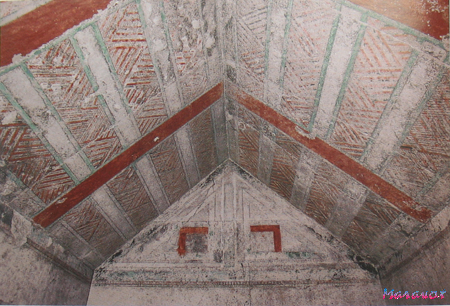 Translation
of Lydian, showing its relationship to the
Etruscan language (new 6.26.06).
Translation
of Lydian, showing its relationship to the
Etruscan language (new 6.26.06).
 Translation of Phrygian,
showing its relationship to the Etruscan
language . Of interest is the discovery of a
stele from Southeastern Turkey, Zincirli, that
appears to record in the Phrygian language the
conquest of that area by the Assyrian king,
Sennacherib (704-681 B.C.). The area is known to
historians as Cilicia, and the eastern corner
(area of the Seyhan and Ceyhan rivers) is
recorded in Assyrian documents as Kûe or Que.
The text of the Phrygian relief from Zincirli
lists the name Kuom. Because the Phrygian script
is from an area that is not recognized by
archeologists as part of Phrygia (Phrygia proper
being far to the west of Turkey, in the bend of
the Halys river), the stele implies an extension
of the dominion of Phrygia well beyond the
territory attributed to them by historians.
Because of this anomaly we revisited the
abundant Assyrian texts from the 12th century
B.C. to the time of Sennacherib to ascertain any
connection from the Assyrian records that would
imply Phrygian sovereignty over the area of Que.
The records not only confirmed that the
Phrygians (called Muski, Mushki, by the
Assyrians) possessed Que, the texts ( of Assur-nâsir-pal
(884-859 B.C. ) also
locate the Phrygians just across the Tigris
river from Armenia (Urartu). This may imply that
the Phrygians entered Anatolia (Turkey) by way
of the Caucasus Mountains,
against the historical theory that they crossed
the Hellespont from Thrace into Anatolia.
Equally fascinating are the monuments of the
"Three Kalas" of Midas City, located near the
Halys River, that appears to contain the name of
the mythical Phrygian king Midas. King Midas is
remembered as the king of the Mygdonians of
Phrygia, son of king Gordius and the goddess
Cybele who founded Ancyra (Ankara). He is said
to have been the discoverer of both black and
white lead, but he is best known for his
connections with gold.
Translation of Phrygian,
showing its relationship to the Etruscan
language . Of interest is the discovery of a
stele from Southeastern Turkey, Zincirli, that
appears to record in the Phrygian language the
conquest of that area by the Assyrian king,
Sennacherib (704-681 B.C.). The area is known to
historians as Cilicia, and the eastern corner
(area of the Seyhan and Ceyhan rivers) is
recorded in Assyrian documents as Kûe or Que.
The text of the Phrygian relief from Zincirli
lists the name Kuom. Because the Phrygian script
is from an area that is not recognized by
archeologists as part of Phrygia (Phrygia proper
being far to the west of Turkey, in the bend of
the Halys river), the stele implies an extension
of the dominion of Phrygia well beyond the
territory attributed to them by historians.
Because of this anomaly we revisited the
abundant Assyrian texts from the 12th century
B.C. to the time of Sennacherib to ascertain any
connection from the Assyrian records that would
imply Phrygian sovereignty over the area of Que.
The records not only confirmed that the
Phrygians (called Muski, Mushki, by the
Assyrians) possessed Que, the texts ( of Assur-nâsir-pal
(884-859 B.C. ) also
locate the Phrygians just across the Tigris
river from Armenia (Urartu). This may imply that
the Phrygians entered Anatolia (Turkey) by way
of the Caucasus Mountains,
against the historical theory that they crossed
the Hellespont from Thrace into Anatolia.
Equally fascinating are the monuments of the
"Three Kalas" of Midas City, located near the
Halys River, that appears to contain the name of
the mythical Phrygian king Midas. King Midas is
remembered as the king of the Mygdonians of
Phrygia, son of king Gordius and the goddess
Cybele who founded Ancyra (Ankara). He is said
to have been the discoverer of both black and
white lead, but he is best known for his
connections with gold.
While the god Dionysus was on his expedition to
India with his train, old Seilenus wandered away
and was captured by Phrygian peasants, who took
him to the king. Some say that Midas caught him
by mixing wine with water in a spring,
presumably in the hope of profiting from his
prophetic powers. In either case, the king
entertained Seilenus graciously and then gave
him a guide to lead him back to Dionysus and his
company. Dionysus was so grateful to Midas that
he offered to grant any boon that he asked.
Midas, who was fond of luxury, asked that all he
touched might turn to gold. Reluctantly the god
consented. Midas was at first delighted with the
results, but he soon discovered that when he
tried to eat, the food turned to metal. Before
long the ravenously hungry king was begging
Dionysus to take back his miraculous gift. The
god could not do that, but he advised Midas to
wash in the river Pactolus. The king did so and
his "golden touch" was transferred to the river,
which forever after had gold-bearing sands.
Midas then was asked to judge between Pan and
Apollo as to which was the better lyre player.
Midas awarded Pan with the distinction, but
Apollo was so wrathful over the decision he
changed the ears of Midas into the ears of an
ass. He wore a Phrygian cap with its flaps
covering his ears after that and only his barber
knew that his ears were the ears of an ass. The
barber could not keep the secret and one day
whispered the secret into a hole in a deserted
meadow. Reeds grew up on the spot and began
whispering the secret. From that day passersby
were astonished to hear them murmuring, "Midas
has ass's ears." Historically, Midas was one
dynastic title — alternating with the
name of Gordius — of a succession of
Phrygian kings who ruled in the valley of the
Sangarius River. Gordion was their capital city.
The Assyrian texts refer to the name of Midas (Mitâ); Sargon
II (704- 705 B.C.) reports: "[I} drove out Mitâ, king of Muski;
who restored the captured fortresses of Kûe."
(1.03.08).
Indo-European
Table 1
The Etruscans' view of
their faith — after death —
Etruscan_Faith.html
Hittite
Treaties.html
LINKS
of interest (Etruscan_Phrases_f.html)
Old
Etruscan_Phrases_a.html (now
Etruscan_Phrases_x.html)
Notes:
(1) Illiad, translated by W.
H. D. Rouse, A Mentor book, 1938, pp. 265 ff.
All quotes on the Illiad are from the
Rouse translation.
(2) Praying to the North Wind and the West
Wind. Compare the importance of the Wind
gods in the ceremony to their function in the
Rig Veda, quoted in Banquet
of the Gods.
(3) Following this Achilles began the games,
consisting of chariot races, boxing and
wrestling matches, spear throwing, throwing a
lump of iron, and other feats.
(4) An interesting comment by the Roman
historian Suetonius (70 A.D. - 130 or 140 A.D)
refers to an Etruscan word. About 100 days
before Augustus Caesar's death a bolt of
lightning struck a statue of Caesar near the
Campus Martius. A bronze plaque on the statue
contained the word, Caesar, and the bolt
melted the "C" in his name, leaving the
letters, aesar. The "flash of lightning ..was
interpreted to mean that he would live only a
hundred days from that time, the number
indicated by the letter C, and that he would
be numbered with the gods, since aesar
(that is, the part of the name Caesar which
was left) is the word for god in the Etruscan
tongue." [Lives of the Caesars,
Suetonius, "The Diefied Augustus," XCVII].
There is one Etruscan word, AIS, that comes
near to "aesar," and it appears in the Zagreb Mummy Script. In
most instances it appears as a single word,
AIS, and in a compound, AIS AN. At the end of
the script, Z1861, the contruction, AIS ERAS
appears. I translated AIS as "bronze object"
and its use was in the context of worship,
i.e., Z1861 "they shall turn / change; to the
bronze you wander; to Zeus of the serene
trellis you assemble."
(5) "The
Etruscans," Federica Borrelli and Maria
Cristina Targia, translated by Thomas Michael
Hartmann, The J. Paul Getty Museum, Los
Angeles, 2004, J. P. Getty Trust.
(6) Bibliographical Data from
our earlier work, "Catalogue of Etruscan
Words," 1981, pdf file.
(7) Comment on Sources: Sources used in "Etruscan Phrasaes,"
are quoted in situ, as we prefer to
place a link to the source where it applies.
It is easier to update and, for the reader,
easier to use. We may not agree with the data
in all sources linked in "Etruscan Phrases."
All of the data pertaining to the translation,
grammar, and process of translating, the
Etruscan language is original to this work and
not developed from any other source. Because
the common understanding among Etruscologists
was that the "Etruscan language is not
Indo-European and an isolate, unlike any
language, modern or dead," which is contrary
to the presentation of "Etruscan Phrases,"
there has been no need to refer to those
sources, except as noted in situ on
these pages. We credit sources on photographs,
etc., where possible.
My commentary relative to the history of the
Etruscans is a composite, sifted from many
works, including those listed in the
"Catalogue of Etruscan Words," bibliographical
data which include perhaps one of the best
works on the Etruscans: "The Etruscans," by
Massimo Pallottino, Indiana University Press,
1975 (first published in 1942). An
Etruscologist from Italy categorized the
"Etruscan...non-Indo-European theorists" in an
email to the author as the "Pallottino
School," an appropriate nomenclature, I think.
However, my "Catalogue of Etruscan Words,"
1981, used examples from Staccioli's works to
illustrate the erroneous linguistic view we
can call the "Pallottino School." Pallottino's
Part 3, "The Etruscan Language," includes a
short "vocabulary" and pronunciation table
that is based on the study of short
inscriptions, usually on tombs. His analysis
covers the efforts of those who preceeded him.
Their conclusions on the language have been
misleading scholars at least since 1942. I am
indebted to Edward Tripp's "The Meridian
Handbook of Classical Mythology," New American
Library, 1974 for the Greek Mythology used in
"Etruscan Phrases."
*Background
documents: —
 (Etruscan_Phrases_b.html)
(Etruscan_Phrases_e.html)
Please beam me
up to Maravot's_Index.html
Launched
7.26.98
Updated: 9.6.98; 9.20.98;
11.8.98; 11.28.98; 12.12.98; 1.17.99; 3.7.99;
3.27.99 (pg. 4); 5.31.99; 7.3.99; 7.18.99;
7.31.99; 8.22.99; 8.29.99; 9.6.99; 9.11.99;
10.3.99; 10.17.99; 11.14.99;11.21.99;
11.28.99; 12.2.99' 12.13.99; 12.25.99;
3.5.2000; 5.27.2000; 7.4.2000;
6.30.02;7.06.02; 7.28.02; 8.04.02; 8.11.02;
8.25.02; 9.15.02; 9.22.02; 9.29.02; 10.13.02;
10.25.02; 11.08.02;12.02.02; 12.08.02;
12.22.02; 12.28.03; 1.01.03; 1.12.03; 2.02.03;
2.09.03; 2.16.03; 2.22.03; 3.02.03; 3.16.03;
4.05.03; 4.13.03; 5.04.03; 5.11.03; 5.18.03;
5.26.03; 6.01.03; 6.08.03; 6.22.03; 6.29.03;
7.13.03; 7.20.03; 8.31.03; 9.07.03; 9.14.03;
9.21.03; 9.28.03; 10.13.03; 10.26.03;
11.11.03; 11.17.03, 11.19.03; 11.23.03;
11.27.03; 12.04.03; 12.07.03; 12.11.03;
12.14.03; 12.22.03; 12.28.03; 1.04.04;
1.11.04; 1.17.04; 1.26.04; 2.01.04; 2.08.04;
2.17.04; 2.21.04; 2.29.04; 3.02.04; 3.20.04;
3.25.04; 4.07.04, 4.22.04; 4.25.04; 5.14.04;
5.16.04; 5.22.04; 6.21.04; 7.01.04; 7.09.04;
7.11.04; 7.12.04; 7.14.04; 7.17.04; 8.01.04;
8.04.04; 8.17.04; 8.26.04; 8.27.04; 9.24.04;
10.07.04; 11.21.04; 1.29.05; 2.23.05; 4.17.05;
5.02.05; 5.19.05; 5.30.05; 7.22.05; 9.04.05;
11.14.05; 11.17.05; 11.21.05; 11.22.05;
1.31.06; 2.01.06; 2.02.06; 4.10.06; 5.08.06;
5.09.06; 5.11.06; 6.04.06; 6.16.06; 6.23.06;
7.16.06; 7.23.06; 7.25.06; 8.16.06; 8.22.06;
8.28.06; 8.29.06; 9.10.06; 9.16.06; 9.23.06;
9.27.06; 9.28.06; 9.29.06; 10.01.06; 11.13.06;
11.20.06; 11.22.06, 11.26.06; 11.29.06;
12.03.06; 12.05.06; 12.11.06; 12.18.06;
12.25.06; 1.13.07; 1.24.07; 1.29.07; 2.03.07;
2.16.07; 2.17.07; 2.22.07; 2.23.07; 3.04.07;
3.10.07; 3.11.07; 4.03.07; 4.17.07; 4.27.07;
4.30.07; 5.01.07; 5.08.09; 6.13.07; 11.07.07;
12.08.07; 1.01.08; 1.06.08; 1.07.08;
2.11.08;3.0508; 6.12.08; 11.02.08; 1.04.09;
1.15.09; 2.13.09; 5.22.09; 5.30.09; 10.22.09;
2.16.10; 4.19.10; 10.20.10; 10.22.10;
10.26.10; 1.10.11; 4.17.11; 5.16.12; 5.19.12;
5.23.12; 7.11.12; 7.24.12; 8.09.12; 12.07.12;
12.27.12; 1.28.13; 2.10.13,; 3.02.13; 3.07.13, 5.26.13; 7.13.13;
11.21.13; 1.15.14; 4.18.14; 6.08.14;
11.16.14; 1.12.15; 5.13.16, 6.01.16;
5.16.17; 9.06.17; 12.18.17, 03.29.18,
4.12.18, 1.01.19, 10.07.19;11.03.19,
01.11.2020, 1.17.2020;
2.06.2020,3.02.2020; 04.16.21,
06.11.2022, 06.25.2022
2
Copyright © 1981-2022 Maravot. All rights
reserved.
Copyright © 1981-2022 Mel Copeland. All rights
reserved.