



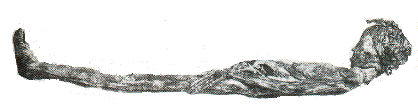
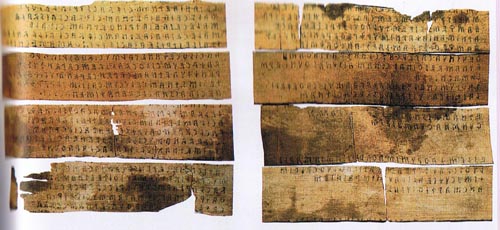
(from a work published in 1981)
Note: We are currently updating this
page based upon our recent
document findings, "Work notes on the
Zagreb Mummy.pdf"
Characters common to the
Roman / English Alphabet
(The codes below the
letters reflect relationships to other alphabets. See the
Vocabulary/Index.html for definitions.)
* = Letters which are common to the Zagreb Mummy Script
|
|
|
|
|
|
|
|
|
|
t* |
|
Z |
|
|
(h = b) |
|
|
(ep) (g) |
(g) (c = la, nu) |
(ep) (g) |
(g) (b = do) |
(b = ro) (pc) (ep) (g) |
|
(pc = s) (ep = s) (g)
(c= pe, zo) (b = we) |
|
| a | c, que, k, s | e | f, v | i | k, que | l |
|
Q (rare) | t | o | s |
 |

* |
 * * |
 |
 |
   |
 |
   * * |
 |
 * * |
 * * |
 |

|
 * * |
 |
| th | K, ch, que, ge | u ,o | G, i | L
rare |
F,V,
y, g |
G, I
V ,O |
M |
rare |
S | S,Z | S | S | h | x (rare) |
 * * |
  |
 |
 * * |
O* |
|
also interchanged with the V in the Zagreb Script |
8* = V
(rare) |
L* | B | b |
|
 (the loop is rare; see script PS) |
| S,Z
S,Z |
AE? | B | P | R | R | V,F,u, o | V,F,u | L | B | G |
|
|
(7.16.06) I am now verifying the various Etruscan scripts against a new Glossary developed from Table 1, Etruscan-Indo-European Vocabulary. We have added a map showing Canino, the town near the Fiora river that appears to be the location where the person of the Zagreb Mummy originated.
(9.04.02)
The Zagreb Mummy text is the longest extant Etruscan text. For this reason it is the most important with regard to completion of a translation of the various Etruscan texts. At the beginning of my work on the Zagreb Mummy text I knew very little about the mummy and quite frankly preferred not to know lest it prejudice my working out the grammatical patterns, etc. In the beginning what I wanted to know is how its words and grammatical patterns fit in with the other texts upon which I had been working. At this moment it is clear that it not only reflects the vocabulary and grammar of other texts, as listed in the Etruscan Phrases pages, but also obviously contributes more knowledge of the language.
My first study of the Zagreb text, because the texts I am working on are so hard to read, is now being corrected based upon findings in the Tavola Cortonensis preliminary translation. Underlines and letters with an underline are unreadable from my copy. The images with which I have been working are very poor. I am presently attempting to obtain good photo copies of the original linens, and when I obtain them I should be able to clarify some of the "unreadable" texts. Some of the characters of the linen are purposely smudged or over-written. Towards the end of the linen the verb 'to smudge" is used explaining why certain texts are that way. Generally where the word IRI appears it is smudged or over-written so badly you can't make any sense of the characters. I think the scribes were reflecting a great deal of superstition to the extent that by smudging the text relating to the wrath of the gods/underworld the mummy would avoid the wrath as well. Escaping the wrath seems to be the pervasive thought. In the beginning of the text, Script ZS, we are told about the wall and escaping through it. Many Etruscan murals show the dead being pursued and in the process of escaping through the wall of the tomb. Two of these murals, the Tuchulca Mural and the Charon Mural, are on this site.
The words are selected from the Etruscan_Phrases.html, Table 1, Etruscan-Indo-European Vocabulary. You can access other scripts through the bottom frame.
I have learned a bit about the Zagreb Mummy from Dr. Ivan Mirnik, M.A., Ph.D. of the Arheoloski muzej u Zagrebu (The Zagreb Archaeological Museum). The linen wrapping of the mummy is called, "Liber Linteus Zagrabiensis". According to Dr. Mirnik the museum collaborated with Mrs. Mechthild Flury-Lemberg of the Abegg Foundation at Riggisberg nr. Berne. She reconstructed the Zagreb Book of Linen. Mr. Nazzareno Gabrielli, the chief of the Vatican Museum Laboratories, is the one who saved the mummy. Others who helped with the reconstruction of the texts include specialists: the late Massimo Pallottino, Francesco Roncalli (who supervised the reconstruction), Ambros Josef Pfiffig and Helmut Rix. Mr. Igor Uranic, who is in charge of the museum's Egyptian collection, oversees the Zagreb Mummy.
When I learn other details about the mummy I will post them here. At the moment the less I know about the mummy the more objective this work will be. The work is proceeding much more quickly than with other texts--for obvious reasons--and before long I will get the answers to certain questions, such as:
 Where was the mummy found?
It was found in Egypt, according to the Zagreb Museum. The
text refers frequently to CISVM (Cisum) which may be the town,
Chiusi or the word for a four wheeled cart. Also Falarri, as
in the Tavola Cortonensis, is mentioned frequently. This is a
town up the Tiber from Rome. Also Spina is mentioned, which is
a few miles northwest of Venice.It is a town mentioned in the
Tavola Eugubine. Rome is mentioned several times in several
contexts.
Where was the mummy found?
It was found in Egypt, according to the Zagreb Museum. The
text refers frequently to CISVM (Cisum) which may be the town,
Chiusi or the word for a four wheeled cart. Also Falarri, as
in the Tavola Cortonensis, is mentioned frequently. This is a
town up the Tiber from Rome. Also Spina is mentioned, which is
a few miles northwest of Venice.It is a town mentioned in the
Tavola Eugubine. Rome is mentioned several times in several
contexts.
Is the mummy an Italian? What is the forensic
data as to any genetic links the mummy may have with the
particular population where the body was interred? This may be
the only surviving corpse of the Etruscan Civilization. What
do we know about it?
When was the mummy embalmed? How old was she when
she died? What did she die from? Did she have children?
What did the container in which she was preserved
look like, etc.? Was it a sarcophagus of stone?
In what kind of burial was it found? A tholos
tomb, shaft grave? What were the artifacts which accompanied
the mummy? Where were they made?
Are there any peculiarities or anomalies between
the embalming of known Egyptian mummies and this one?
Does it show any characteristics which might
share a common technique with a particular group of mummies?
Is the linen Egyptian? If it is, how is it that
an Etruscan scribe wrote upon the linen? Would it have been
written on in Italy and then shipped back to Egypt? I don't
think so. I think, just as all deaths can never be
anticipated, when the person was dying she requested that she
be mummified and the wrapping carry her message to "heaven,"
the gods who would be receiving her in her after-life. She no
doubt requested that her body be interred in her home. She
would have had to have had a fairly high station in life to
afford such a luxury and, no doubt, because she had been
wrapped in a text, she was well educated; and the message
would be expected to reflect the soul of the departed, her
mind and points of view. Since the text would never be
expected to be read by any mortal, it could be assured that
the linen probably thematically follows the Egyptian Book
of the Dead (writings in the Egyptian tombs, much of
which have to do with formulas to get the departed through the
judgment of Osiris, the judge of the Underworld). But it would
address Etruscan gods and values.
Was the linen one long piece of fabric when the
scribe first wrote on it? And then was it torn into panels?
Some of the panels appear to have the top half of a line of
text and the panel which would have been directly below it
seems to carry the bottom half of the line of text. Associated
with this is a line suddenly becoming smaller in size and then
returning back to "the normal size." It is as if the voice of
the soul of the mummy is whispering, having text so much
smaller, when it addresses god/the gods.
When the
Greeks, led by Alexander the Great, began the Hellenization of
Egypt, mummies began to be found in coffins with Hellenistic
designs, often with painted portraits of the deceased on the
lids. There may be a relationship here to the Zagreb mummy,
assuming the Zagreb museum has more particulars on the
artifact entrusted to it.
(9.04.05)
The
following history of the Zagreb Mummy is from James Wellard,
"The Search for the Etruscans," Saturday Review Press, NY, NY,
1973, pp. 75-84.
..[Richard] Burton was the first man to draw the English-speaking world's attention to that strange object called the Zagreb Mummy, which was to affect drastically all future studies of the Etruscans. For the Zagreb mummy was not simply the embalmed corpse, wrapped in the traditional linen bands, of a red-headed Egyptian girl. The linen itself was covered with an unknown script which Burton saw, studied, but never recognized as a unique example of an Etruscan manuscript. The Zagreb mummy is central to the story of the search for the Etruscans, while at the same time it typifies, in its way, the strange vicissitudes of the science of Etruscology.
The Egyptian relic was acquired in Alexandria in 1848 by a Croatian called Michael Baric, a minor official in the Hungarian Chancellery. While travelling in Egypt, Baric bought as a souvenir a sarcophagus containing (he hoped) a mummy. There was, at this time, a very brisk trade in mummies, either for the interest attached to the actual coffins in which they were enclosed, or for the ornaments which were sometimes found on the cadaver. In earlier times still, the embalmed bodies of ancient Egyptians had an additional value; they were ground up and used as medicine – 'mummy' being a staple drug found in all well-stocked apothecaries' shops throughout Europe. 'Mummy' was said to be especially effective for wounds, bruises, varicose veins, and dysentery, the discovery of its curative properties being ascribed to the celebrated Jewish physician, El Magar, who lived in Alexandria in the twelfth century.
But by the mid-nineteenth century when Michael Baric obtained his relic, 'mummy' was no longer in general use as a medicine, and the buying and selling of the corpses was restricted to antiquarians and tourists. The latter group were often palmed off with a fake. The English mummy expert, Thomas Joseph Pettigrew, a surgeon at the Charing Cross Hospital and at the Asylum for Female Orphans, reports many cases where innocent travellers brought back from Egypt bundles of rubbish consisting of sawdust, rags, sticks, the vertebrae of cats, monkey bones, and the like, stuffed into bogus sarcophagi made in the back streets of Cairo bazaars. One wonders if specimens of these frauds are not still reposing in the minor museums and private collections of the western world.
But Baric was lucky, for he had acquired a genuine sarcophagus and mummy, though neither he nor any one else for the next fifty years had any idea of the unique nature of his purchase. Still, even to have one's own mummy in the 1840's was something of an achievement, and excitement was always great when the relic was presented to the public at a special ceremony known as 'opening the mummy.' Thus, a huge sarcophagus brought back from Thebes by the French traveller M. Cailliaud was opened in Paris in the presence of learned men on 30 November 1823, and after the seven layers of wrappings were unwound, making some six hundred yards of linen two to three inches wide, the savants found themselves face to face with a naked man fifty to fifty-five years old, his arms and hands held straight against his sides, his hair, which was perfectly preserved, being lightly marcelled, his chest, arms and belly flecked with the remains of gilt. But what was most interesting of all to the scholars was the discovery that the wrappings round this mummy were inscribed in Greek. As we shall see, the linen bindings of Michael Baric's mummy were even more sensational.
He was not to know this, however, for he died in 1859, bequeathing his souvenir to his brother Elias, a parish priest of a village in Slavonia. Elias had even less interest in this object than his brother Michael, who had at least had some fun by standing his souvenir upright in the corner of his drawing-room and informing his credulous lady visitors that it was the body of the sister of King Stephen of Hungary. Elias preferred to get rid of the mummy altogether and so he presented it to the museum of Agram (today Zagreb) where it was duly catalogued as follows:
Mummy of a young woman (with wrappings removed) standing in a glass case and help upright by an iron rod. Another glass case contains the mummy's bandages with are completely covered with writing in an unknown and hitherto undeciphered language, representing an outstanding treasure of the National Museum.
The existence of the mummy with the unknown writing on the wrappings was first reported in an article in The Croation Review of 1880, but it had already come to the attention of Richard Burton in 1877. Burton had published his Etruscan Bologna in the previous year. During his exile, this extraordinary man, in addition to his interest in the Etruscans, had commenced a study of runes in the hope of finding a connection between the runic alphabet and the Arabian script of el-Mushajjar; and while travelling to Alexandria in the company of Dr. Heinrich Brugsch, the greatest Egyptologist of his time, Burton happened to be discussing his theory of the origin of runes, when Dr. Brugsch remarked that the runic script reminded him of the writing he had found on the wrappings of the Zagreb mummy ten years before. 'Imagine my surprise,' the German doctor remarked, 'when I found that the characters were not hieroglyphs, but partly Greco-European and partly Runic; at any rate, non-Egyptian.'
Brugsch and Burton both concluded that the unknown text was a translation of the Egyptian Book of the Dead into some Arabic tongue. Both, of course, were wrong, though to Burton goes the distinction of being the first to get the text copied out for publication and study. At his suggestion, Mrs. Burton requested Philip Proby Cautley, the Vice-Consul, to undertake the onerous and difficult job of copying the text.
In January of 1878, therefore, Vice-Consul Cautley presented himself at the Zagreb Museum where he was cordially received by the Director, the abbé Ljubic. The mummy still stood in the museum, but the bandages had been removed to the abbé's study, where Cautley inspected them. The Vice-Consul now makes a significant comment in his report to Burton, for he says:
The writing is divided into sections of five or six lines each, measuring about seven and a half inches long, according to the length of the cloth. These must have been in hundreds; and one of the best specimens was shown to me at the town photographer's. Each piece appears to have been a chapter...(Richard F. Burton, 'The Orgham Runes and El-Mushajjar: a Study,' Transactions of the Royal Society of literature, vol. xii, No. 1. 1882, pp 32-8).
Now if Philip Cautley is saying that there must have been hundreds of lengths of bandages inscribed with Etruscan script (One which had evidently been acquired by the local photographer), it is possible, and indeed even probable, that a considerable amount of the original has gone astray by being passed round among the interested citizens of Zagreb and hence, has, by this time, been lost. Additional evidence for this theory is Burton's statement that, according to Dr. Brugsch who examined the bandages in 1867, the number of lines would have filled sixty octavo pages. At thirty lines to a page, this would amount to one thousand eight hundred lines. What we actually have are some two hundred and sixteen lines.
Cautley now persuaded the abbé Ljubic to let him try copying the text on tracing cloth, an idea which 'seemed to excite the priest's meriment.' Nevertheless, the Vice-Consul worked away and was able to copy five chapter of five or six lines each of the now famous liber lineus, a sample of which was first give to the world in 1882 in the Transactions of the Royal Society of Literature.
It is astonishing that Burton's discovery – in its way as significant as his African findings – was ignored or passed over by European scholars, since Cautley's tracings represented the first piece of Etruscan literature ever to be seen since Roman times. Moreover, every piece of Etruscan script that had come to light had always presented the possibility that the experts might finally find the key to the language and so an answer to the many puzzles of this mysterious people. But not a single scholar throughout Europe recognized the text of the Zagreb mummy as Etruscan, even though this was a period of intensive research into the unknown language by some of the greatest philologists of the time.
There are several reasons. First, the Transactions of the Royal Society of Literature could not be expected to have had a very large circulation outside the actual membership of the Society itself; second, Richard Burton's linguistic theory of an oriental origin of the Ogham runes was never taken seriously by the academicians, who probably ignored his article; and third, Cautley's tracings are not very precise, whence it is difficult even for someone familiar with the Etruscan alphabet to recognize the script as it is reproduced in the twelfth volume of the Transactions. In fact, it took another ten years for the Etruscologists to realize that the most important philological find of the century awaited them in the Zagreb Museum.
It was the Germans who eventually solved the mystery of the Zagreb mummy, since it was the nineteenth-century German scholars who undoubtedly had the necessary eruditions and methodology to do so. There was certainly not a single British Etruscologist of any stature at this time. In fact, the subject has never appealed to British scholars, though it has always fascinated erudite amateurs like George Dennis; and it has always attracted devoted eccentrics like Sir William Betham, who spent many a happy hour (as Burton no doubt did with his palm runes) translating – or, rather, torturing – Etruscan into English by means of a key of his own invention. The Sir William Bethams, indeed, are still with us, and hardly a year passes that some amateur does not 'solve' the mystery.
But as one would expect, there was no nonsense about the German's approach to the Zagreb mummy. In 1891, they obtained permission from the authorities for the actual bandages to be sent to the library of the University of Vienna where Professor Jakob Krall was able to make his examination under laboratory conditions, with the help and advice of his learned colleagues. It was not long before he suspected the Etruscan origin of the text, not only by recognizing the alphabet but by identifying several words whose meaning had been guessed at or was actually known from ancient glosses. His surprise was great, however, for he had expected the script to be either Coptic, Libyan or Carian, so now the question of forgery arose. Admittedly, the likelihood of some prankster amusing himself by covering yards of linen with Etruscan characters seemed remote, but stranger things have happened in the world of scholarship, as the Piltdown skull will constantly remind us. The Germans were taking no chances of being hoaxed, so the professors set about analyzing the linen bandages, the ink, and all the circumstances involved in the mummy. They proved conclusively that the wrappings were genuine Egyptian mummy bandages of the Greco-Roman period and that the ink was made in the ancient manner from soot or pulverized coal. Hence the forger, if such there was, would have had to go to great pains to find or manufacture the genuine articles. In any case, the number and variety of words which were not known at the time (1891) but were found in inscriptions unearthed at a later date proved beyond a doubt that the text must have been written by an Etruscan scribe.
The next question that required an answer was whether the inscribed bandages had been specially prepared for the dead girl as her personal shroud; or whether they were bandages which the embalmers had acquired at a remnants sale. Egyptian morticians obviously needed enormous quantities of linen for swaddling their corpses and they were not particular about where it came from. We may compare the wrapping in a contemporary newspaper of some frangible object like a teacup for export abroad. The archeologist of the future would probably be more puzzled by the newspaper than by the cup. The Egyptian embalmers, however, were not interested in what, if anything, was written on the linen they tore into strips to make bandages for swaddling the mummy, and Professor Krall believed from his examination of the Zagreb bandages that this was the explanation of the Etruscan text; for he concluded that the linen on which the text was originally written was torn into strips rather recklessly, without consideration for the proper sequence of the lines. Moreover, the strips were bound round the mummy with the writing facing inwards, which would imply that whatever it said had no reference to the dead person.
There are, then, two theories to choose from. The first is that the dead girl was herself an Etruscan who died in Egypt where she may have lived with her family. In common with other foreigners who died in Alexandria, she was embalmed before burial. The Etruscan part of the ceremony in that case would have been the inclusion of a memorial of some kind, and that is what the liber lineus must be.
This theory has been accepted by those scholars who maintain that many rich Etruscan families fled to Egypt after the conquest of their principal cities by the Romans during the Republic – a diaspora which could, perhaps, be compared with the exodus of Jews from Germany to America during the 1930's. Also comparable with the Jewish migration would be the Etruscan's devotion to their own religion and their own gods, about which the mummy book seems to be primarily concerned.
But here difficulties arise; for if the text on the bandages is a book of ritual, as most Etruscologists now take for granted, why was it wrapped round the body of a young woman? We know from the evidence of other mummies that the custom was then (as it is now) to commemorate the deceased with the matter-of-fact details of his name, parentage, length of life (the ancients were meticulous in recording this fact even to the number of days as well as years and months a person lived), and professional or social distinctions. Such a record, one would expect, would have been right and fitting for the dead girl. And since we have absolutely no evidence that women were especially reverenced as priestesses by the Etruscans, it follows that there would be no justification for wrapping the girl's body in a book of ritual.
We are forced, then, to accept the alternative theory that the linen bindings and the mummy they swathed have no relevance to each other; in other words, the dead girl was not necessarily an Etruscan at all, but that the embalmers simply enfolded her in the linen wrappings that came to hand.
There appear to be 43 separate linen panels
upon which the writings appear.The cadence of the lines
follows a pattern as well. This text, like the Tavola
Cortonensis, does not use the character, "K." The two texts
use "C" and . Also another common
character between the two scripts is the character for "F"
which is:  . They
share a similar way of writing the "M," but the Tavola
Cortonensis probably shows the proper way the letter was
written, whereas the
hand writing on Zagreb Mummy was less stylized: . Both texts use three
characters denoting various forms of the "S." These are:, , and .
. They
share a similar way of writing the "M," but the Tavola
Cortonensis probably shows the proper way the letter was
written, whereas the
hand writing on Zagreb Mummy was less stylized: . Both texts use three
characters denoting various forms of the "S." These are:, , and .
The first panels as listed below are a prayer. One could conclude that it should be a prayer to god/the gods to restore the soul to life. The wrappings were never designed to be read by anyone but god. Imagine, then, as god's assistants unwrap the mummy and read the prayer as it is being unveiled, what the mummy expects them to grant. As it turns out the phrases in the top wrappings are repeated in the bottom panels, next to the body. There are formula, word groups which are repeated over and over, but sometimes with different punctuation marks, slightly changing the meaning.
As is true of the Tavola Cortonensis the language remains closest to Latin with shadows of French and Italian in the vocabulary. For example the word PVIA (appears in several other texts), spelled here, PFIA, is Italian, "puia" and French "puis", i.e., "then."
Where I am unsure about a character or word(s) they are underlined. Because of the repetitious word groups I have been able to reconstruct some words where the fabric is torn or missing.
The script is very close to Latin. In the process of the translation of this text I use the most applicable words from the vocabulary pages of this site. The vocabulary was built from a comparative analyses of words used in all the extant Etruscan texts. That analyses is the foundation, or work-sheet, for ascertaining how the words conjugated and declined. Up until this point I would copy and paste phrases--as for instance these analyzed from the Zagreb Mummy script--into the Etruscan Phrases work-sheet. Continuing that process is not necessary since the pattern--at least with regard to the Tavola Cortonensis and Zagreb Mummy Script--is very close to Latin, with shadows of Italian and French. What do I mean by "shadows of Italian and French?" When cultures come in contact words are absorbed to and fro. Sometimes the root verb is transmitted as an adjective to another language. An example is the word ETvNAM which I first read as the verb, It. espiare, "to attone for, expiare, to serve." The same verb in French is "expier" and Latin, "expiare." In French we have the word, "atonement," meaning "reconcilation, compensation, redemption, expiation." While this may be the meaning of this very repetitious word, I have bent towards the following: We atone/wonder/we are inspired (L. atttono-tonare-toni-tonitum, to be stunned, inspired, frantic; Fr. étonner and s'étonner). The word begins at Z327.
In like manner we can observe root verbs in Etruscan to be represented in Latin as nouns or adjectives.
The vowels used by the Etruscans generally coincide with the same vowel in Latin.
Conjugation patterns. As one will readily see in the vocabulary, the Etruscan words follow a consistent "regular" pattern of conjugation. The verb, sum, is irregular and recalls the French use of the verb. The verb, FAC, Latin, facio, is irregular with forms shown as FAS, FAT, etc. The Etruscan use of infinitives uses the "V" = "o" suffix as in Latin cases. The verb AMAR, "amar"conjugates as: AM, "I love," AMAS, "you loved," AMA, "he/she/it loves." AME is "you love." AMV, "amo," I read as the infinitive of this verb and the word AMVER, "amoer," AMVR, "amor," the noun. AMI I read as "friend."
The word CFA would be read as qua. The "F" is used both as a vowel, "u" and a consonant "F." Sometimes it is close to the "8" where the consonant "v" is required, as in the word, 8ERV, "vero," truth. KFA is pronounced more like chua. Another character with a "K" sound is the "K."
In the Zagreb Mummy text we have frequent declensions of the word for "three." The text addresses the concept of wrath (L. ira-ae; Etruscan IRI) and uses the word, three, in many contexts of wrath. There is a trinity of gods and if SVS = It. sosia, double, the soul has a double which becomes one with the three gods. This formula is expressed in the top and bottom panels of the wrapping. Associated with the precept are blackbirds which the narrator sometimes raises and other times the soul raises. Sometimes the blackbirds (MERLUM; It. merlo, L. merula-a) are associated with wrath, i.e., from the blackbirds of wrath you escape (L. eno-are), as in: MERLVM IRI ENAS.
While I haven't been able to verify the exact name of the woman, it is certain that she is addressed as CN. In the bottom layers of the wrapping a verse uses the word for "abbreviation" in the context of the written CN. "CN" is also used in another script. See the vocabulary.
Another often repeated word group is SAC NI and SAC NI CLERI and then SAC NI CN at Z1662. The word, sack (It. sacco; Fr. sac; L. sacculus-i) seems, in the final analyses, to refer to the mummy wrapping itself and to CN at Z1662. At Z336, in the top layers of the wrapping, and at Z1861, the bottom panel, we have the same groups of words containing the word SeREN (It. sereno, Fr. serein, "serene"). Note the juxtaposition of the same words with a shift in punctuation marks.
Z336 AIS
ERAS SEVS CLETRAMSeREN CFE RAK Ce
[Translation: to the bronze (L. aes, aeris) you wander (L.
erro-are) of Zeus to the grating/trellis (L. clatro-orum,
trellis) the serene (It. sereno, m.; Fr. serein) you assemble
together (L. coeo-ire-iv-itum) I raconte/narrarate (Fr.
raconter) here (Fr. ce)]
Z1861 8ARRANAIS ERASSEVS CLETRAM SeREN CFE [Translation:
they shall change (L. vario-are); to the bronze (L. aes,
aeris) you wander (L. erro-are); Zeus of the grating/trellis
(L. clatro-orum, trellis) serene (It. sereno, m.; Fr. serein)
you assemble together (L. coeo-ire-iv-itum)]
This is how the text reads as a whole, with formulas which switch and mix words and word groups to create a magic spell to protect the soul through its journey where it will be transformed to become one with the gods, eternal and where it resides in a dual form of the earth as it knew it. Etruscan cities are mentioned in connection with the soul's passage.
Other verses tend to be formulas expressing the process of mummification. The panel at Z1770 illustrates the pouring of what appears to be mixture from goat's blood 'here:"
Z1770 CVSCLVCECAPERISAM TI CeSFEMRVM SA [Translation: I give as a
reason (L. causor-ari) you drain (L. cloaca-ae, f.) the
Caperi/goats (L. caper-ri, m. he-goat) to your leg (It. zampa,
f.; Fr. jambe) here; we are accustomed (L. suemus) of Rome
herself] (L. se, sese) Note: CAPERI is mentioned first at Z-B4
and repeated with various declensions. CAPER, CAPERE, CAPERI,
CAPERIS.
Z1777 MATANCLVTRASHILAR
[Translation: they are boiled (L. madeo-ere); I closed up (L.
claudo, claudere, clausi, clausum and cludo) to make
joyful/cheer up (L. hilaro-are)].
Two blank panels follow and then fragments leading to one last complete panel.
The Etruscans did fear wrath in the underworld. One image of wrath is described by three snakes. They are associated with the Chimaera. On the top of the devil, Tuchulcha's head are two snakes and from his head comes another snake giving chase to the departed who in the Tuchulcha Mural on this site is disappearing through the wall of the tomb. This horrifying figure, or god of the Under-world, has an image which Christains find comparable to their image of the devil, who has horned ears and a hooked or beaked nose. The images in the tombs of Etruscans show gods with wings, just as Christians perceive angels. Continuing with this thought, as one works through this Zagreb Mummy script on the day of judgment, we can recall the same horrifying images of hell in our own tradition as are being described by the Etruscans in their tradition. The more I explore this script on judgment the more I ask myself how much influence the Etruscans had on our vision of the devil and hell, the vision of having to descend into hell and then escape to "heaven". Christ descended into hell, according to Catholic teaching, and raised the dead, taking them to "heaven". The back wall of the Sistine Chapel in the Vatican is a good comparison for understanding what the Etruscans saw as their fate. For despite the wrath in the escape they obtain eternal life.
Getting back to the "three snakes," since they are so ingrained in the vision of the Chimera (mentioned in the script), one will find in the Tavola Eugubine, location Q442 and Q483 the word, "TRE8IPER," treviper. The word, viper, is used in the Zagreb Mummy script.
Where you see the "work" image is where I am presently reworking the text.
To see a copy of each script click on the link, i.e. SCRIPT ZA.
 This is the result of my third pass through /
reconciliation of the texts. (7.15.09) An update is again in
progress to reconcile the words in these texts to the updated
July 2009 Glossary: Etruscan_GlossaryA.xls
This is the result of my third pass through /
reconciliation of the texts. (7.15.09) An update is again in
progress to reconcile the words in these texts to the updated
July 2009 Glossary: Etruscan_GlossaryA.xls
Panel 1, Fragment
...she strives after here
...you make joyful/person's name, Hilare, the eagle
...to a greater extent to be on guard against
...we rejoice
Panel 2, Fragment
...supposing that in time I honor out of the
prayers
...I am gentle; the double she raises up
...the bones there indeed
...the he-goats
Panel 3
........from the thunder; I am you; from the
thunder
the trellis; serene she assembles to the god Dis; you
sail/pass......Veler
the diseasehere; they would influence; whether the serpent
born of wrath.....here
I revealed; I do there; whether; they sing? to us....however
the trells; serene you cherish there which they sing of the
vine stock; I do there
at the altar you do not reign; by the sea lest you cherish;
the shield; you struggle
Panel 4
the wine of the bones; three at a time; Velere;
in drunkenness she stands
one; I am gentle/soft; not to reign; and indeed of the
matters; the wrath of things; she summons there
you
[pl.] have made mild the wine from ourselves the whey of the
lady
to yours we speak; you lived of the chaise; the chariot; you
roll around; I carry; the kidneys
through the years poor of pine-wood you care for things; you
merited; you are moist/wetted of the rich
(or alternatively you merited the Homeric).
Panel 5
wandering about myself; of the God Tin himself;
we speak to yours; you lived of the chaise; behold!
in here; I cover Veler of the resin to us the chariot you
possess...
she has wealth I cover; they got again/discovered here; my
lords; you join together the lords here; you join together
the house of honey; I watch; they move the wax you
leave/allow; the chariot/wheel
Panel 6
(fragment missing) if you arise of the
matters/things the blackbirds I raise you escape
(fragment missing) the disease/stigma; to come of the light
you lifted up; I do not reign
(fragment missing) to the ladies; in drunkenness she stood;
the trellis
(fragment missing) to recounte she watches the galley of wine
(fragment missing) the goddess Leto I love; serene you assist;
to recounte; the sister
(fragment missing) the bones you raise I do not reign....the
matters
Panel 7
to the bandages/swaddling bands of the trellis;
the serene you assemble of yourself; I carry the grain
to reconte; to watch over not to reign; the vases; CN I take
up/assume; woe! I carry
the grain I hid; the sister of the galley of wine; three at a
time; Velere
in drunkenness she stood; one I soften; I do not reign; the
god Dis; you pass from state to state here
the vases; you possess the chariot; I carry the kidneys; she
has wealth I bury; they got again / discovered here
my lords; you join together the lords here; you join together
here; or whether the house; of honey; I watch
Panel 8
line unreadable
they move by what way?...........supposing that you die
of the blackbirds of wrath here; you escape; if however Velere
in drunkenness you stayed
at the chaise you pass from state to state here; the vase if
however; to the bronze I wander the vase; but if
of the bronze;I lament the birth of a vase upon I recount
here; the skirts; I hid
the sister; to them truly sometimes I wander of the wine I
draw in
Panel 9
line unreadable
from CN I joined together; they ordain; in here; the vases;
well just look! but if to us
the sack unless which the three; you hasten you spit out the
three here
you escape; I wander over the matters; of the god Tin himself;
to yours we speak; you lived; the chaise
of the chariot; you are in the possession of; alone the
kidneys to rise, to hang onto the things they get again rich
Panel 10
the sac unless evident/bright to hasten we
shall spue out from the stream I merited
you escape; to recount of the sister; not to reign; by the
thunder they shall change
to the bronze you wander; Zeus of the trellis; the serene you
assemble together; I reconte here
to the sister not to reign; you are three; to the swaddling
bands; herself I carry
......not I reign to the chaise you pass from state to state
here; I change
Panel 11
the chariot you posses; I carry the kidney of
the sister; to hang on to things they get again rich
the sack unless I made clear/illustreous; to hasten there; we
shall spue out from the river I merited you escape but if;
to be cast ashore in this way; or if here; to the chaise you
pass from state to state here
the vase; but if; to be ejected/cast ashore the vase that
thing; to recount; the skirts/cassocks
I hid of the sister; I do there; the resin upon I recount; you
create; you join together the defendants
you have here the hideous region I hid; the god Ep of the
house of the borders to us; whatsoever three at a time
Panel 12
the beech trees and also he releases the bronze
I lament the birth; the frightening object you pull up; to be
angry
whatever; I do there; not to reign you are or; you pay money
they reveal
to them you wander; Zeus we honor; I am gentle not to reign
woe! I trusted
you go I had faith here; the vases of the chairot; they
reveal; the bones of wool here
you soften; the reigns/whips you joined together here;
Aurelius of the sack unless she calls
to hasten there; she spues out there; to the blackbirds you
are here; you escape here; they reveal her
Panel 13
line unreadable
SN to the river I am frantic who to them I cease years and
indeed death/Orcus' to the fruitful the offspring
the old bucket (or Hamphes--a person) you long for; the
towers; the king; to be bound/ being bound you are free from
you deny the years and indeed; we deny death/Orcus; you perish
you swam back; N N the river Rage
the vase of the lights; from the thunder; you rejoiced; also I
recount however
Panel 14
the accused person you renew; the he-goat here
you have of it; she was born; she will pay money of herself
from the thunder; the great queen there; from the thunder; ai!
she celebrates there; I watch the perfect;
hereupon the sack unless she calls
you (plural) did not bring forth; they illuminate Velere; the
bucket of the treasury; this thing she joined/collected
together
line unreadable
Panel 15
from the thunder; to them truly of that person;
Veler you are; she creates you
you watched truly you watched Veleres
Panel 16
you are the theme; we bring forth that person
she summons there; you pay money in/towards her sea
your ghastliness; I recount; you regard; you summoned; to the
people of Cato I am absent from the ghastliness; we conceal
the tops of the earthen pots; the eagle I have unless; of
Pania
even like the sole martyr
Panel 17
because she possessed; from the thunder; in
what manner; I make there the wrath not at all of the king
of evil; because she possesed; from the thunder; in what
manner; I make there the bronze you deceive
evil; because; she possesed Triner; from the thunder in what
manner you nourish
evil; because; she possesed; from the thunder; in what manner;
I make there; the daughter; you deceive
you stayed her; you stayed her; she possesed; in what manner
Triner she takes to her own the sack unless of the god Tini
Panel 18
whether to hasten any of the year; the salt she
eats of the men I recounte
to wander Chaos to hasten she unites there; we are accustomed;
they chop, they guard
I reign over whom of hers; we wonder; they chop/separate; they
bewail the comrades here of the men
you I am; from the thunder; to us the place of slaughter; the
he-goat she cherishes
you have summoned the bronze indeed; to the staff whether we
hunt; I kill; the bones/bodies there
Panel 19
line unreadable
to the cellar you wall in yourself; from the thunder you
reconte here of their bones; she refused to give
the eagle she loves; we wonder; to hasten she ruined Hilare
the eagle
I make there; they chop to rase where that you escape the
eagle we wonder
I strike the staff to distress the comrades; the man you meet
with, the eagle, from the thunder
you I am; from the thunder; I hide CN, I do there; the altar I
watched
line unreadable
Panel 20
line unreadable
CN thine CN until they wax the vine of the Arno here I like
whom from
the comrads of the men; from the thunder; the great rite; from
the thunder; ai!
I make there the brazen footed unit; you took an oath, they
wax, they chop
the defendant of Orcus, from the thunder; hereupon we subdue
the comrades here of the men
they wax, they chop the threshingfloor I watched; from the
thunder, they wax
Panel 21
your king, within you weed; she trusts; I make
there the thunder
you till, she unites; you watched; from the thunder now you
were trusted the sole heir of the funeral pyre
Panel 22
I hid this/her hour; we weeded Veler she
cherishes; they wove there
the mother-in-law you preserved her she is herself absent to
pray of the whole I reconte; of the gods
you lead the prison there; I am soft/tender I have left the
wine
Panel 23
her we avoid; Aquilar you love; the kidneys
......
the matter of the aversion she permits; to draw out the double
she lifts up here to a greater extent the hinderance of these
things
the matter of the aversion you leave alone of yourself to
leave behind the wine of Aquilar you love
she works at the mill in her season; in time I honor I make
there the bones; you shall drain
the goats of the rich leg; I make there ; I farm of Velere the
things; the sack unless hers
thereupon CN I bargain with the lords the three together of
Velere; they interweave there, you are united
Panel 24
I am soft purified......
to the rose resin of our moon she was satisfied; I am
satisfied of the moon
the sack unless here of Sires the swift you spit out three,
you escape
wandering about myself of Tini himself we speak to yours, you
lived of the chaise of the beech trees
and indeed there the god Tin of the bronze I lament, I arise
of the resin Veler I make there
from the thunder you I am; from the thunder; I hide CN of the
three someone/something
Panel 25
she was born......the queen
out of the covering there you are ignorant
one and the same I am soft; I do not reign
the covering there lest the wine you escaped
the vases here, the sack unless a house of the three
line unreadable
Panel 26
to the island of Fescennia you transport CN;
tomorrow the Picene towards the gods
at the lord the resin which the sack unless whatsoeveer swift
you spit out three; you escape, you wander to the god Tini
himself of yours we speak
you lived, the chaise, the chariot; you are in the power of
the divine; the kidneys you hang onto
From the queen of the sac unless evident/brilliant here in/of
the bronze you purify these things
Panel 27
the blackbirds I raise; you escape to reconte;
I tend the galley
of the wine of the three of Velere; they interweave one and
the same I am soft
I do not reign to the double you lift up; the successions of
the ancestress....in
they ordain in the dryness Veler of resine......the lambs of
the house of the three
you hasten, you spit out the three, you escape...the god Tini
himself
line unreadable
Panel 28
line unreadable
you hang on here of the booty here; the sack if not evident to
hasten the bones you purify the things
the blackbirds I raise; you escape to reconte of the sister
not to reign
thine you raise the vases here; they shall change to the
Velerie they interweave themselves
to reconte the serene trellis you regard; not to reign
you are three to the swaddling bands; the double you raise; to
reconte of herself I carry the grain
line unreadable
Panel 29
line unreadable
I carry the grain I hid; the sister not to reign Velere they
interweave there
one and the same I am soft, I do not reign to the chaise you
pass from state to staate here; in the vases
of the chariot you are in the power of; I carry the kidneys;
you cleave to here; the booty here
of the sack if not evident to hasten there; you spit out the
things, the blackbirds I raise
you escape without the wine of Velere; they interweave there
of the god Dis
Panel 30
we adorn the bronze indeed of Hineru; the wine
I draw out; I demand indeed
We call by name where someone esteemed I cleansed to them
indeed I reconte frequently
Panel 31
I carry, you perish you swam back; we call by
name where someone they hollow out
by the sea; the fortune-teller you love; we arise; they chop;
to the strong I act
I make there; adorned with gold I sail through the Furies
to the plowed land you love, of the lambs, the ibis, we join
together at the riches of the lake
of the king of whom you sail; to the eagle Hamphes of delight
you are alone to yourself
Panel 32
I watched Serphoe the eagle, the ibises she
whirls around, CN there ; I say nothing of these matters
the six alone you assemble in you of the flesh to herself of
Canin the market
you go; the ibis MNR she assembles to; she loves of the three
the beech grove indeed there of the god Tini
to them I groan indeed here; hereupon in this place she is
covered; from the thunder; to you I am; from the thunder
I hide CN; Hiner I reign over; the Chimaera of the Anio here
you escaped; I make there
line unreadable
Panel 33
Rome of the isle of flesh to myself I gather
the cattle; the day of the Romans to honor
I have the lands of Ipa; I demand the dish she likes; I am
born; I summon
of Hineru the sixth; you are veiled; at the sea you engage the
young married woman CN
to Mars indeed of the bones the gods she watches in the flesh
in the kingdom
I set straight the branch alone she cherishes of the sea she
engages here the watchman in these matters
Panel 34
of sound mind I trust in Vulcan, Pluto of the
gods yours I enjoy; he rests himself
at the altar we confirm the bronze indeed; we rejoice; the
sister she is carried up of the brine
you went out here that/where the heights I weed; you went out
here from the salt/brine
she strives after the holy here
I reconte indeed; they snatch the sac of the procuress of
Fiera; I bring; you bless indeed
I empty yours, her opening you sew; she sailed away by/through
the King of darkness
Panel 35
line unreadable
she has here in this place herself the king of the stream that
she rests but Rome herself anything
of the darkness although the prison cells I am put in the
power of for she asks of the Latins
the gods; the procuress she has of/by the door; you escape;
she got out of the consuming fetters
I spit out you alone of her; the grand-daughter of king Lais
of the staff out of the darkness
line unreadable
Panel 36
line unreadable
I make there, the consecrated wine of the god Dis; I hid the
feather of the Trojans
The things you plunder of the god Dis; the Trojan she takes to
her own of the Hanerin; I hid
at the tower you have at this time the rich wine; I make
there; of the six we wonder
we boil CN the beam they chop; I compose of the friend of the
god Tini
....from the thunder; the matters of Troy; from the thunder
Panel 37
to the Hanerin, from the thunder; I hide CN; we
wonder, to the Romans of the god Tini
by Erinyes you are the theme of the succession; at the wall in
greatness you reign
the swift I make there; at the altar of the king the bones I
brought forth; your chain, the chair of the pick-axe
in the chair of feathers (winged chair), she goes to the end;
I was obliged I spit out yours to them indeed; Hinerus
she summons the resins
Panel 38
you are the theme, to us someone, from the
thunder the bronze indeed....
the little toga here, I wander of the things; I sing of the
thunder; she yields
in the thunder they reveal Veler the long-lived; you were
preserved
Panel 39A & 39B
line unreadable
to the Veleri I celebrate....the rounds there of CN; they will
be; woe! I bear the grain
to the watchmen there.........the thunder in this place you
are the theme by which someone
to the kidney she has........the thunder they reveal
Panel 40
line unreadable
the thunder she holds here; from the thunder; from the Romans
because the brook of the flocks
the chariot of the gods, the woolen she in here she escaped
the god of the Chimaera
he strikes down the Satyrs, you escape by swimming the river
Hampheris of the Rhine country
to the king of the altars we groan; the Anio the resting place
of the Etruscans, Hilar (Hilar = sausage/intestines?)
...............cunningly the one and the same
Hampheris.........
Panel 41
....from the thunder
to the bronze indeed here in this place I come forth, the
defendant to us; to the bronze you wander, of Zeus
I watch the column of the wall; Hilar(Hilar =
sausage/intestines?) you watch opposite the third here
you pass oveer the summit, I arise the one and the same she
cherishes the blackbird the restorer
of the wall, Hilar (Hilar = sausage/intestines?) she watches;
we cover with regard to three at a time these things of the
wall
I come forth of the kings one and the same she cherishes, you
have at that time Hilar (Hilar = sausage/intestines?)
she watches to reign
Panel 42
in this direction in time here the head there I
moisten by whatever way I like; she escapes here to them
indeed to bring forth
you have at that time the Hilar(Hilar = sausage/intestines?)
of Rome, from the third here of the Constellation of the Great
Bear
we wonder the bronze indeed here in this place we subdue I do
there we thunder
we watch, by this means they heap something; the goddess Uni
the great, the beginning indeed there
I cultivate; the matter of the eagle whether the sack if not
CN to hasten by whatever way from the salt
Panel 43
I give as a reason, you drain the goats, your
leg here; we are accustomed of Rome herself
they are boiled, I drain you pull Hilar(Hilar =
sausage/intestines?)
Panel 44--blank
Panel 45--blank
Panel 46
.....the king he comes into existence he is
healthy
......upwards he went forth
.....the rock he takes to himself
....I inscribe the things, CN they will be
.....the aversion I pull out of the region
Panel 47
......the lambs of CN......
..... I lock up myself; the god Tini supposing that.....
.... you are in the power of they carry the sister
.....I made illustrious to hasten there
.....I judge yours
Panel 48
........the wrath....the swift
........swiftly the mattter here you join here, whether
.............you are in the power of; I endure
...........to yours we speak, the habitude within, the
chariot...........of these matters/things
....to the sister, I hang on to the things, they get again the
rich, the sack neither
.....the things/matters of the blackbirds I raise; CN
Panel 49
you join together here, whether to the house
you lead; they are at leisure to us/her; you mark the
seats/settings of the moon here
to reconte, she dries up, not to reign; the trellis, the
serene you regard
the gods, the vases, the grain to come, her double, I do not
reign
they shall change, to the bronze you wander, to Zeus of the
serene trellis you assemble
to reconte, she dries up, not to reign; the gods, the vases,
not to reign;
* This expression may be rather than "we wonder" by thunder; the Etruscans divined using thunder and lightening.
Panel 1, Right hand fragment:
ZFrag. A-1-- MVLA Ce_
[Translation: she strives after (L. molior-iri) here (Fr. ici)
Note: See Z1282.
ZFrag. A-2 HILARE A
[Translation: you make joyful/cheer up (L. hilaro-are) the
eagle (ACIL) See Z701.
ZFrag. A-3 MAC CAF_ _[Translation:
to a greater extent/more (L. magis [or mage]) to be on guard
against (L. caveo, cavere, cavi, cautum)] See Z817.
ZFrag. A-4--LAETIM H_[Translation:
to the joyful, fertile (L. laetus-a-um)] Note: the "im" =
"um," Acc. suffix. See Z516
Panel 2, Left hand fragment:
ZFrag.
B-1--R SI PVR VRN E PRII
[Translation:_ supposing that (L. si) I purify (L. purgo-are)
I honor (L. orno-are) out of (L. e)
the prayers (L. priere, supplication, f. prayer book, ritual;
Fr. f. prière; It. f. preghiera)] See Z834.
ZFrag. B-2--MVLAK SVS LEFA [Translation: I
am gentle (L. mollesco-ere); the double (It. m. sosia) she
raises/lifts up (L. levo-are)] See Z981, LEFE.
ZFrag. B-3--_MVS Le NA [Translation:
_ The bones (L. os, ossis) or mouth (L. os, oris) there indeed
(L. ne, nae)]
ZFrag. B-4--_S CAPERI
[Translation:
_ the he-goats (L. m. caper-ri)] See Z1770, CAPERI
Panel 3 (six lines of text) Script ZA
Z-1 (fabric tear/missing word) R E TvNAM TESIM E TvNAMT(ESIM--fabric tear/missing
words) [Translation: from/by (L. e, ex) the thunder
(L. tonitrus [-us] m. and tonitrum-i; verb, L.
tono-are-ui-itum) of the dice (L. tessara-ae, "-im" Acc.) from/by (L. e, ex) the thunder (L. tonitrus [-us] m.
and tonitrum-i; verb, L. tono-are-ui-itum)] (to the tile, cube)
Z-7 CLETRAM SeREN CFATIS FE _ _ _T 8eLER [Translation:
to the grating/trellis (L. m. clatri-orum); serene (L.
sereno-are; It. m. sereno) you shake (L. quatio, quatere; 2nd
pers. sing. quatis) you sail/pass.....Veler, person's name? or
to pluck? (L. vello, vellere)]
Z-12 TAR CeMVTINVMAN
ANCFISNAC
IRI _ _ _ R Ce [Translation: the disease/stigma (It. f.
tara) here (Fr. ici) or alternatively Taharqa (Pharoah
Khunefertemre Taharqa; 690-664 B.C.) changed / exchanged (L.
muto-are, to mutate) or Galic town, Modena (L. Mutina-ae),
whether (L. an) the snake/constellation Hydra (L. anguis-is)
born (L. nascori-i) of wrath (L. ira-ae)_ _ _ here (Fr. ici)
or to us (It. ce); alternatively NACIRI may be nascori.];
Note: The "-um" suffix suggests a noun
Z20 RESIFAC LeAN Se CANIN CE_ _ _
_ _ _ _SIN [Translation: I gave back/revealed (L. resero-are;
It. rendere; Fr. rendre) I make/ do (L. facio, facere, feci,
factum) there (le) whether (L. an) themselves (L. se, sese)
they sing (L. cano-canere) to us? (It. ce) ......however, but
if (L. sin) ] Note: the reflexive pronoun, SE appears in front
of the verb in this script.
Z29 CLETRAM SeREN KFELKi Se CANIN CEPIS FAC Le [Translation: the grating (L. m. clatri-orum) serene (L. sereno-are; It. m. sereno)
of whatever kind (L. qualisqumque [-cunque], qualecumque) or
some, any, whatever (Fr. quelque) they sing themselves (L.
cano-canere) of Cepis/the vine stocks (It. ceppo, m., stump;
Fr. cep, m. vine-stock); I make (L. facio, facere, feci,
factum) there)]
Z40 ARA
NVN RENEMARAMNA KFE AEKiSMVLE [Translation:
at the refuge/altar (L.f. ara) of Nun you reign (L.
regno-are); of/by the sea (L. mar-is; marinus-a-um) lest (L.
ne, nae) you cherish (Fr. choyer) the
shield (L. f. aegis-idis, especially the shield of Jupiter and
Minerva) you toil/struggle (L. molior-iri)] Note on Egyptian
god Nun. This phrase, "at the altar of Nun you rule: the sea:
Despite all the various Creation myths that the Egyptians subscribed to, they had one thing in common, Nun. Even though the myths named different gods as the original creator, they all agreed that he sprang from Nun, the primordial waters. Nun was more than an ocean, he was a limitless expanse of motionless water. Even after the world was created, Nun continued to exist at it's margins and would one day return to destroy it and begin the cycle again.
Following the creation, Nun played a role in the destruction of mankind when humans no longer respected and obeyed Re in his old age. Re called together all the gods and goddesses together, including Nun, and asked them what he should do about the problem. Nun suggested that Re should call forth his Eye to destroy mankind. Re did so, and his Eye, in the form of the goddess Sekhmet traveled across Egypt killing all men. Also, Nun protected Shu and Tefnut at birth and he kept the demonic powers of chaos (represented as serpents) in check.
Nun was portrayed as a bearded man with a blue or green body, symbolizing water and fertility. Sometimes he is shown with female breasts as well. In one hand he holds a palm frond, a symbol of long life and wears another one in his hair. [From egyptianmyths.net]
Panel 4 (six lines of text) Script ZA
Z47 FINVM
VSI TRIN8eLERE IN
CRAP STI [Translation:
to the wine (L vinum-i) the bones/bodies (L. os, ossis) or I
burned (L. uro.urere, ussi) three at a time (L. trin-ae-a)
Velere (person's name; possibly of the town Falerri) in L. in)
rough cast (Fr. crépi) I rustle or make a noise (L.
increpo-are) or probably, drunkenness/debauchery (L.
crapula-ae, f.) she stood/stayed (It. stare)]
Z54 VNMvLAK NVN
RENeRAC
Le RIIRI
RIECIA
Le [Translation: one (L. unus-a-um); I am gentle/soft (L.
mollesco-ere); Nun (Egyptian god of fertility, ocean) to reign
/ the ruler? (L. regno-are, to be a king, master, prevail;
regnator-oris,m., ruler, king) and indeed (L. ac, atque) there
(le) the things / matters (L. res, rei); the wrath (L. ira-ae,
f.) or alternatively, she swore an oath (L. iruo-are; iruavit,
3rd person perfect) of Rhea / Cybele (L. Rhea-ae) she summons
(L. cieo, ciere, civi, citum) or alternatively, because (L.
quia) there] Note: NVN RENeR--not to
disown/deny (Fr. rener) may be a better context for this
often repeated phrase and also NVN REN. Note: IRI RIE CIA Le
is probably "she swore an oath to Rhea because there.."
Z64 HVS LeNE FINVM E SISI SERAMV ERA CVSE [Translation:
there, hark! (L. heus!) you make mild (L. leno-ire) or
alternatively, the thread, line (L. linea-ae) of wine (L
vinum-i) from (L. e, ex) ourselves (L. se or sese, sui, sibi);
Seramus the lady (L. f. era-ae) or alternatively, to Seramus
the lady, you plead (L. causor-ari)] Note: Seramo (Seramus)
may possibly be the Babylonian goddess Semiramis.
Z72 8ASEI SPVRES TREIENAS ERvR SE
TIN SI [Translation:
to the bandage (L. fascia-ae) or alternatively vases (vas,
vasis, a utensil; It. m. vaso, pot, vessel, vase) you spit out
(L. spuo, spuere, spui, sputum; spuares, 2nd pers. conj.
impf.) three (L. tres, tria); you escape (L. eno-are, to swim
out, escape by swimming, flee) I wander (L. err-are; error,
1st pers. present indicative) itself, myself? (L. se, sese);
of the god Tin supposing that (L. si) ] See Panel 8, Z300 and
the following verse which replicates Z72, Z84; also Z103.
Note: 8ASEI declines line the name of Helen: ELENEI and must
be a proper name; i.e., Basei. However, it may be bandage,
band, girdle (L. fascia-ae). SPVRES TREI - shift from Latin
tria to trei; thus 8ASEI may be plural noun. Spures appears to
be a plural noun, seed? (Gr. spora, seed), but it declines
like a verb: SPVR, SPVRA, SPVRE, SPVRERIM, SPVRES.
Z84 TI VRIM AFILS KISCISVMRVTETVLRANI [Translation:
to you (L. tu, te, vos, tibi, tuus; It. ti) I speak /beg (L
oro-are; orem, 1st. pers. conj.) you lived, availed (L. avere,
to avail; 1st. pers. imperfetto, valessi, 2nd pers. impf.,
valessi, 3rd pers. impf., valesse) of the chaise/chair (It.
chiesa, f. church; Fr. chaise, f. chair, seat); the chariot
(L. cisium-i) ; wheel (L. rota-ae, f.) I carry (L. tolero-are)
the kidneys? (L. renes-um; It. m. rene)] Note: See Z1818 which
contains the same verse. Note: RANI is probably not "kidneys"
since the context going into line Z92 is "at the poor years of
pine-wood you cure/heal things." RANI declines like a verb:
RAN, RANE, RANES, RANO. The context seems to be "renew." Thus,
You renewed (L. renovo-are, to renew, restore, repair,
repeat). The context would be: you renewed at the poor years
of pinewood; you are for things."
Z92 A ANI PARF PINES CVRE RIMERIVME RIC [Translation: at/by (a) the
years (L. annus-i) poor (L. parvus-a-um) of pine-wood (L.
pineus-a-um) you care for (curo-are) things (L. res, rei); I
merited (L. mereo and mereor; 1st pers. perfect, merui) the
moisture, fluids? (L. umor (hu)-oris; It. umidita, moisture)
rich (L. dives-vetis; It. ricco; Fr. riche)]
Panel 5 (four lines of text) Script ZB
Z101 ERvR SETIN SI TI
VRIMAFILSKISEC [Translation: (L. err-are; error, 1st pers.
present indicative) itself, myself (L. se, sese); of the god
Tin supposing that (L. si) to you (L. tu, te, vos, tibi, tuus;
It. ti) I speak /beg (L oro-are; orem, 1st. pers. conj.you
lived, availed (L. avere, to avail; 1st. pers. imperfetto,
valessi, 2nd pers. impf., valessi, 3rd pers. impf., valesse)
of the chaise/chair (It. chiesa, f. church; Fr. chaise, f.
chair, seat); behold/see! (L. ecce)] Note: This is a repeat of
line Z72-Z84; See Z880.
Z110 IN CeTEC8eLER RESIN CE CISVM PVTE T.....
[Translation: in (L. in) here (fr. ici; It. ce, adv. there) I
cover/bury ( L. tego, tegere, texi, tectum) Veler (possibly
family name referring to the town, Falerri) the resin (L.
resina-ae) to us (It. ce) the chariot (L. cisum-i) you possess
( L. potior-iri) T...] Note: Z84: CISVM RVTE.
Z122 HA TEC REPINE CeME
LERISFE LERI CeSFE [Translation: she has (L. habeo,
habere) covered ( L. tego, tegere, texi, tectum) or she has
been covered? you are found again (L. reperio, eperire,
repperi, repertum) here (Fr. ici) to me (L. Acc. me) victory,
(L. laurus-i), or by the spectre / god (L. larua-ae; god, lar,
laris, lares); you join together/sew (L. suo, suere, sui,
sutum) by the spectre /god (L. larua-ae; god, lar, laris,
lares) here (Fr. ici) you join together (L. suo, suere, sui,
sutum)] See Z214 for content of Z111-Z133. Note: Is HA TEC a
compound verb? "She has covered?" The word LER is a place on
the Piacenza liver (PL-5, PL-7) ; LERNI is PL-26. The word has
something to do with the gods.
Z132 CaSa
MELERVNMVTIN CERE SINE RVT [Translation: the house (L. casa) of
honey/sweetness (L. mel, mellis; It. miele) the dart, arrow
(L. runa-ae) they change, move (L. muto-are; 3rd pers. pl.
mutant) you bewail, lament (L. queror, queri) or alternatively
the wax (L. cera-ae) you leave (L. sino, sinere, sivi, situm);
the wheel / chariot (L. f. rota-ae, wheel, chariot] Note:
MVTIN CERE SINE is a phrase.
Panel 6 (six lines of text) Script ZB
Z139
[fragment missing] SI VRE RI MERLVM ERIC ENAS [Translation:
if, supposing that (L. si) you speak (L. oro-are) of the
things / matters (L. res, rei) to the blackbirds (L.
merula-ae; It merlo m., Fr.merle) I raise (L.
erigo-rigere-rexi-rectum) you escape (L. enno-are; to escape
by swimming, flee]
Z145
[fragment missing] TAR 8eNER LVS LEFES NVN REN [Translation: the
disease/stigma (It. f. tara) or probably the bull (L.
taurus-i) to come (L. venio, venire, veni, ventum) to the
light (L. f. lux, lucis) you raise up (L. levo-are) Nun (Nun,
Egyptian god of fertility) I reign , rule (L. regno-are)]
Z151
[fragment missing] LERES IN CRAP STI CLETRAM [Translation: to the spectres / gods (L.
larua-ae; god, lar, laris, lares) in (L. in) rough cast (Fr.
crépi) or alternatively, drunkenness/debauchery (L.
crapula-ae, f.) you stood/stayed (It. stare) of the
grating/trellis (L. clatro-orum, trellis)] See panel 8. Note:
LER, LERI, LERES appears to be a 3rd Declension: -es = nom.
pl., -i = dat. sing.
Z156 [fragment missing] RAKaR TVRA HEKSR FINVM [Translation: to narrarate (Fr. raconter, to relate, to tell, to narrate, to recount) she watches over (L. tueo-ere) the galley (L. hexeris-is, f. a galley with six banks of oars) of wine (L. vinum-i)]
Z160
[fragment missing] LETV AMSeREN IFE RAKaR SVR [Translation: (the goddess) Leto
I love (L. amo-are) serene, quietly (It. sereno, m.; Fr.
serein) you assist (L. iuvo-are, iuvi, iutum) to narrarate;
(Fr. raconter, to relate, to tell, to narrate, to recount) the
sister (L. soror; It. suora f.; Fr. soeur, f.)]
Z176
[fragment missing] VS LEFES NVN REN F CT REI [Translation:
the bones (L. os, ossis) you raise (L. levo-are) Nun, goddess
of fertility I reign, rule (L. regno-are)_ _ _the things (L.
res, rei)]
Panel 7 (six lines of text) Script ZC
Z180 AL
ØASEI (PHASEI ) CLETRAMSeREN CFE EIM TVL FAR [ Translation: to
the (It. al) bandages/swaddling bands (L. fascia-ae, f.; It.
fascia, f.); of the grating/trellis (L. clatro-orum, trellis);
the serene (It. sereno, m.; Fr. serein) you assemble L.
coeo-ire-iv-itum) of itself/yourself (L. eum, eam, id,
himself, herself, itself); I carry/bear (L. tolero-are) the
grain (L. far, farris)] Note: See Z1027 which names the
goddess Pha "of Asia."
Z190 RAKaRTVR NVN RENeR 8ASI CN TRAM EITVL
[ Translation:to narrarate (Fr. raconter, to relate, to tell,
to narrate, to recount) to guard/ watch over (L. tueo-ere) not
(L. non) to reign (L. regno-are); the vases (L. vas, vasis, a
utensil; It. vaso, m. pot, vessel, vase); CN I take up/assume
(subjunctive case? L. traho, trahere, traxi, tractum) ; woe
(L. ei!) I carry/bear (L. tolero-are)] Note: 8ASI shifts here
from the feminine plural EI suffix to I.
Z197 FAR
CELI SVR
HEKeSR FINvM TRIN 8eLERE [Translation:
the grain (L. far, farris) I hid (L. celo-are); the sister (L.
soror; It. suora f.; Fr. soeur, f.) of the galley (L.
hexeris-is, f. a galley with six banks of oars) of wine (L.
vinum-i); three at a time (L. trin-ae-a); Velere]
Z206 INCRAP STI VN MvLAK NVN
REN TIS ESFIS Ce[Translation:
in (L. in) drunkenness/debauchery(L. crapula-ae, f.) she
stood/stayed (It. stare) ; one (L. unus-a-um; It. un, uno,
una) I soften (L. mollesco-ere, to become soft or gentle); not
(L. non) I reign (L. regno-are); Dis (Pluto); you pass from
state to state / go out (L. exeo-ire-li [ivi] -itum) here (Fr.
ici)]
Z214 8ASEICISVM PVTE TVL
RANS HA TECREPINE Ce [Translation: the vases (L.
vas, vasis, a utensil; It. vaso, m. pot, vessel, vase) the
chariot (L. cisum-i) you obtain/posses ( L. potior-iri); I
carry/endure (L. toero-are) the kidneys (L. renes-um, m. pl.;
It. rene, m.; Fr.rein, m.); she has wealth I bury/ cover ( L.
tego, tegere, texi, tectum); they got again / discovered (L.
reperio, eperire, repperi, repertum) here (Fr. ici)] See Panel
9, Z308 on Repin, repine.
Z224 ME
LERISFE LERI CeSFE CeAN CaSa
MELE RVN [
Translation: my lords you join together/sew (L. suo, suere,
sui, sutum) the lords here (Fr. ici); you join together/sew
(L. suo, suere, sui, sutum) here, or whether (L. an) the house
(L. casa); honey/sweetness (L. mel, mellis); ) I watch (It.
ronda, f; Fr. rond, adj. round, ring, circle, orb)
Panel 8 (five lines of text) Script ZC
Z234 MVTIN
CF[words illegible] SI VFE[Translation: they move (L moveo, movere, movi,
motum) by what way? (L. qua) ...supposing that (L. si) you
die/ leave (L. obeo-ire-ivi-itum)]
Z245
MERLVM IRI Ce ENASSIN8eLERE IN CRAP STI [Translation:
to the blackbird(s) (It merlo m.; L. merula-ae f.) of wrath
(L. ira-ae, f.) here (Fr. ici); you escape (L. eno-are); if
however (L. sin) Velere in (L. in) rough cast (Fr.
crépi) or alternatively, drunkenness/debauchery(L.
crapula-ae, f.) she stood/stayed (It. stare)]
Z255 KIS ESFIS Ce8ASE SINAIS ER 8ASESIN [ Translation: the chaise/chair (It.
chiesa, f. church; Fr. chaise, f. chair, seat) you pass from
state to state / go out (L. exeo-ire-li [ivi] -itum) here
(Fr.ici); the vase (It. vaso, m.; L. vas, vasis, a utensil) if
however (L. sin) to the bronze (L. aes, aeris) I wander (L.
erro-are) of the vase (It. vaso, m.; L. vas, vasis, a
utensil); if however/but if (L. sin)]
Z263 AISCEM NAC 8ASE IN RAK CeSVTANASCELI [Translation:
of the bronze (L. aes, aeris); I lament (L. gemo, gemere,
gemui, gemitum) the birth (L. nascor-i, to be born) of a vase
(It. vaso, m.; L. vas, vasis, a utensil) upon (L. in) I
narrarate (Fr. raconter) here (Fr. ici); the cassocks/skirts
(It. sottana, f.) I hid (L. celo-are)]
Z272 SVR EIS NA PE FAK FINVM TRAVPRVKiS [Translation:
the sister (L. soror; It. suora, f.; Fr. soeur, f.); to them
(L. eis, gen. & dat. they; It. essi, esse, them) truly (L.
ne, nae) sometimes (L. per) I wander (L. vagor-ari) of the
wine (L. vinum-i) I draw in (L. traho, trahere, traxi,
tractum); the shameless/bold (L. procax-acis)
Panel 9 (5 lines of text) Script ZD
Z281 [line unreadable]
Z289 E CN
SERI LECIN IN Ce8ASIEHEM
SIN CE [Translation: from (L. e, ex) CN I joined together (L.
sero, serere, seruui, sertum); they ordain (L. lego-are); in
(L. in) here (Fr. ici); the vases (It. vaso, m.; L. vas,
vasis, a utensil); well, just look! (L. hem ) but if (L. sin)
to us (It. ce)
Z290 SAC NI CI
TRES CILeReS SPVRES TRES Ce
[Translation: the sack/purse (L. sacculus-i, m.; It. sacco,
m.; Fr. sac, m.) unless/nor (L. ni, unless; Fr. ni, nor) which
(L. quae or qua) the three (L. tres, tria); you hasten (L.
celero-are) you spit out (L. spuo, spuere, spui, sputum) three
(L. tres, tria) here (Fr. ici)] Note: See Z72 where SPVRES TRES shifts to SPVRES TREI.
Z300 ENAS ER RIE
TIN SITI
VRIM AFILiS KIS [Translation:
(repeated verse--see Z72, Z84, panel 4) you escape (L.
eno-are); I wander over/ err (L. ero-are) the things/matters;
of the god Tin himself (L. se, sese, sibi; It. si) to
you/yours we speak /beg (L oro-are) you lived; the
chaise/chair (It. chiesa, f. church; Fr. chaise, f. chair,
seat);] Note: See Z945-Z953 for a repetion of Z300 and Z308.
Z308 CISVM PVTE SVL
RANS VR HARaR RI REPIN RIC [
Translation: of the two wheeled cart, the chariot (L.
cisium-i); you are in the possession of (L. potior-iri) alone
(L. solus-a-ae) the kidneys (L. renes-um, m. pl.; It. rene,
m.; Fr.rein, m.) to rise / the edge (L. orior,
oriri, ortus; ora-ae, rim, edge) ; to hang on to (L. haereo,
haerere, haesi, haesum) the things (L. res, rei); they get
again (L. reperio) rich (It. ricco; Fr. riche)See Z1825 with
similar content continuing with SAC NI (Z317). See Z842 for
rich vs veil (L. rica-ae, f.).
Panel 10 (6 lines of text) Script ZD
Z317 SAC NI CLERICILeR Le SPVRERIM E RIV MERI [Translation:
the sack/purse (L. sacculus-i, m.; It. sacco, m.; Fr. sac, m.)
unless (L. ni, if not, unless; Fr. ni, nor) evident (L.
clareo-ere; clarus-a-um) to hasten (L. celero-are) there; we
shall spue out (L. spuo, spuere, spui, sputum) from (L. e, ex)
the brook/stream ( L. rivus-i, m.; It. rio,m) I merited (L.
mereo and mereor, to deserve, earn, merit)] Note: This phrase
is repeated at Z386.
Z327 ENASRAKaRSVR
NVN RENeRE TvNAM 8ARRAN [Translation:
you escape (L. eno-are); to recount/narrarate (Fr. raconter);
of the sister (L. soror; It. suora f.; Fr. soeur, f.) not (L.
non) to reign (L. regno-ari); by/from (L. e, ex) the thunder (L. tono-are-ui-itum; It. tuono, m.; Fr.
tonnerre.m.) they shall change (L.
vario-are)]
Z336 AIS
ERAS SEVS CLETRAMSeREN CFE RAK Ce [Translation: to the
bronze (L. aes, aeris) you wander (L. erro-are); Zeus of the
grating/trellis (L. clatro-orum, trellis); the serene (It.
sereno, m.; Fr. serein) you assemble together (L.
coeo-ire-iv-itum); I raconte/narrarate (Fr. raconter) here
(Fr. ici)] Note: see Z5, Z1021, ZZ1846, Z1861 for the epithet,
CLETRAM SeREN and Z1861 for the phrase
8ARRAN AIS ERAS SEVS CLETRAM SeREN CFE.
Z347 SVR NVN RENeR ES TREIAL ØASEI (PHASEI) EIM TVL [Translation: to the sister (L. soror;
It. suora f.; Fr. soeur, f.) not (L. non) to reign (L.
regno-ari) you are (L. es) three; to the (It. al)
bandages/swaddling bands (L. fascia-ae, f.; It. fascia, f.);
herself (L. eum, eam, id, himself, herself, itself) I
carry/bear (L. tolero-are)]
Z357 FAR
CELI SVR NVN RENeR EISER SICSEV Ce
[Translation: the grain (L. far, farris) I hid (L. celo-are)
of the sister (L. soror; It. suora f.; Fr. soeur, f.); not (L.
non) to reign (L. regno-ari); to be ejected/cast ashore (L.
eicio-eicere-ieci-iectum) in this way (L. sic); or if (L. sive
and seu) here (Fr. ici)]
Z369
[seven characters unreadable.. .NVN REN KIS ESFIS Ce 8AR [Translation: _ _ _ _ _ _ _not (L. non) I
reign (L. regno-are) to the chaise/chair (It. chiesa, f.
church; Fr. chaise, f. chair, seat) you pass from state to
state / go out (L. exeo-ire-li [ivi] -itum) here (Fr. ici) I
change (L. vario-are)]
Panel 11 (6 lines of text) Script ZD
Z378 CISVM
PVTE TVLRAN SVR HARaR RI REPIN RIC[Translation:
the chariot (L. cisum-i) you obtain/posses ( L. potior-iri) I
carry/endure (L. tolero-are) the kidney (L. renes-um, m. pl.;
It. rene, m.; Fr.rein, m.) of the sister (L. soror; It. suora
f.; Fr. soeur, f.) to hang on to (L. haereo, haerere, haesi,
haesum) the things (L. res, rei); they get again (L. reperio)
) rich (It. ricco; Fr. riche)] Repeating verse; see Z308,
Z1825 for the HARaR RI REPIN RIC continuing with SAC NI
(Z386); see Z1057 for the phrase CISVM PVTE TVL RANS.
Z386 SAC NI CLERI CILeR LeSPVRERIM E RIV MERI [Translation:
the sack/purse (L. sacculus-i, m.; It. sacco, m.; Fr. sac, m.)
unless (L. ni, if not, unless; Fr. ni, nor) evident (L.
clareo-ere; clarus-a-um) to hasten (L. celero-are) there; we
shall spue out (L. spuo, spuere, spui, sputum) from (L. e, ex)
the brook/stream ( L. rivus-i, m.; It. rio,m) I merited (L.
mereo and mereor, to deserve, earn, merit)] See Z317, Panel 10
where this verse is repeated--the text is damaged.
Z396 ENAS SINEISER SICSEV Ce KIS ESFIS Ce[ you escape (L. eno-are) if however/but if (L.
sin) to be ejected/cast ashore (L. eicio-eicere-ieci-iectum)
in this way (L. sic) or if (L. sive and seu) here (Fr. ici);
to the chaise/chair (It. chiesa, f. church; Fr. chaise, f.
chair, seat) you pass from state (L. exeo-ire-li [ivi] -itum)
here (Fr. ici)]
Z405 8ASE SIN
EISER 8ASE IS RAKaR SVTANAS [Translation: the vase (It.
vaso, m.; L. vas, vasis, a utensil); if however (L. sin) to be
ejected/cast ashore (L. eicio-eicere-ieci-iectum) the vase
(It. vaso, m.; L. vas, vasis, a utensil) that thing (L. is,
ea, id) to recount (Fr. raconter); the cassocks/skirts (It.
sottana, f.)]
Z412 CELI SVRFAC Le RESN IN RAKCRESFE RAE [I hid (L.
celo-are) of the sister (L. soror; It. suora f.; Fr. soeur,
f.) I make (L. facio, facere, feci, factum) there the resin
(L.resina-ae, f.) upon (L. in) I recount (Fr. raconter); you
create (L. creo-are), you join together (L. suo, suere, sui,
sutum) the accused persons/defendants (L. rea-ae, f. reus-i,
m.)]
Z421 HE CeTAITeR VR CELIEP CaSa VR CECITI TRINVM [Translation:
you have here (Fr. ici); the hideous (L. taeter-tra-trum)
region (L. ora-ae, f.) I hid (L. celo-are); the god Ep of the
house (L. casa) of the region/boundaries (L. ora-ae, f.) to us
(It. ce); whatsoever (L. quivis, quaevis, quidvis, quodvis)
three at a time (L. trin-ae-a)]
Panel 12 (6 lines of text) Script ZE
Z432 HETRN
AC LaKA AIS CEM NAC TeRVR TRAKSRINVR [ Translation: the beech trees
(Fr. Hêtre) and also/indeed (L. ac, atque) he releases
(L. Laxo-are) the bronze (L. aes, aeris) I lament (L. gemo,
gemere, gemui, gemitum) the birth (L. nascor-i, to be born);
the ghastly/frightening object (L. terror-oris, m.; It. adj.
terreo) you pull up (L. traho, trahere, traxi, tractum); to be
angry/snarl (l. ringor-i)]
Z439 CITS FAC LeNVN RENeR ES AN TINeS RESAN
[Translation: whatever (L. quivis, quaevis, quidvis, quodvis)
I do(L. facio, facere, feci, factum) there; not (L. non) to
reign (L. regno-ari) you are (L. es) or (It. an); you pay
money (L. tinnio-ire) they reveal/unbolt (L. resero-are)]
Z446 EIS
ERASSEVS VNVM MvLAK NVN RENeR EI
FITI [Translation:
to them (L. eis, gen. & dat. they; It. essi, esse, them)
you wander (L. erro-are); Zeus we honor (L. honore-are); I
soften/ am gentle (L. mollesco-ere) not (L. non) to reign (L.
regno-ari) woe (L. ei!) I trusted (L. fido, fidere, fissus
sum)]
Z455 8A FITI
Ce8ASEI CISVM RESANE VS LANE Ce[Woe!
(L. vae!) or alternate, she goes (It. va; Fr. va) I trusted
(L. fido, fidere, fissus, sum) here (Fr. ici); the vases (L.
vas, vasis, a utensil; It. vaso, m. pot, vessel, vase) of the
chariot (L. cisum-i); they unbolt reveal (L. resero-are) the
bones / body (L. os, ossis) of the wool (L. lana-ae, f.) here
(Fr. ici)]
Z463 MvLAKE LVRI SERI CeARELIS SAC NI CaLA [ You
soften/are gentle (L. mollesco-ere); the straps, reins/ whips
(L. lorum-i) you joined together (L. sero, serere, serui,
sertum) here (Fr. ici); Arelis (L. Aurelius-a-um, name of a
Roman plebeian gens) of the sack/purse (L. sacculus-i, m.; It.
sacco, m.; Fr. sac, m.) unless (L. ni, unless; Fr. ni, nor)
she calls (L. calo-are)]
Z470 CILeR
LeSPVRA Le MERLVM ES CeENAS CeLA RESAN
[Translation: to hasten (L. celero-are) there; she spues out
(L. spuo, spuere, spui, sputum) there; to the blackbirds (It
merlo m.; L. merula-ae f.)fr. merle, m.) you are (L. es) here
(Fr. ici); you escape (L. eno-are) here (Fr. ici); her (It.
la) they reveal/unbolt (L. resero-are)]
Panel 13 (5 lines of text) Script ZE
Z481 [line unreadable--contains many smudged characters]
Z489 SN RIV
PHVR (øVR) Ki EIS CESV ANI AK
VRK 8ILiK FETRA [Translation: to SN to the river
(It. rio, m.; Fr. rivière, f., stream) I rage/am
frantic (L. furo-ere) or alternatively, Rage, who (L. qui; It.
chi) to them (L. eis, gen. & dat. they; It. essi, esse,
them) I cease (L. cesso-are) the years (L. annus-i) and indeed
(L. ac, atque) Orcus (L. Orcus-i, m. the infernal regions,
underworld/the god of the underworld/death); to the fruitful/
auspicious (L. felix-icis) the offspring (L. fetura-ae f.)]
Z500 HAM
ØES (PHES) ESFESTVRIRVISTRETER 8ACE [Translation:
the bucket (L. hama, bucket) old (L. fessus, old) you long for
(L. esurio-ire) the towers (L. turris-is, f.; It. torre, f.;
Fr. tour, f.) of the king (Fr. roi, m.); Streter ( person's
name) or alternatively to be bound (L. striongo, stringere,
strinxi, strictum; It. stretta, f. tightening, hold, grip) you
are free from (L. vaco-are)]
Z508 APNIS ANI AKAPNIMVRKPERE RENIN N RIY Ø(PH) [Translation: you
deny (L. abnuo-nuere-nui) the years (L. annus-i) and indeed
(L. ac, atque) we deny (L. abnuo-nuere-nui) Orcus (L. Orcus-i,
m. the underworld/the god of the unerworld/death); you perish
(L. pereo-ire-li-ivi-itum, you swam back (L. reno-nare) N N
the river (It. rio, m.; Fr. rivière, f., stream) PH
(abbreviation for Rage? see Z489 above) Rage] Note: See Z1097
for PERE RENI.
Z516 8AS
ØERI (PHERI) E TvNAM LAETIANCe RAK SIN [Translation: the vase/
utensil (L. vas. vasis) of the lights (It. faro, m.; Fr.
phare, m.) we wonder/we are inspired
(L. attono-tonare-toni-tonitum, to be stunned, inspired,
frantic; Fr. étonner and s'étonneer; alternate:
E TvNAM = from (L. e, ex) the thunder (L. tono-are-ui-itum;
It. tuono, m.; Fr. tonnerre.m.); you offended/violated (L.
laedo, laedere, laesi, laesum); alternate you rejoiced (L.
laetor-ari); also ( It. anche) I recount/retell (Fr. raconter)
however/ but if (L. sin)]
Panel 14 (6 lines of text) Script ZF
Z522 REVS NVA CAPER CeHE
CINAKFA TINRS SA [Translation:
the accused person (L. reus-im, m.) you renew (L. novo-are)
the he-goat (L. caper-ri, m.) here (Fr. ici); you have of
it/that, about it (It. ci); she was born (L. nascor-i; It.
nacque); she will pay money (L. tinnio-ire) herself (L. se,
sese; It. se)]
Z530
ETeNAM FEL RINA LeE TeNAMAI SVNA LeRVN TEReS [Translation: we wonder/we are inspired (L.
attono-tonare-toni-tonitum, to be stunned, inspired, frantic;
Fr. étonner and s'étonneer; alternate: E TvNAM =
from (L. e, ex) the thunder (L. tono-are-ui-itum; It. tuono,
m.; Fr. tonnerre.m.); the great(1) queen
(L. regina,; It. reginna, f.; Fr. reine, f.) there; we wonder/we are inspired (L.
attono-tonare-toni-tonitum, to be stunned, inspired, frantic;
Fr. étonner and s'étonneer), ai! (L. ai!)
he/she celebrates/sings (L. sono, sonare, sonnui, sonitum)
there; I watch (It. ronda, f. rounds, watch, patrol; Fr. rond,
adj.) the perfect (L. tersus-a-um)]
Z540 IK SAC NI CaLA [Translation: hereupon (L. hic) the sack/purse (L. sacculus-i, m.; It. sacco, m.; Fr. sac, m.) unless (L. ni, unless; Fr. ni, nor) she calls (L. calo-are)]
Z543 SARRVMvS NE LVSAN 8eLERHAM øISCA ( PHISCA) RE SERI
[Translation: you (pl.) brought forth not (L. ne; Fr. adv. ne)
they illuminate (L. luceo, lucere, luxi) Velere; the bucket
(L. hama, bucket) of the treasury (L. fiscus-i, basket, money
bag, treasury) the thing (L. res, rei) you joined together (L.
sero, serere, serui, sertum)]
Z551 LA
IFISCA LYS TRIS 8eLER FAC Le TvNAM [ Translation: her (It. la) he
disembowels (L. eviscero-are); the light/life/hope (L. lux,
lucis) of the sad/gloomy/bitter (L. tristise) Velere; I
make/do/form (L. facio, facere, feci, factum) there the thunder (L. tono-are-ui-itum; It. tuono, m.; Fr.
tonnerre.m.)]
Z559 [line unreadable]
Panel 15 (4 lines of text) Script ZF
Z560 [line unreadable]
Z561 E
TeNAM EIS NA IS8eLER
ES CRA ISTI
[Translation: we wonder/we are inspired
(L. attono-tonare-toni-tonitum, to be stunned, inspired,
frantic; Fr. étonner and s'étonneer; alternate:
E TvNAM = from (L. e, ex) the thunder (L. tono-are-ui-itum;
It. tuono, m.; Fr. tonnerre.m.); to them (L. eis, gen. &
dat. they; It. essi, esse, them) truly (L. ne, nae) of/that
person (L. is, ea, id); Veler you are (L. es) he/she creates
(L. creo-are) you (L. iste, ista, istud)] Note: For 8eLER see
Z1423.
Z568 RVNS NARVNS 8eLERS [Translation:
you watched (It. ronda, f. rounds, watch, patrol; Fr. rond,
adj.) truly (L. ne, nae); you watched (It. ronda, f. rounds,
watch, patrol; Fr. rond, adj.) Veleres]
Panel 16 (5 lines of text) Script ZF
Z572 ES
LEMSARRVM IS ACA LeTINiS IN MAR LE [Translation:
you are (L. es) the theme (L. lemma) of the series/succession
(It. série f.; Fr. série) or alternatively we
bring forth (L. sero, serere, sevi, satum) that person (L. is,
ea, id) he/she summons (L. accio, ire, ivi, itum) there; you
pay money (L. tinnio-ire) in/towards (L. in) sea (L. mare-is)
her (It. le, her)]
Z582 LVR TIRAKTVREACICATI CAR LVRCELeRIM [Translation:
ghastliness/paleness (L. luror-oris, m.) of you/yours (L.
tibi; It. ti) I speak/recount (Fr. raconter); you regard (L.
tuor or tueor, tueri, tuitus and tutus) you summoned/called
(L. accio, ire, ivi, itum); to the people of Cato/Cati I am
absent from (L. careo-ere-u) the ghastliness/paleness (L.
luror-oris, m.); we conceal (L. celo-are, to hide, conceal,
keep secret) Note: see Z500 on TVRI.
Z591 KIMI CVKIEACIL HV NISPAINIEM [ Translation:
the summits/tops (It. cima, f.; Fr. cime, f.) of the earthen
pots (It. coccio, m.), the eagle (L. Aquila-ae) I have if not,
unless (L. nisi) of Pania (town near Chiusi)]
Z598 ANCeMARTIR SYLA Le
[Translation: even like (It. anche) the witness/martyr (It. m.
martire, Fr. m. martyr) sole (L. solus-a-um) there]
Z603 [line unreadable]
Panel 17 (6 lines of text) Script ZG
Z605 [line unreadable]
Z606 CEIA HIA E TvNAMCIS FAC Le IRI NIFL RVI [Translation:
because (L. quia) she possessed/had power over (L
habeo-ere-ui-itum); we wonder/we are
inspired (L. attono-tonare-toni-tonitum, to be stunned,
inspired, frantic; Fr. étonner and s'étonneer;
alternate: E TvNAM = from (L. e, ex) the thunder (L.
tono-are-ui-itum; It. tuono, m.; Fr. tonnerre.m.) in what manner
(L. qui, quibus), I make/do (L. facio, facere, feci, factum)
there the wrath (L. ira-ae, f.) not at all (L. nihil, nil) of
the king (Fr. roi, m.)]
Z614 MALECEIA
HIAE TvNAMCISFAC Le AIS FALE [Translation:
of evil (L. malum-i, evil, harm, disaster, punishement; adv.
male, badly, ill); because (L. quia); she possessed/had power
over; we wonder/we are inspired (L.
attono-tonare-toni-tonitum, to be stunned, inspired, frantic;
Fr. étonner and s'étonneer; alternate: E TvNAM =
from (L. e, ex) the thunder (L. tono-are-ui-itum; It. tuono,
m.; Fr. tonnerre.m.) in what manner (L. qui,
quibus), I make/do (L. facio, facere, feci, factum) there the
bronze (L. aes, aeris) you deceive (L. fallo, fallere,
fefelli, falsum)]
Z622 MALECEIA HIA TRINeRE
TvNAM CIS ALE [Translation:
of evil (L. malum-i, evil, harm, disaster, punishement; adv.
male, badly, ill); because (L. quia); she possessed/had power
over Triner (L. Trinacria-ae, f., Sicily/the triangular land;
Gr. Thrinacia?) we wonder/we are
inspired (L. attono-tonare-toni-tonitum, to be stunned,
inspired, frantic; Fr. étonner and s'étonneer;
alternate: E TvNAM = from (L. e, ex) the thunder (L.
tono-are-ui-itum; It. tuono, m.; Fr. tonnerre.m.) in what manner
(L. qui, quibus) you nourish (L. alo, alere, alui, altum [for
alitum])]
Z629 MALECEIA HIA
E TvNAM CIS FAC LeFILE FALE [Translation: of evil (L.
malum-i, evil, harm, disaster, punishement; adv. male, badly,
ill) because (L. quia) she possessed/had power over; we wonder/we are inspired (L.
attono-tonare-toni-tonitum, to be stunned, inspired, frantic;
Fr. étonner and s'étonneer; alternate: E TvNAM =
from (L. e, ex) the thunder (L. tono-are-ui-itum; It. tuono,
m.; Fr. tonnerre.m.) in what manner (L. qui,
quibus), I make/do (L. facio, facere, feci, factum) there; the
daughter (L. filia-aef. It. figlia, f.; Fr. file f.) you
deceive (L. fallo, fallere, fefelli, falsum)]
Z638 STAI LE STAI LEHIACIS TRINeR ASA SAC NI TN
[Translation: You stayed (It. stare, to stand, to be, to stay,
to lie, to sit, to go on, keep, to live, to last etc.); her
(It. le); You stayed (It. stare, to stand, to be, to stay, to
lie, to sit, to go on, keep, to live, to last etc.); her (It.
le); he/she possessed/had power over; in what manner (L. qui,
quibus) Triner (L. Trinacria-ae, f., Sicily/the triangular
land; Gr. Thrinacia?) she takes to her own (L. ascio-scire) of
the sack/purse (L. sacculus-i, m.; It. sacco, m.; Fr. sac, m.)
unless (L. ni, unless; Fr. ni, nor) of the god Tin]
Panel 18 (6 lines of text) Script ZG
Z648 AN CILeR
CEK ANESALSV CIFA
8IRIN NAR [Translation:
or/whether (L. an) to accelerate/hasten (L. celero-are)
some/any/whatever (It. checche; Fr. quelque) of the year (L.
annus, anni) the salt/wit (L. salsus-a-um) she eats (It.
cibare, vt.) of men (L. vir, viri) ; I make known (L.
narro-are)]
Z656 FAKiR CEVS CILeR CFA LeSFEMCEPEN TVTIN
[Translation: to wander (L. vagor-ari) the empty void (L.
Chaos) to accelerate/hasten (L. celero-are) there; we are
accustomed (L. suemus, pl. as from sueo) they chop/seperate
(It. m. ceppo; Fr. cep, m., branches/stump/bonds; L.
separo-are, to separate, to part) they guard (L. tuto-are, to
protect, watch, keep; Transf. to guard against)]
Z665 REN Ki SVA E TvNAMCEPENCEREN SVCI Ce8IRIN [ Translation: I reign over (L. regno-are)
whom (It. chi) of hers/it (It. sua, suo); we wonder/we are inspired (L.
attono-tonare-toni-tonitum, to be stunned, inspired, frantic;
Fr. étonner and s'étonneer; alternate: E TvNAM =
from (L. e, ex) the thunder (L. tono-are-ui-itum; It. tuono,
m.; Fr. tonnerre.m.); they chop/seperate (It. m.
ceppo; Fr. cep, m., branches/stump/bonds; L. separo-are, to
separate, to part); they bewail/complain of (L. queror, queri,
questos) the comrades (L. socius-a-um) here (Fr. ici) of the
men (L. vir, viri)]
Z674 TE
SIME TvNAMCE
LVCVMCAITIMCAPER
KFA [Translation: you I am (L.
sim); we wonder/we are inspired (L.
attono-tonare-toni-tonitum, to be stunned, inspired, frantic;
Fr. étonner and s'étonneer; alternate: E TvNAM =
from (L. e, ex) the thunder (L. tono-are-ui-itum; It. tuono,
m.; Fr. tonnerre.m.);to us (It. ce) the
region/situation (L. locus-i, m.) of the cutting
down/slaughter (L. caedes-is, f.); the he-goat (L. caper-ri,
m.) she cherishes/fondles (Fr. choyer)
Z681 HE CIAAIS NACLEF AN AKIMENACYSI Le
[Translation: you have summoned (L. cieo, ciere, civi, citum);
the bronze (L. aes, aeris) indeed (L. ne [nae]) to the
staff/key (L. clava-ae, f. staff or cudgel; Fr. clé or
clef, key) or/whether (L. an) we hunt (L. ago, agere, egi,
actum); I kill off/torture (L. eneco-necare-necui-nectum) the
bones/bodies (L. os, ossis) there]
Z690 [line unreadable]
Panel 19 (7 lines of text) Script ZH
Z691 [line unreadable]
Z692 SELFRMVRvS SeE TvNAMRACA CeVS LINEKIE
[Translation:
to the cellar (L. cellarius-a-um, of a store-room; as subst. a
cellarer; Fr. cellier, m. cellar, store-room) you wall in (L.
murus-i, wall; Fr. mur, m. wall, murer, to wall, block in)
yourself; we wonder/we are inspired (L.
attono-tonare-toni-tonitum, to be stunned, inspired, frantic;
Fr. étonner and s'étonneer; alternate: E TvNAM =
from (L. e, ex) the thunder (L. tono-are-ui-itum; It. tuono,
m.; Fr. tonnerre.m.); she speaks/racontes (Fr.
raconte) here; the bones/body (L. os, ossis) them/their's (It.
li) she refused to give (L. nego-are)]
Z701 ACIL
AME E
TvNAMCILeR EFETIHILAREACIL
[Translation: the eagle (L. aquila-ae) you love (L. amo-are);
we wonder/we are inspired (L.
attono-tonare-toni-tonitum, to be stunned, inspired, frantic;
Fr. étonner and s'étonneer; alternate: E TvNAM =
from (L. e, ex) the thunder (L. tono-are-ui-itum; It. tuono,
m.; Fr. tonnerre.m.); to accelerate/hasten (L.
celero-are) she ejected/ruined (L.
everto-everti-vertere-vert-versum) you make joyful (L.
hilaro-are) the eagle (L. aquila-ae) ]
Z709 FAC
Le CEPENRASR Ki CE ENEACILE TvNAM [Translation:
I make I make/do (L. facio, facere, feci, factum) there; they
chop/seperate (It. m. ceppo; Fr. cep, m.,
branches/stump/bonds; L. separo-are, to separate, to part) to
shave/erase (L. rado, radere, rasi, rasum; Fr. raser) who (L.
qui; It. chi) to us (It. ce) you escape (L. eno-are) the eagle
(L. aquila-ae); we wonder/we are
inspired (L. attono-tonare-toni-tonitum, to be stunned,
inspired, frantic; Fr. étonner and s'étonneer;
alternate: E TvNAM = from (L. e, ex) the thunder (L.
tono-are-ui-itum; It. tuono, m.; Fr. tonnerre.m.)]
Z719 ICCLEF ANeRSVCI8IR IRFENE ACILE TvNAM [Translation: I strike (L. icio or ico,
ici, ictum) the staff/key (L. clava-ae, f. staff or cudgel;
Fr. clé or clef, key) to distress (L. ango-are) the
comrades (L. socius-a-um, m.) the man (L. vir, viri) you meet
with (L.[irrvenio] invenio, invenire, inveni, inventum); the
eagle (L. aquila-ae) we wonder/we are
inspired (L. attono-tonare-toni-tonitum, to be stunned,
inspired, frantic; Fr. étonner and s'étonneer;
alternate: E TvNAM = from (L. e, ex) the thunder (L.
tono-are-ui-itum; It. tuono, m.; Fr. tonnerre.m.)]
Z727 TE
SIM ETvNAMCELV CN FAC LeARA RVNI [ Translation:
you I am (L. sim); we wonder/we are
inspired (L. attono-tonare-toni-tonitum, to be stunned,
inspired, frantic; Fr. étonner and s'étonneer); I hide (L.
celo-are); CN I make/do (L. facio, facere, feci, factum)
there; the altar/refuge (L. f. ara) I watched (It. ronda, f;
Fr. rond, adj. round, ring, circle, orb)]
Z735 [line unreadable]
Panel 20 (7 lines of text) Script ZH
Z736 [line unreadable]
Z737 CN TI
CNINCEREN CEP ARNA CeAM CE E [ Translation: CN thine/your (L. tibi;
It. ti) CN; until (L. in) they wax (L. cero-are) the
stump/vine-stock (It. ceppo, m. stump, log; Fr. cep, m.
vine-stock) of the Arno (L. Arnus-i) here (Fr. icic) I love
(L. amo-are) which/whom (L. quae; It. che; Fr. que) from (L.
e, ex)..missing text..] Note: See Z1192 which shows CeIK;
see also Z761. IK appears to be L. hic, here, in
this place, in this matter, hereupon.
Z748 SVCI8IRIN E
TvNAM FEL RITEETvNAMAI _ _ _ [Translation:
comrades (L. socius-a-um) of the men; (L. vir, viri) we wonder/we are inspired (L.
attono-tonare-toni-tonitum, to be stunned, inspired, frantic;
Fr. étonner and s'étonneer; alternate: E TvNAM =
from (L. e, ex) the thunder (L. tono-are-ui-itum; It. tuono,
m.; Fr. tonnerre.m.); the great/worthy (It. valere,
Fr. valeur, f.; valoir, worthy, to be worthy) rite/in due form
(L. rite; It. rito, m.; Fr. rite, m.); we
wonder/we are inspired (L. attono-tonare-toni-tonitum, to be
stunned, inspired, frantic; Fr. étonner and
s'étonneer; alternate: E TvNAM = from (L. e, ex) the
thunder (L. tono-are-ui-itum; It. tuono, m.; Fr. tonnerre.m.))
_ _ _]
Z755 FAC
LeARPA AS CVNVERICEREN CEPEN [Translation: I make/do (L. facio,
facere, feci, factum) there the brazen footed (L. aeripes) the
whole unit divided into 12 parts (L. as, asgis, m.) you took
an oath (L. coniuro-are); they wax (L. cero-are) they
chop/seperate (It. m. ceppo; Fr. cep, m.,
branches/stump/bonds; L. separo-are, to separate, to part)]
Z761`RA VRK E TvNAMIK MATAM
SVCI Ce8IRIN [Translation: to the defendent (L. rea-ae)
of the infernal regions (L. Orcus-i, m. the underworld/the god
of the unerworld/death) we wonder/we
are inspired (L. attono-tonare-toni-tonitum, to be stunned,
inspired, frantic; Fr. étonner and s'étonneer;
alternate: E TvNAM = from (L. e, ex) the thunder (L.
tono-are-ui-itum; It. tuono, m.; Fr. tonnerre.m.); hereupon (L.
hic) we subdue (Fr. mater) the comrades (L. socius-a-um) here
of the men (L. vir, viri)]
Z769 CEREN
CEPEN ARE RVNI E TvNAM CEREN [Translation: they wax (L.
cero-are)..reconstructed text: they chop/seperate (It. m.
ceppo; Fr. cep, m., branches/stump/bonds; L. separo-are, to
separate, to part) the court-yard; threshing floor, playground
(L. area-ae, f.) I watched (It. ronda, f; Fr. rond, adj.
round, ring, circle, orb) we wonder/we
are inspired (L. attono-tonare-toni-tonitum, to be stunned,
inspired, frantic; Fr. étonner and s'étonneer;
alternate: E TvNAM = from (L. e, ex) the thunder (L.
tono-are-ui-itum; It. tuono, m.; Fr. tonnerre.m.); they wax (L.
cero-are)]
Z775 [line unreadable]
Panel 21 (2 lines of text) Script ZI
Z776 RVI TECIS SARISEL FITA FAC
Le TvNAM [Translation: king (Fr. roi, m.) your; within (L.
cis) you weed/hoe (L. sarrio-ire-ui and ivi) her/she he trusts
(L. fido, fidere, fissus sum); I make/do (L. facio, facere,
feci, factum) there the thunder (L. tono-are-ui-itum) Note:
for the use of EL in the possessive case see the Perugia
Cippus, script K, first line.
Z784 CVLvS CFASPETRIE TvNAM IC ES FITI E AS PIRE [Translation:
you till (L. colo, colere, colui, cultum) she unites (L.
coeo-ire-ivi-itum); you will watch (L.specto-are) or
alternatively, you will be sent (It. spedire); we wonder/we are inspired (L.
attono-tonare-toni-tonitum, to be stunned, inspired, frantic;
Fr. étonner and s'étonneer; alternate: E TvNAM =
from (L. e, ex) the thunder (L. tono-are-ui-itum; It. tuono,
m.; Fr. tonnerre.m.); now/here (Fr. ici) you were
trusted (L. es plus fido, fidere, fissus sum) the sole heir
(L. ex asse) of the funeral pyre (L. pyra-ae, f.)]
Panel 22 (3 lines of text) Script ZI
Z791 CELIHVR ISSARRYMIS8eLER KFANERVNS Le
[Translation: you hid (L. celo-are) hour/time (L. hora) this
(L. is, ea, id) we weeded (L. sarrio-ire-ui and ivi); Veler
he/she cherishes/fondles (Fr. choyer) ;they wove (L. neo,
nere, nevi, netum) there;
Z798 SVCRIRESERI Ce Se CARAPRIR
AS RAKTEI [Translation: the mother-in laws (L.
socrus-us, f.) you preserved (L. reseruo-are) here (Fr. ici) ;
she is herself absent (L. careo-ere-u); to pray (Fr. prier) of
the whole unit divided into 12 parts (L. as, asgis, m.) I
speak/recount (Fr. raconter); of the gods (L. di [dii], divi)]
Z805 MENAS CLvTRA Le MVLAK HV
SINAFINVM
[Translation: you (plural) lead (It. menare; Fr. mener) the
prison/enclosed place (L. claustrum-i) there; tender (L.
molliculus-a-um, soft, tender) I have left/permitted (L. sino,
sinere, sivi, situm) the wine (L. vinum-i)]
Panel 23 (6 lines of text) Script ZI
Z812 LA IFETSvM ACILaR AME RANES S_ _ _ _
[Translation: her (It. la; Fr. la) we avoid (L. eject);
Aquilar (name, possibly related to L. aquila, eagle) you love
(L. amo-are); the reins (It. m. rene; Fr. m. rein, kidney; L.
renes-um) (_ unreadable text)]
Z817 RE VK SINACAFER SVS LEFA CeMAC RAMVR RI [Translation:
The matter (L. res, rei) of the aversion/dislike (It. uggia,
f.; possibly related to Fr. ogre, m., ogress, f., ogre, ogres)
she permits/leaves alone (L. sino, sinere, sivi, situm) to
draw out (It. cavare); the double (It. m. sosia) she lifts up
(L. levo-are) here; to a greater extent/more (L. magis [or
mage]) the delay/hinderance (L remora-a, f.; It. remora, f.)
of these things (L. res, rei)]
Z826 RE VK SINE
TI RAMVER FINVM ACILaR AME Translation:
The matter (L. res, rei) of the aversion/dislike (It. uggia,
f.; possibly related to Fr. ogre, m., ogress, f., ogre, ogres)
you permit/leave alone (L. sino, sinere, sivi, situm) of
yours; to leave behind (L. remoror-ari) the wine (L. vinum-i)
of Aquilar you love (L. amo-are)]
Z834 MVLAHVR SIPVR
VRNFAC
Le VSICLVCeRRAS [Translation:
she grinds at the mill or works at (L. molo-ere-ui-itum or
molior-iri) in her season (L. hora); supposing that (L. si) in
time (L. porro) I honor (L. orno-are) I make/do (L. facio,
facere, feci, factum) there the bones (L. os, ossis) you shall
drain (L. cloaca-ae, f.; v. sicco-are; Fr. assécher)]
Z842 CAPERI SAM RICFAC LeAR 8eLERE RISAC NI SA [Translation: the he-goat
(L. m. caper-ri) of the leg (It. zampa, f.; Fr. jambe) rich
(It. ricco; Fr. riche); I make/do (L. facio, facere, feci,
factum) there; I farm (L aro-are) Velere of these matters (L.
res, rei) ;the sack/purse (L. sacculus-i, m.; It. sacco, m.;
Fr. sac, m.) nor (L. ni, unless; Fr. ni, nor) herself (L. se,
sese; Fr. sa)]
Z851 I8 CN
IC LERITRIN8eLERENERVNS
LeVNE [Translation:
thereupon (L. ibi) CN I strike/strike a bargain with (L. icio
or ico, ici, ictum) the lords/gods; the three together (L.
trina-ae-a) Velere they interweave (L. neo, nere, nevi, netum)
there; you unite (It. unire; Fr. s'unir)] Note: See Z1800 for
IC LERI.
Panel 24 (6 lines of text) Script ZJ
Z859 MvLAK PVRI_ _ _ _ (rest unreadable)_ _ _ _ [
Translation: I am soft/tender (L. mollesco-ere) I was purified
(L. purgo-are).........]
Z865 RESINE RVSENVS LVNESATISAT LVNE [Transltation: the resin (L. resina-ae)
rose colored (L. roseus-a-um); our (L. nos) moon; she was
satisfied (L. satio-are) I am satisfied (L. satio-are) of the
moon (L. luna-ae, f.)]
Z872 SAC NI Ce SIRESCILeReS SPVRES TRES ENAS [Translation: the sack/purse
(L. sacculus-i, m.; It. sacco, m.; Fr. sac, m.) if not (L. ni,
if not, unless; Fr. ni, nor) here of Sires; the swift (L.
celer-eris-ere) you spit out (L. spuo, spuere, spui, sputum)
three (L. tres, tria) you escape (L. eno-are)] Note: see
phrase Z72 for CILeRES SPVRES TREI ENAS ERR SE TINSI.
Z880 ERvR SE TIN SI TI
VRIM
AFILS KISHETReN [Translation: wandering about myself (L.
se, sese); of the god Tin himself (L. se, sese, sibi; It. si)
to yours we speak (L. oro-are) you lived of the chaise/chair
(It. chiesa, f. church; Fr. chaise, f. chair, seat) of the
beech trees / beech grove (Fr. m. hêtre)]
Z887 AC Le
TiN AISCEM NAK RESIN8eLER FAC Le [Translation: and indeed (L. ac,
atque) there of the god Tin; the bronze (L. aes, aeris) I
lament (L. gemo, gemere, gemui, gemitum) I arise/ proceed (It.
nascere) of resin (L. resina-ae); Veler I form/make/do (L.
facio, facere, feci, factum) there]
Z897 E
TvNAMTE SIM E
TvNAMCELV CNTRINALC [ we wonder/we are inspired (L.
attono-tonare-toni-tonitum, to be stunned, inspired, frantic;
Fr. étonner and s'étonneer; alternate: E TvNAM =
from (L. e, ex) the thunder (L. tono-are-ui-itum; It. tuono,
m.; Fr. tonnerre.m.) you I am (L. sim); we wonder/we are inspired (L.
attono-tonare-toni-tonitum, to be stunned, inspired, frantic;
Fr. étonner and s'étonneer; alternate: E TvNAM =
from (L. e, ex) the thunder (L. tono-are-ui-itum; It. tuono,
m.; Fr. tonnerre.m.); I hide (L. celo-are) CN of the
three (L. trin-ae-a, three at a time) some/someone (L. aliqui,
aliquae)]
Panel 25 ( fragment--6 lines of text) Script ZJ
Z905 NAKFA _ _ _ _ _ _ _[characters unreadable] RENF [Translation: she was born (L. nascor-i; It. nacque).........the queen (L. regina-ae, f.)
Z908 E HVS Le NESTeS [Translation:
from/in respect to (L. e, ex) Hos (possibly the covering,
dust-sheet; Fr. housse, f.) there you are ignorant (2nd person
plural; L. nescio-ire-ivi and - i - itum)]
Z913 IVNMvLAK NVN REN [Translation:
_ one (L. unus-a-um; It. un, uno, una; Fr. un, une) I am
soft/tender (L. mollesco-ere) not (L. non [old forms noenum,
noenu]) I reign/influence (L. regnum-i; It. regno; Fr.
règne)]
Z918 HVS
Le NEFINVMESI [ Hos (possibly
the covering, dust-sheet; Fr. housse, f.) there lest (L. ne)
the wine (L. vinum-i) you came out/escaped/passed from state
to state (It. escire [uscire]; L. exeo-ire-li [ivi]-itum, go
out go away, go forth, to pass from state to state) ] Note:
see Z1203 on ESI.
Z922 8ASEI CeSAC NI CaSaTRES [Translation: the vases (L.
vas, vasis, a utensil; It. vaso, m. pot, vessel, vase) here
the sack/purse (L. sacculus-i, m.; It. sacco, m.; Fr. sac, m.)
if not (L. ni, if not, unless; Fr. ni, nor) of the house (L.
casa-ae, f.) of the three (L. tres, tria)]
Z928 [line unreadable]
Panel 26 (5 lines of text) Script ZK
Z929 ISLE FESNI FE CNKRA PESN
IN TEI [Translation: to the island (L. insola-ae) of
the people of Fescennia you sail/transport (L. veho, vehere,
vexi, vectum) CN; tomorrow (L. cras) the Pesen in/with/within
(L. in) the gods (L. di [dii] divi)] Note: Feseni may refer to
the people of Felsina (modern Bologna) or the people of
Fescennia-ae. The phrase beginning KRA...is
basically unreadable.
Z937 A LER
RESIN CESAC NI CITFESCILeReS [Translation at
(L. a) the lord; the resin (L. resina-ae) of which/whom (L.
quae; It. che; Fr. que) the sack/purse (L. sacculus-i, m.; It.
sacco, m.; Fr. sac, m.) nor (L. ni, if not, unless; Fr. ni,
nor) whatsoever (L. quivis, quaevis, quidvis, adj. quodvis)
the swift (L. celer-eris-ere)]
Z945 SPVRES TRES ENAS ERE TIN SITI VRIM [Translation:
you spit out (L. spuo, spuere, spui, sputum) three (L. tres,
tria); you escape (L. eno-are) you wander (L. erro-are) of the
god himself; to you/yours (L. tibi; It. ti) we speak /beg (L
oro-are)] Note: For SI TI VRIM. see Z103, Z1818.
Z953 AFILeSKIS CISVMPVTETIVRANeS HARE [Translation:
you lived; the chaise/chair (It. chiesa, f. church; Fr.
chaise, f. chair, seat); the chariot (L. cisium-i); you are
put in the power of (L. potio-ire) the divine (L. dius-a-um);
the kidneys (L. renes-um) you hang on to (L. haereo, haerere,
haesi, haesum)]
Z960 E RINF SAC NI CLERI Ce AIS PVRE RI [Translation:
from (L. e, ex) the queen/lady (L. regina-ae, f.) of the
sack/purse (L. sacculus-i, m.; It. sacco, m.; Fr. sac, m.)
unless (L. ni, if not, unless; Fr. ni, nor) evident (L.
clareo-ere); here (fr. ici) to the bronze (L. aes, aeris) you
purify (L. purgo-are) these things]
Panel 27 (6 lines of text) Script ZK
Z969 MERLVM
ERIC ENASRAKaRTIR HEKSeR [Translation:
to the blackbird (L. merula-ae,f.; It. merlo, f.) I raise (L.
erigo-rigere-rexi-rectum; you escape (L. eno-are); to narrate
(Fr. raconter) I pull/tend (It. tirare; Fr. tirer) the galley
(L. hexeris-is, galley with six banks of oars)]
Z975 FINVMTRIN8eLERENERVN SI VNMvLAK [Translation:
the wine (L. vinum-i) of the three (L. trin-ae-a, three at a
time); Velere, they interweave ourselves (L. neo, nere, nevi,
netum) one (L. unus-a-um; It. un, uno, una; Fr. un, une) I am
soft/tender (L. mollesco-ere)]
Z981 NVN
REN SVS LEFESARI A8A (torn
fragment)_ _ EICE IN TFRI
[Translation: not (L. non [old forms noenum, noenu]) the
reign/influence (L. regnum-i; It. regno; Fr. règne) or
alternatively, I rein over (L. regno-are) the double (It. m.
sosia) you lift up (L. levo-are) the series/succession (It.
série f.; Fr. série) or alternatively you
brought forth/ give rise to (L. sero, serere, sevi, satum) of
the ancestress (It. f. ava) ...you cast out (L.
eicio-icere-ieci-iectum) against (L. in) the towers (L.
turris-is, f.)]
Z990 LECININ SEC8eLER
RESINE _ _ (torn
fragment) _ _ ACNI CaSa TRES [Translation:
they ordain (L.lego-are) in (L. in) the dryness (fr. m. sec,
sèche) Veler of the resin (L. resina-ae) _ _ _ _ _ the
lambs (L. agnus-i, m. lamb) of the house (L. casa-ae f.) of
the three (L. tres, tria)]
Z999 CILeReSSPVRES TRESENAS (torn fragment) RSETIN SI [Translation: you hasten (L.
celero-are); you spit out (L. spuo, spuere, spui, sputum) the
three (L. tres, tria); you escape (L. eno-are) _ _ _ rse; the
god Tin himself (It. si)]
Z1005 [line unreadable]
Panel 28 (7 lines of text) Script ZL
Z1005 [line unreadable]
Z1006 HARE CeREPINE CeSAC NI CLERICILeR VS PVRE RI [Translation:
you hang on (L. haereo, haerere, haesi, haesum) here (Fr. ici)
the booty (L. rapina-ae) here; the sack/purse (L. sacculus-i,
m.; It. sacco, m.; Fr. sac, m.) unless (L. ni, if not, unless;
Fr. ni, nor) evident (L. clareo-ere) to hasten (L. celero-are)
the bones (L. os, ossis) you purify (L. purgo-are) the things
(L. res, rei)]
Z1016 MERLVM ERICENASRAKaRSVRNVN RENeR [Translation:
to the blackbird (L. merula-ae,f.; It. merlo, f.) I raise (L.
erigo-rigere-rexi-rectum) you escape (L. eno-are) to narrate
(Fr. raconter) I lift up the blackbird (It. merlo) ; you
escape to speak; the sister (L. soror; Fr. soeur) not (L. non
[old forms noenum, noenu]) to reign (L. regno-are]
Z1013 TVS
LEFE8ASEI Ce8ARaRAN8eLEREINERVN SI [Translation:
thine (L. tuus-a-um) you raise (L. levo-are) the vases (L.vas,
vasis, a utensil; It. m. vaso, pot, vessel, vase) here; they
shall change (L. vario-are);the Velerii; they interweave (L.
neo, nere, nevi, netum) themselves]
Z1021 RAKaR CLETRAM SeREN TFENVN RENeR [Translation:
to narrate (Fr. raconter); the trellis/grating (L.
clatri-orum) you look at/regard (L. tueo-ere) not (L. non [old
forms noenum, noenu]) to reign (L. regno-ari]
Z1027 ES
TREIAL
ØASEI (PHASEI)SVS LEFERAKaR EIMTVLFAR
[Translation: you are (L. es) three (L. tres, tria); to the (It.
al) bandages/swaddling bands (L. fascia-ae, f.; It. fascia,
f.); the double (It. sosia) you raise (L. levo-are) to narrate
(Fr. raconter); herself (L. eum, eam, id, acc.) I endure/carry
(L. tolero-are) the grain/meal (L. far, farris; It. farina,
f.; Fr. farine, f.)] Note: See Z180 which calls Pha the godess
of the Cletram.
Z1038 [line unreadable]
Panel 29 (6 lines of text) Script ZL
Z1039 [Line unreadable]
Z1040 TVLFAR CELISVR NVN RENeR 8eLERE
NERVNS Le [Translation: I endur/
bear (L. tolero-are) the grain/meal (L. far, farris; It.
farina, f.; Fr. farine, f.); I hid (L. celo-are) the sister
(L. soror; Fr. soeur) not (L. non [old forms noenum, noenu])
to reign (L. regno-ari); Velere; they interweave (L. neo,
nere, nevi, netum) there]
Z1049 VN MvLAK NVN REN KISESFIS Ce8ASEI [Translation: one (L. unuus-a-um) I am soft (L.
mollesco-ere) not (L. non [old forms noenum, noenu]) I reign
(L. regno-ari) to the chaise/chair (It. chiesa, f. church;
Fr. chaise, f. chair, seat) you pass from state to state /
go out (L. exeo-ire-li [ivi] -itum) here (Fr. ici); the
vases the vases (vas, vasis, a utensil; It. m. vaso, pot,
vessel, vase)]
Z1057
CISVMPVTETVL RANSHARE CeREPINE Ce [Translation: the chariot
(L. cisium-i) you are in the power of (L. potio-ire); I
endure/carry (L. tolero-are) the kidneys (L. renes-um); you
hang on to/cleave to (L. haero, haerere, haesi, haesum) here;
the booty (L. rapina-ae) here] Note: See Z214 which shows
8ASEI CISVM PVTE on one line.
Z1065 SAC NI CLERICILeR LeSPVRE RIMERLVM ERIC [Translation: the
sack/purse (L. sacculus-i, m.; It. sacco, m.; Fr. sac, m.)
unless (L. ni, if not, unless; Fr. ni, nor) I made evident (L.
clareo-ere) to hasten (L. celero-are) there; you spit out (L.
spuo, spuere, spui, sputum) the things (L. res, rei) to the
blackbird (L. merula-ae,f.; It. merlo, f.) I raise (L.
erigo-rigere-rexi-rectum)]
Z1073 ENASSINFINVM
8eLERENERVNS LeTIS [Translation: you escape (L.
eno-are) without (L. sine) the wine (L. vinum-i) of Velere;
Velere; they interweave (L. neo, nere, nevi, netum) there of
the god Dis/underworld (L. Dis, Ditis, god of the lower world,
Pluto or the god of wealth)]
Panel 30 (3 lines of text) Script ZM
Z1080 PINCIMAIS NAHINeRVFINVMTRAVPRVCV NA [Translation:
we adorn (L.pingo, pingere, pinxi, pictum) the bronze (L. aes,
aeris) indeed (L. ne [nae]; Hinerus the wine (L. vinum-i) I
draw in (L. traho, trahere, traxi, tractum); I demand (L.
proco-are and procor-ari) indeed (L. nae)]
Z1088 CIEMCE ALKVSLAVTVM NETIEIS NARAK SEPI [Translation:
We call by name (L. cieo, ciere, civi, citum) which/whom/where
(L. quae; It. che; Fr. que) something (L. aliquis, aliquid)
esteemed (L. laudatuss-a-um) I cleansed It. nettare; Fr.
nettoyer); to them (L. eis, gen. & dat. they; It. essi,
esse, them) indeed (L. ne [nae]; I narrate (Fr. raconter)
frequently (L. saepe) or alternatively, I treated
separately/separated (L. separo-are)]
Panel 31 (5 lines of text) Script ZM
Z1097 TVL
PERE RENICIEMCE ALKVSCAVINI
[Translation: I endure/carry (L. tolero-are) you perish; (L.
pereo-ire-li-ivi-itum) you swam back (L. reno-nare)We call by
name (L. cieo, ciere, civi, citum) which/whom/where (L. quae;
It. che; Fr. que) this/something ( L. aliquis, aliquid) they
hollow out (L. cavo-are)]
Z1139 MAREMSAK AMENACVMCEPEN8aLAN AK [Translation: to/by the sea
(L.mare-is); the fortune-teller (L. saga-ae, f.) you love (L.
amo-are) we arise (L. nascor-i) they chop/seperate (It. m.
ceppo; Fr. cep, m., branches/stump/bonds; L. separo-are, to
separate, to part) to the strong (L. valens-entis) I set in
motion/act (L. ago, agere, egi, actum)]
Z1146 FAC
LeAFRATVM KVRVPER ERENI RVCV [Translation: I
make/do (L. facio, facere, feci, factum) there; adorned with
gold (L. auratus-a-um) I sail/hasten (L. curro, currere,
cucurri, cursum) from/by/through (L. per) the Furies (L.
Erinys-yos, pl. Erinyes); I request/inquire (L. rogo-are)]
Z1153 ARVSAMEACNESEMIPASERVM A TISIM LaKA [Translation:
the plowed land/region (L. arvus-a-um, arvum-i) you love (L.
amo-are) of the lambs (L. m. agnus-i); in that matter (L. ibi)
or alternatively the ibis (L. ibis, genit. ibis & ibidis)
we connect (L. sero, serere, erui, sertum, to join together,
put in a row, connect) at (L. a) the riches (L. dis, ditis) of
the lake/pool (L. m. lacus-us; It. lago, m.)]; Note:
the separate sheets/panels upon which this writing appears are
joined together on the departed, and it appears that the
writer is explaining that the riches of the underworld are
being achieved through the written fabric. The underworld has
a river called the Styx across which the ferryman, Charon,
takes the souls of the departed. They have to pay him to cross
the river to paradise which is on the shores of a lake into
which the river Styx feeds.
Z1161 RVI KI EFE ACILHAMØES (HAMPHES) LAESSVLV SI [Translation:
the king (L. rex, regis; Fr. roi) to/of whom (It. chi) you
sail (L. eveho-vehre-vexi-vectum) the eagle (L. Aquila-ae)
Hamphes of richness/delight (L. laetitia-a) you make
solitary/are alone (L. solo-are) yourself]
Panel 32 (6 lines of text) Script ZM
Z1168 RVNISERØVEACILIPEI RVTACN LeTAS RI
[Translation: I watched (It. ronda, f; Fr. rond, adj. round,
ring, circle, orb) Serphoe; the eagle (L. f. Aquila-ae) Ipei
(the ibis; L. ibis, genit. ibis & ibidis ) she whirls
around (L. roto-are; CN there; I say nothing ( L.
taceo-ere-itum; It. tacere) of these matters (L. res, rei)]
Z1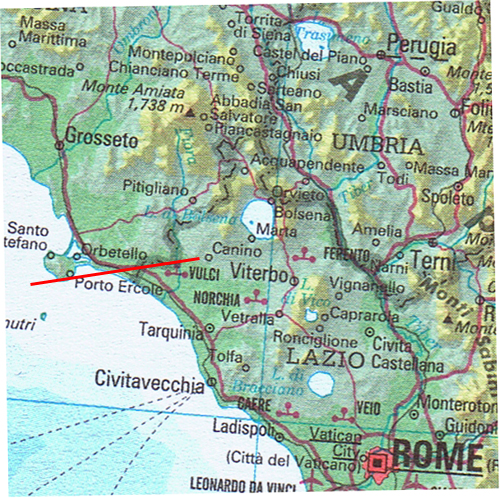 177 HEKSSVLvS CFE TVCARNISSe CANIN FEIRA [Translation:
the six (L. sexus-us, m. ; Gr. hex, m.) alone (L. solus-a-um)
you assemble (L. coeo-ire-ivi-itum) in you; the flesh (L.caro,
carnis) herself (L. se, sese) of Canin (town of Canino) of the
Fiora river or alternatively the market (It. fiera, f. fair,
market] Note that Canino is located about 10 miles from the
Fiora river. This text no doubt refers to Canino on the Fiora,
possibly the home of peerson of the Zagreb Mummy.
177 HEKSSVLvS CFE TVCARNISSe CANIN FEIRA [Translation:
the six (L. sexus-us, m. ; Gr. hex, m.) alone (L. solus-a-um)
you assemble (L. coeo-ire-ivi-itum) in you; the flesh (L.caro,
carnis) herself (L. se, sese) of Canin (town of Canino) of the
Fiora river or alternatively the market (It. fiera, f. fair,
market] Note that Canino is located about 10 miles from the
Fiora river. This text no doubt refers to Canino on the Fiora,
possibly the home of peerson of the Zagreb Mummy.
Z1183 ITEIPAMeNeR CFAAMATRINVM HETReN AC Le TN
[Translation: you go (L. ito-are); Ipa MNR she assembles (L.
coeo-ire-ivi-itum) she loves (L. amo-are) from the group of
three/from the three groups (L. trin-ae-a, three at a time) of
beech trees (Fr. m. hêtre) indeed (L. ac, atque) there
of the god Tin]
Z1192 EISCEM NA CeIKFELeRAE TvNAMTE SIM E TvNAM [Translation: to
them
(L. eis, gen. & dat. they; It. essi, esse, them) or
alternatively, I long for / am hungry (L. esurio-ire) I groan
(L. gemo, gemere, gemui, gemitum) indeed (L. ne [nae] here;
hereupon/in this place (L. hic) ); she is veiled/covered (It.
velare; Fr. voiler); we wonder/we are
inspired (L. attono-tonare-toni-tonitum, to be stunned,
inspired, frantic; Fr. étonner and s'étonneer;
alternate: E TvNAM = from (L. e, ex) the thunder (L.
tono-are-ui-itum; It. tuono, m.; Fr. tonnerre.m.) to you/yours I
am (L. sim, subj.) we wonder/we are
inspired (L. attono-tonare-toni-tonitum, to be stunned,
inspired, frantic; Fr. étonner and s'étonneer;
alternate: E TvNAM = from (L. e, ex) the thunder (L.
tono-are-ui-itum; It. tuono, m.; Fr. tonnerre.m.)] Note: FELeRA declines: FELeRE; see Z1236
below and FELeRES, FELaRV. On SPVR TA
EIS, "to them" see Z1397.
Z1203 CELV CNHINeR RINKIMeRANAN
CeESIFAC Le [I hide (L. celo-are) CN; Hiner I reign
over (L. regno-are); the Chimaera (L. Chimaera-ae) of the Anio
(L. m. Anio-enis and poet. Anienus-i, a tributary of the Tiber
river; alternatively a name of a person, place, or people)
here (Fr. ici); you came out/escaped (It. escire [uscire]; I
make/do (L. facio, facere, feci, factum) there] Note: HINeR
declines: HINeR, HINeRA, HINeRV. (L. hinnio-ire; Fr. hennire,
to neigh, whinny). See Z1292, Z1397, Z1628.
Z1214 [line unreadable]
Panel 33 (6 lines of text) Script ZN
Z1215 [line unreadable]
Z1216 RVM
ISLECARNASe MET 8ACIRVMI TIEVNVR [Translation Rome of the isle
L. insula-ae, f.; It. isola, f.; Fr. ile, f.); in the flesh
(L. caro, carnis); to myself (L se, sese) I gather (L. meto,
metere, messui, messum) the cattle (L. vacca-ae); the Romans
day (L. dies-ei, m.) to honor (L. honos & honor-oris;
honoro-are)] Note: See Z929 on ISLE FESNI.
Z1227 HV TERIIPARVCVPETeNAAMANACCAL [Translation: I
have the lands (L. f. terra-ae) of Ipa; I demand (L. rogo-are)
; the dish (L. patina-ae) she loves; I am born (L. nascor-i),
I call/summon (L. calo-are)]
Z1236 HINeRVHEKSFELeREMAR CFENVR CN [Hinerus the sixth you are
veiled/covered (It. velare; Fr. voiler); the sea (L. mare,
maris; Fr. f. mer) you engage (L. coeo-ire-ivi-itum) the
daughter-in-law/young married woman (L. nurus-us; It. f.
nuora) of CN]
Z1243 MARS
NA VSTEIS TVRACARNALRVIVM [Translation: to
Mars (L. Mars, Martis, m.) indeed (L. ne [nae]) of the bones
(L. os, ossis); the gods (L. di [dii], divi, dea, diva) she
guards (tueo-ere) the carnal/sensual/lustful/in the flesh (L.
caro, carnis; It. adj. carnale; Fr. adj. carnal) in the
kingdom (L. Fr. royame, m. kingdom; It. reame, m. kingdom)]
Z1250 KVReK CEPEN SVL KFA MAR CFA CePRVRvSE RI [Translation: I
set straight (corrigo-riger-rexi-rectu, to put straight, set
right, reform, amend) the branches (It. ceppo, m. stump; Fr.
cep, m. vine-stock; cépage, m. vine-plant) alone (L.
solus-a-um) he/she cherishes/fondles (Fr. choyer) the sea (L.
mare, maris; Fr. f. mer) she engages (L. coeo-ire-ivi-itum)
here; the look-out man (L. proreta-ae and proreus-i) in these
matters (L. res, rei)]
1264 [line unreadable]....CEPEN _ _ _FINVM [Translation......the branches.....the wine (L. vinum-i)]
Panel 34 (5 lines of text) Script ZN
Z1265 SANESFVLC NICSPLVTINTEIM VT TI CESA SI
[Translation: of sound mind/uninjured (L. sanus-a-um) Vulcan
(L. Volcanus [Vulc]-i) I trust in (L. nitor, nixi, nisus or
nixus); Pluto (L. Pluto-(on)-onis); of the gods (L. di [dii]
divi) I enjoy (L. utor, uti, usus) of you/yours (L. tibi; It.
ti) he rests (L. ceso-are) himself (L. se, sese)]
Z1274 ARA
RATVMAIS NALEITRVMSVR EFA SAL [Translation:
at the refuge/altar (L. f. ara) we confirm (L. reor, reri,
ratus) to the bronze (L ais, asis) indeed (L. ne [nae]); we
rejoice (L. laetor-ari) the sister (L. soror, It. suora, Fr.
soeur) she is carried up (L. eveho-vehere-vexi-vectum) of the
salt (L. sal, salis, m.)] Note: SVR is spelled differently
here (not SVR)
Z1282 ESI CeCI HALT SARV ESI Ce SALMVLASANTI Ce
[Translation: you went out (L. escire [uscire]) here that (It.
ci) the summit (It. m. alto; Fr. m. haut) I weed/hoe (L.
sarrio [sario]-ire-ui and -ivi) you went out (L. escire
[uscire]) here of the salt/brine (L. sal, salis, m.); she
strives after (L. molior-iri) the holies (L. sanctus-a-um)
here] Note: seeZ1337, VINVM SANTIS. If VINVM is m. singular,
then SANTIS is singular = wine holy, L. vinum sanctus.
Z1292 RAC NARAPeN SACLENA FIERARECPEIS NA
[Translation: I speak (Fr. raconter; It. caccontare) indeed
(L. ne [nae]); they snatch (L rapio, rapere, rapui, raptum)
the sack (It. m. sacco, Fr. m. sac); the breath/wind/energy
(It. f. lena) or alternatively the procuress (L. lena-ae,
f.) of Fiera I bring (It. recare); you bless (L. beo-are)
indeed (L. ne [nae])]
Z1300 HAVS
TI8ANV SENERISAFEF PE RVINERI [Translation: I empty /swallow
yours (L. haaurio, haurire, hausi, haustim; It. esaurire)
room/opening (It. vano, m.) her (L. se, sese) you weave (L.
neo, nere, nevi, netum); she sailed away (L.
aveho-vehere-vexi-vectum) in the presence of (L. per) the king
(Fr. roi, m.) of darkness (It. nero, m. black, darkness; Fr.
adj. black, dark, gloomy, wicked; negro, m. black)]
Panel 35 (6 lines of text) Script ZO
Z1309 [line unreadable]
Z1310 HA IK
SE RVI RIFA CICESA SIN RVM SACILFA [Translation: she has here in this place
(L. hic [and heic]) her (L. se, sese) king (Fr. roi, m.) of
the stream (L m. rivus-i) that (It. ci) she rests (L.
ceso-are) but (L. sin) Rome herself anything (L. quilibet,
quaelibet, quodibet, subst. quidibet)]
Z1319 NERI CANFA CARSI PVT NAMRVCA LATiNAM (Translation: to the
darkness (It. nero, m. black, darkness; Fr. adj. black, dark,
gloomy, wicked; negro, m. black) as much as you
please/although (L. quamvis); alternatively a person's name
(Canova?) the prison cells (L. m. carcer-eris) I am in put in
the power of (L. potio-ire) for (L. nam, namque) she asks (L.
rogo-are) of the Latins (L. Latinus-a-um)]
Z1326 TEILENA HA VSTIS ENAS ESI CATeNIS 8ESI [Translation: the gods (L.
di [dii] divi); the breath/wind/energy (It. f. lena) or
alternatively the procuress (L. lena-ae, f.) she has of/by the
door/mouth (L. ostium-i); you escape (L. eno-are); she got out
of (It. escire [uscire]); the fetters/chains (L. f. catena-ae;
It. catena) the consuming (L. vescus-a-um)]
Z1334 SPVR
TA SVLvS LENAPTI
RVI LAIS CLA8 EKS NERI [Translation: I
spit out (L. spuo, spuere, spui, sputum) you alone (L.
solus-a-um) of them (Fr. le, him); grand-daughter (L. f.
neptis-is) of king Laius (L. m. Laius-i, father of Oedipus) of
the staff/club (L. clava-ae, f.; It. clava, f.) from/out of
(L. e, ex) the darkness (It. nero, m. black, darkness; Fr.
adj. black, dark, gloomy, wicked; negro, m. black)]
Z1335 [line unreadable]
Panel 36 [6 lines of text] Script ZO
Z1336 [line unreadable]
Z1337 FAC
LeFINVMSANTIS TiSCELIPENTRVTVM [Translation: I make/do (L.
facio, facere, feci, factum) there the wine (L. vinum-i)
consecrated/holy (L. sanctus-a-um) of Dis (god of the
underworld--Pluto) I hid (L. celo-are) the feather/pen (L.
penna-ae, f.; It. penna, f.; Fr. plume, f., empenner, to
feather one's nest) or alternatively the pain/distress (It.
pena, f; Fr. peine, f.) of the Trojans (L. Tros, Trois, m.;
adj. Trous, Troius, Troicus, Troiannus-um, Trojan)] See Z1292
for SANTI, holies.
Z1345 RIRAPiNES
TiSTRVTAN ASA HANeRINCELI [Translation: these things (L.
res, rei) you plunder (L. rapio, rapere, rapui, raptum) of
Dis/the underworld; theTrojan (L. Tros, Trois, m.; adj. Trous,
Troius, Troicus, Troiannus-um, Trojan) she takes to her own
(L. ascio-scire) Hanerin (probably the people of Henna [Enna],
a city in central Sicily which was the cult center of Demeter
and her daughter. It is believed to be the site where Hades
abducted Persephone); I hid (L. celo-are)] Note: See Z1372 on
HANRIN.
Z1352 TVR HE TVMFINVM RICFAC
LeHEKSE TvNAM [Translation: at the tower (L. turris-is;
It. f. torre; Fr. f. tour) you have at this time (L. tum) the
wine (L. vinum-i) rich (It. ricco, adj.; Fr. riche, adj.); I
make/do (L. facio, facere, feci, factum) there; the six (L.
sexus-us, m. ; Gr. hex, m.); we
wonder/we are inspired (L. attono-tonare-toni-tonitum, to be
stunned, inspired, frantic; Fr. étonner and
s'étonneer; alternate: E TvNAM = from (L. e, ex) the
thunder (L. tono-are-ui-itum; It. tuono, m.; Fr. tonnerre.m.)]
Z1359 IK MATAM CN TICNeR CEPENTES AMI TiN [Translation:
hereupon/in this place (L. hic) ) we subdue (Fr. mater) or
alternatively, we boil (L. madeo-ere) CN of/on the beam (L.
tignarius-a-um, of beams, faber. a carpenter) they
chop/seperate (It. m. ceppo; Fr. cep, m.,
branches/stump/bonds; L. separo-are, to separate, to part); I
compose/construct/weave together (L. texo, texere, textum) of
the friend (Fr. m. ami; amie, f. friend, girlfriend; L.
amica-ae, friend or mistress; It. amica, friend, lady friend)
of the god Tin] On CEPEN see Z1139.
Z1367
[words unreadable] E TvNAM RITRVS
E
TvNAM [Translation: we wonder/we are
inspired (L. attono-tonare-toni-tonitum, to be stunned,
inspired, frantic; Fr. étonner and s'étonneer;
alternate: E TvNAM = from (L. e, ex) the thunder (L.
tono-are-ui-itum; It. tuono, m.; Fr. tonnerre.m.) of these
matters (L. res, rei) of Troy? (L. Tros, Trois) we wonder/we are inspired (L.
attono-tonare-toni-tonitum, to be stunned, inspired, frantic;
Fr. étonner and s'étonneer; alternate: E TvNAM =
from (L. e, ex) the thunder (L. tono-are-ui-itum; It. tuono,
m.; Fr. tonnerre.m.)]
Panel 37 (5 lines of text] Script ZP
Z1372 HANeRINE TvNAMCELV CNE TVNAM A RVMI TiN [
Translation: to the Hanerin (probably the people of Henna
[Enna], a city in central Sicily which was the cult center of
Demeter and her daughter. It is believed to be the site where
Hades abducted Persephone) we wonder/we
are inspired (L. attono-tonare-toni-tonitum, to be stunned,
inspired, frantic; Fr. étonner and s'étonneer;
alternate: E TvNAM = from (L. e, ex) the thunder (L.
tono-are-ui-itum; It. tuono, m.; Fr. tonnerre.m.) I hide (L.
celo-are) CN; we wonder/we are inspired
(L. attono-tonare-toni-tonitum, to be stunned, inspired,
frantic; Fr. étonner and s'étonneer; alternate:
E TvNAM = from (L. e, ex) the thunder (L. tono-are-ui-itum;
It. tuono, m.; Fr. tonnerre.m.) to (L. a) the Romans of the god
Tin]
Z1378 PER
ERENI ES LEM SARRVMMVR INFEL
RINES
[by
(L. per) the Furies (L. Erinys-yos, pl. Erinyes) you are (L.
es) the theme (L. lemma-atis) of the series/succession (It.
série f.; Fr. série) or alternatively we bring
forth (L. sero, serere, sevi, satum); the wall (L. murus-i,
m.; It. muro, m.; Fr. mur, m.) in (L. in)
greatness/great/worthy (It. valere, Fr. valeur, f.; valoir,
worthy, to be worthy) you reign (L. regno-are; It. reggere;
Fr. régner)] Note: For ES LEM SARRVM see Z572.
Z1386
CILeReS FAC LeARA RVIVS ETICATeNE TI SeLA PIKVN [Translation: the swift (L. celer-eris-ere) I
make/do (L. facio, facere, feci, factum) there; the
protection/refuge/altar (L. ara, f.) of the king (Fr. roi,
m.); the bones/body (L. os, ossis) I brought forth (L.
edo-edere-didi-ditum); the fetter/chain (L. catena-ae) of
yours (L. tibi; It. ti) the chair (L. sella-ae, f.) they
pick (L. picorer) or alternatively, of the pick-axe (It.
piccone, m.]
Z1397 SeLA
PINAS8A FINV8LI SPVR TA EIS NAHINeRV
[Translation:
the chair (L. sella-ae, f.) of feathers (L. pinna-ae); i.e.
the winged chair; she goes (It. 3rd person indic. of andare,
to go; Fr. 3rd person pres. of aller, to go) to the end (Fr.
fin, f.; L. finis); I bound up / was obliged (L. obligo-are) I
spit out (L. spuo, spuere, spui, sputum) you to them (L. eis,
gen. & dat. they; It. essi, esse, them) indeed (L. ne
[nae]) Hinerus]
Z1408 CaLARESiNS[she calls/summons (L.
calo-are) you yield/give up (L. resigno-are; It. rendre; Fr.
résigner)]
Panel 38 [3 lines of text] Script ZP
Z1410 ES LEMCE ALKVSE
TvNAMAIS NA _ _ _ _ _ _ _ (words
unreadable) [Translation: you are (L. es) the theme (L.
lemma-ae) to us (It. ce) something (L. aliquis, aliquid); we wonder/we are inspired (L.
attono-tonare-toni-tonitum, to be stunned, inspired, frantic;
Fr. étonner and s'étonneer; alternate: E TvNAM =
from (L. e, ex) the thunder (L. tono-are-ui-itum; It. tuono,
m.; Fr. tonnerre.m.) of the bronze (L aes, aeris)
indeed (L. ne, nae)]
Z1417 TVKLA CeER RISVN TvNAMCETA [Translation:
the little toga (L. f togula-ae) here; I wander over/ err (L.
ero-are) these matters (L. res, rei); I sing (L. sono, sonare,
sonnui, sonitum) of thunder (L. tonitrus [-us] m. and
tonitrum-i; verb, L. tono-are-ui-itum) she yields (L. cedo,
cedere, cessi, cessum)]
Z1423 IN
TvNAMRESAN8eLERFEIFESRESERI [Translation:
to/against (L. in) the thunder (L. tonitrus [-us] m. and
tonitrum-i; verb, L. tono-are-ui-itum) they reveal (L.
resero-are) Veler; the long lived/enduring (L. vivax-acis) you
were preserved (L. reservo-are)] Note: For 8eLER see Z561.
Panel 39A & 39B [ two fragments, 4 lines of text]
Z1429 [line unreadable on both fragments]
Z1430
8eLERI FET (torn fabric)
RVNS LeCN RVNTEI TVL FAR [Translation: to the Veleri I
celebrate (Fr. feter; It. festeggiare) the
orbs/rounds/watchmen (It. ronda, f; Fr. rond, adj. round,
ring, circle, orb) there; CN; they will be (L. erunt); woe!
(L. ei!) I endure/bear (L. tolero-are) the grain/meal (L. far,
farris; It. farina, f.; Fr. farine, f.)] Note: For FET see
TC80.
Z1438 RVNEM _ LeT (torn fabric) NAMIKES LEM CI ALKVS [Translation:
to the watchmen (It. ronda, f; Fr. rond, adj. round, ring,
circle, orb)_ _ _ _ _ _ of the thunder (L. tonitrus [-us] m.
and tonitrum-i; verb, L. tono-are-ui-itum) in this
place/hereupon (L. hic [and heic]) you are (L. es) the theme
(L. lemma-ae) which someone/something (L. aliquis, aliquid)]
Note the shift from 1410 CE ALKVS to Z1438 CI ALKVS.
Z1444 RAN HA (blank fabric)NI (torn fabric)_
_TvNAM RESAN
[Translation: the kidney (L. renes-um, m. pl. the kidneys) she
has?.......... of the thunder (L. tonitrus [-us] m. and
tonitrum-i; verb, L. tono-are-ui-itum) they reveal (L.
resero-are)]
Panel 40 [6 lines of text] Script ZQ
Z1448 [line unreadable]
Z1553 TVN TENA CeE
TvNAMA RVMI CARIV PeCFA [Translation:
the thunder (L. tonitrus [-us] m. and tonitrum-i; verb, L.
tono-are-ui-itum) she holds (L. teneo, tenere, tenui, tentum)
here (Fr. ici); we wonder/we are
inspired (L. attono-tonare-toni-tonitum, to be stunned,
inspired, frantic; Fr. étonner and s'étonneer;
alternate: E TvNAM = from (L. e, ex) the thunder (L.
tono-are-ui-itum; It. tuono, m.; Fr. tonnerre.m.) from/by (L. a)
the Romans because of (L. quia) the brook (It. rio, m.; Fr.
rivière, f., stream) of the flocks (L. pecu n. plur.
pecua, sheep, flocks; also pastures)]
Z1562 CISVMTEILANTeS
IS IN CeESI TEIKIMeR [Translation:
the chariot (L. cisum-i) of the gods (L. di [dii] divi) the
wool-bearing/wooly (L. lanatus-a-um) it (L. is, ea, id, he,
she, it) in (L. in) here (Fr. ici) it issued/came out
of/escaped (It. escire [uscire]) the gods (L. di [dii] divi)
of the Chimaera)]
Z1571
STRETASATeRSENAS RIV HAMØERIS (PHERIS) RINVS [Translation:
he/it overthrows/strikes down (L. sterno, stenere, stravi,
stratum; It. stretta) the satyrs (L. Satyrus-i, m.); you
escape by swimming (L. eno-are) the river (It. rio, m.; Fr.
rivière, f., stream) Hampheris of the Rhine (L.
Rhenus-i)]
Z1578 RVIARASMVCVM
ANIA KES RASNAHILAR [Translation: to the king of the
altars we groan (L. mugio-ire) the Anio (L. Anio-enis and
poet., Aniennus-i, m.) the resting place/home (L. quies-etis,
f.; Fr. chez, at home) of the Etruscan; Hilar (person's name)
or alternatively to make joyful/cheer up (L. hilaro-are]
Z1586 [line unreadable_ _ _ _ _ _ _ _ CATE VN HAMØERIS (PHERIS) _ _ _ _ ] [Translation: ...cunningly (L. adv. cate) one (L. unus-a-um) Hampheris.....]
Panel 41 [6 lines of text] Script ZQ
Z1590 [line unreadable ending with ETvNAM] we wonder/we are inspired (L. attono-tonare-toni-tonitum, to be stunned, inspired, frantic; Fr. étonner and s'étonneer)]
Z1591 AIS
NAIKNACREVS CE AIS ERAS SEVS [Translation:
to the bronze (L aes, aeris) indeed (L. ne [nae], used before
pronouns) here in this place (L. hic [and heic]) I come forth
(L. nascor-i); the defendent (L. m. reus-i and rea-ae) to us
(It. ce); to the bronze (L aes, aeris) you wander (L ero-are);
the god Zeus]
Z1600 RVN KVLEMMVRHILAR
RVNEE TERTI Ce [Translation: I watch ( It. ronda, f.
rounds, watch, patrol, f.) by the column (L. collum-i; It.
colonna, f. ; Fr. colonnne, f.); the wall (L. murus-i, m.; It.
muro, m; Fr. mur, m.) Hilar you watch ( It. ronda, f. rounds,
watch, patrol, f.) from/oppsite (L. e, ex) the third (L.
tertius-a-um) here (Fr. ici) ]
Z1607 CARPEKIMENAKVN
KFAMERLVM RePVTiS [
Translation: you proceed/pass over (L. carpo, carpere, carpai,
carptum) the summit (It. cima, f.; Fr. cime, f.) I spring
forth/arise (L. enascore, nasci, natis) the one and the same
(L. unnus-aum) she cherishes/fondles (Fr. choyer); the black
bird restorer (L. repostor-oris, m. restorer)]
Z1615 MVRHILAR RVNATECVM
E TRIN RIMVR
[Translation:
of the wall (L. murus-i, m.; It. muro, m; Fr. mur, m.) Hilar,
or alternatively, to make joyful/cheer up (L. hilaro-are) she
watches ( It. ronda, f. rounds, watch, patrol, f.); we
decorate (L. decoro-are) or alternatively, we cover (L. tego,
tegere, texi, tectum) in regard to (L. e, ex) three at a time
(L. trin-ae-a) the things (L. res, rei); the wall (L. murus-i,
m.; It. muro, m; Fr. mur, m.)]
Z1623 [NAC RVIS VN KFA HE TVMHILAR RVNA RENeR [Translation: I
come forth (L. nascor-i) of the kings (Fr. Roi) the one and
the same (L. unnus-aum) she cherishes/fondles (Fr. choyer);
you have at that time (L. tum); Hilar, or alternatively, to
make joyful/cheer up (L. hilaro-are) she watches ( It. ronda,
f. rounds, watch, patrol, f.) to reign/ prevail (L.
regno-ari)]
Panel 42 [5 lines of text] Script ZR
Z1628
HVRSI CeCAP Le RVCEK AMENA CeEIS
NAHINRV [Translation:
in this direction in time (L. horsum) here; the head (It. f.
cappa; Fr. f. cape) there I moisten (L. roro-are) ; whatever/
by whatever way (It. checche; L. quacumque) I like (L.
amo-are); she escapes (L. eno-are) here to them (L. eis, gen.
& dat. they; It. essi, esse, them) indeed (L. ne [nae]) or
alternatively, I long for / am hungry for (L. esurio-ire)
indeed (L. ne [nae]) Hinerus (to bring forth?)] Note: EIS NA
HINRV repeats at Z1192, Z1292,
Z1397. The word declines: HINR, HINRA, HINRV and would
appear to be a verb, possibly L. gigno, gignere, genuii,
genitum, to beget, bear, bring forth, cause.
Z1641 HE TVM HILAR RVMAE TERTI CeCARRA [Translation:
you have at that time (L. tum) the intestines (L. hillae-arum,
f. pl. intestines of animals; kind of sausage) of Rome
from/oppsite (L. e, ex) the third (L. tertius-a-um) here (Fr.
ici); Carrara (place where marble was quaried in Roman times)
or alternatively, at the Great Bear, (It. carráia, f.)]
Z1647 E
TvNAMAIS NAIKMATAMFAC Le TvNAM
(Translation: we wonder/we are inspired
(L. attono-tonare-toni-tonitum, to be stunned, inspired,
frantic; Fr. étonner and s'étonneer; alternate:
E TvNAM = from (L. e, ex) the thunder (L. tono-are-ui-itum;
It. tuono, m.; Fr. tonnerre.m.); to the bronze (L aes, aeris)
indeed (L. ne [nae], used before pronouns) here in this place
(L. hic [and heic]) we subdue (Fr. mater); I make/do (L.
facio, facere, feci, factum) there we thunder forth (L.
tono-are-ui-itum) or alternatively by the thunder (L.
tonitrus-us, m. and tonitruum; Fr. tonnerre, m. thunder)]
Note: See MATAN at Z1777, in which case "we are boiled" would
not seem to work here.
Z1654 RVNEMCI ALKVS MASeNVNI ALTI VRSvM NA Le [Translation: We watch ( It. ronda,
f. rounds, watch, patrol, f.) by this means/which (L. quae,
qui) something/ anyone/someone (L. aliquis) they heap/ mason
(Fr. masser); the goddess Uni the great (L. altus-a-um) the
beginning/understanding (L. orsa-orum) indeed (L. ne [nae])
there]
Z1662 AR
REACILANSAC NI CN CILeR
CEK ASAL
[Translation: I cultivate (L. aro-are) this matter (L. res,
rei); of the eagle (L. Aquila-ae); or/whether (L. an; It. an)
the sac/purse if not (L. ni) of CN; to hasten (L. celero-are)
by whatever way (It. checche; L. quacumque) in (L. a) from the
salt (L. m, sal, salis]
Panel 43 [2 lines of text] Script ZR
Z1770 CVSCLVCECAPERISAM TI CeSFEMRVM SA [Translation: I give as a
reason (L. causor-ari) you drain (L. cloaca-ae, f.; v.
sicco-are; Fr. assécher)] the Caperi/goats (L.
caper-ri, m. he-goat) to the leg (It. zampa, f.; Fr. jambe) of
yours here (Fr. ici); we are accustomed (L. suemus;
suesco-suescere-suevi-suetum); at Rome herself (L. se, sese)]
Note: CAPERI is mentioned first at Z-B4. See Z834 for CLVCeRRAS Z842 CAPERI SAM RIC.
Z1777 MATANCLVC TRASHILAR
[Translation: they are boiled (L. madeo-ere); I drain (L.
cloaca-ae, f.; v. sicco-are; Fr. assécher) you pull (L.
traho, trahere, traxi, tractum) the intestines (L.
hillae-arum, f. pl. intestines of animals; kind of sausage)].
Two blank panels follow and then fragments leading to one last complete panel.
Panel 44 [blank] Script ZR
Panel 45 [blank] Script ZR
Panel 46 [fragment, 5 lines of text] Script ZR
Z1780 RVI FIA 8IRA [Translation: ......The king (Fr. Roi, m.) he comes into existence (L. fio, fieri, factus sum) he is healthy, fresh (L. vireo-ere)
Z1781
FERSVMSPANSA [Translation:
......upwards (L. versum) he went forth (It. spandare; past
part. spanse)
Z1784 PETRASA [Translation:
........the stone/rock (It. pietra, f. stone] he takes to
himself (L. ascio-scire)]
Z1787 SIK
RICNRVNT
[Translation: .......I inscribe (L. segno-are) these things
(L. res, rei); CN they will be (L. erunt)]
Z1789 VK TIR VR [Translation: ......the aversion (It. uggia; possibly related to Fr. ogre, m., ogress, f., ogre, ogres) I pull out (It. tirare; Fr. tirer) of the region/country (L. ora-ae f.)]
Panel 47 [5 lines of text]
Z1792 ACNI CN [Translation: the lambs (L. agnus-i) of CN]
Z1793 SERR SE TIN SI [ I Lock up (It. serrare;
Fr. serrer) myself (l. se, sese) the god Tin supposing that
(L. si)]
Z1797 IPVTETVLRAN SVR
[Translation: _ you are in the power of (L. potio-ire) they
bear/carry (L. tolero-are) the sister (L. soror)]
Z1800 I
CLERICILeR Le
[Translation: I made illustrious (L. clareo-ere); to hasten
(L. celero-are) there]
Z1805 RAT TI [ Translation: I judge/confirm (L. reor, reri, ratus, to think, suppose, judge; It. f. rata, installment) of you/yours]
Panel 48 [7 lines of text in two fragments]
Z1806 [AT_ _ _ _ _ _torn-line unreadable]
Z1807 IRI _ _ CILeReS [Translation: the wrath (L. f. ira-ae) the swift (L. celer-eris-ere)]
Z1809 FELS
RES Ce SFE
CeAN [Translation: the swift/swiftly (L. n.
velox-ocis; adv. velociter; It. adj. veloce; Fr. vite)
matter/thing (L. res, rei) here (Fr. ici) you join
together/sew (L. suo, suere, sui, sutum) here; whether (It.
an)]
Z1813 [_ _
_ _ torn-unreadable] E S [_ _ _ _ torn
-unreadable] PVTETVL [ Translation: out of, from (L. e, ex) _ _ _
_ _ you are in the power of (L. potio-ire); I endure (L.
tolero-are)] Note: Reconstruction based upon Z214.
Z1818 [_ _
_ _ torn-unreadable] ITI VRIMAFILSKISCISVM _ _ _ _ _ _ _ RI
Translation: _ _ _ _ _ to you/yours (L. tibi; It. ti) we speak
/beg (L oro-are) the habitude within (L. cis) the two wheeled
cart, the chariot (L. cisium-i) _ _ _ _of these matters (L.
res, rei) or alternatively, of the lords (LERI)] note: see
Z84--containing the same verse.
Z1825 [_ _
torn-unreadable] SVR HARaR RI REPIN RIC SAC NI [_
_ _torn-unreadable _ _ _I ERIC] [Translation:_ _ _ to the
sister (L. soror; It. suora f.; Fr. soeur, f.) I hang on to
(L. haereo, haerere, haesi, haesum) the things (L. res, rei);
they get again (L. reperio) rich (It. ricco; Fr. riche); the
sack/purse (L. sacculus-i, m.; It. sacco, m.; Fr. sac, m.)
unless/nor (L. ni, unless; Fr. ni, nor)_ _ _ _ _ _ _I erect
(L. erigo-rigere-rexi, rectum)] Note: See Z308 & Z378 for
similar content; the sack is probably the mummy wrapping.
Z1832 [_ _
torn-unreadable] S _ VNI OI MERLVM ERIC CN [_ _ _ _ _ _torn-unreadable] [Translation:
the things/matters (L.res, rei) of the blackbird(s) (It merlo
m.; L. merula-ae f.) I raise (L. erigo-riger-rexi-rectum); CN]
Note: See Z969 for MERLVM ERIC.
Panel 49 [5 lines of text; this is the last panel from the Zagreb Mummy]
Z1835 SFE CeANCaSa MENEVTIN CESIKNE
SETI LVNE Ce [Translation: you
sew/join together (L. suo, suere, sui, sutum) here (Fr. ici)
whether/or (It. an) to the house you lead (Fr. mener); they
are at leisure (l.otior-ari) to us (It. ce); you seal/mark (L.
signo-are) the seats (L. f. sedis-is) of the moon/months (L.
lune) here (Fr. ici)]
Z1846 RAKaR TVRANVN
RENeR CLETRAMSeREN TFE [Translation:
to narrate (Fr. raconter) she burns/dries up (L. torreo,
torrere, torrui, tostum) not (L. non) to reign (L. regno-ari);
the trellis (L. clatri-orum) serene you regard (L. tueo-ere)]
Note: a verb shift occurs with the epithet, CLETRAM SeREN from
CFE to TFE here and at Z1021.
Z1853 TEI 8ASEISAR 8eNERSVS LENVN
REN [Translation: the gods (L.
dii); the vases (L.vas, vasis, a utensil; It. m. vaso, pot,
vessel, vase) Sar to come in the course of time (L venio,
venire, veni, ventum); the double (It. m. sosia) of her (It.
le) not (L. non) I reign (L. regno-ari)]
Z1861 8ARaRANAIS ERASSEVS CLETRAM SeREN CFE [Translation:
they shall change (L. vario-are); to the bronze (L. aes,
aeris) you (pl.) wander (L. erro-are); to Zeus of the
grating/trellis (L. clatro-orum, trellis) serene (It. sereno,
m.; Fr. serein) you assemble (L. coeo-ire-iv-itum)] Note: see
Z336 for the same word group with different punctuation marks.
Z1869
[word unreadable RAKAR] TVRANVN RENeR TEI8ASEINVN RENeR [to narrate (F.
raconter) she burns/dries up (L. torreo, torrere, torrui,
tostum); not (L. non) to reign (L. regno-ari); the gods (L.
dii); the vases (L.vas, vasis, a utensil; It. m. vaso, pot,
vessel, vase); not (L. non) to reign (L. regno-ari)] Note: RAKaR reconstructed
based on Z1846.
Z1877 [line unreadable] Last or first line of the linen depending upon whether you read from the first panel or the last.
Notes: (1) Translation of FEL as "great" supplied by Petre Misicu (pvmisicu@acorp.ro). It coincides with Romanian, he says, "VEL (E), VEL (R) = great. It was used as a prefix to a title, during the Middle Age. From VEL is derived the Romanian word VELEITATE, corresponding to the French VELLEITE." Fr. Vellét é, f., inclination, whim, slight impulse.
 Return
me to Etruscan Phrases Send
me to Table 1, Etruscan Vocabulary
Return
me to Etruscan Phrases Send
me to Table 1, Etruscan Vocabulary Launched 4.15.01
Updated
7.01.01; 7.07.01; 7.15.01; 7.24.01; 7.29.01; 8.05.01;
8.12.01; 8.18.01; 8.26.01; 9.03.01; 9.09.01; 9.16.01;
2.03.02; 3.10.02; 3.17.02; 3.31.02; 4.07.02; 4.21.02;
4.28.02; 5.05.02; 5.12.02; 5.19.02; 5.29.02; 6.02.02;
6.15.02; 6.23.02; 6.29.02; 7.05.02; 7.14.02; 7.28.02;
8.05.02; 8.11.02; 8.18.02; 8.25.02; 9.02.02; 9.07.02;
9.15.02; 9.22.02; 9.28.02; 10.12.03; 11.16.05; 3.27.06;
5.10.06; 7.16.06; 7.22.06; 2.11.08; 7.15.09; 7.19.09;
7.21.09; 12.05.11
Copyright
© 1981-2011 Maravot. All rights reserved.
Copyright
© 1981-2011 Mel Copeland. All rights reserved.

 (rare)
