
Etruscan_Phrases
Translation of the Tavola Cortonensis

by
Mel Copeland
(from a work published in 1981)
About the Translation
1.21.12
- We are in the process of updating all of the
Etruscan Phrases pages, based on the Etruscan
Phrases Glossary spreadsheet. These updates are
presented as Work Notes PDF files. For this page see
"Work
Notes on the Tavola Cortonensis." January 20,
2012. For the Zagreb Mummy see "Work
Notes on the Zagreb Mummy." (These documents
are available at acadameia.edu/Mel
Copeland)
This work is based upon a reconciliation
with other scripts of the Etruscan
Phrases home page. This is a letter to Prince
Salinis and the Salini demanding fare (nalum) for
the passage through the region. The town Velcha, is
mentioned twice and a prince Pomeius (of Pompeii?)
is mentioned. The defenders are in a fortress upon a
craig and the opposing commander notes that he will
stay until the beseiged queen pays the fare
(possibly a ransom). The letter refers to married
women / daughters-in-law (nuora). The letter
concludes with repetitious phrases demanding the
passage money. The letter repeatedly employs the
gods 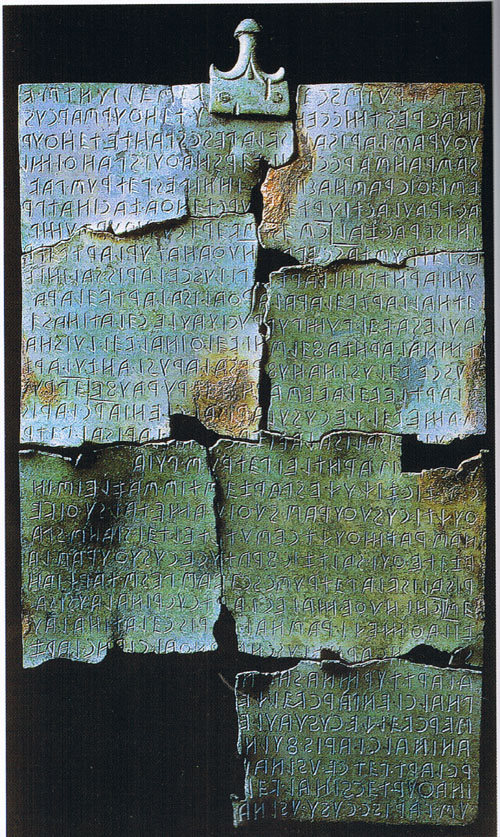 when
making its lawful case and in the final line
concludes the demand before the face of the gods to
hand over the face of the passage money. The text
mentions the Rasna (name the Etruscans called
themselves) twice and refers to its author as of the
Latins. The name, Rasna, also appears at Z1578, of
the Zagreb Mummy script, and K26, K119, a list of
kings and queens of the Etruscans. Places in
Campania and the Oscans are mentioned, and it may be
that the author, identified as of the Latins, was
from the area of Bologna (Felsini) which is
mentioned early in the script. The tablet was found
in Cortona, not far from Felsini. Where you see the
when
making its lawful case and in the final line
concludes the demand before the face of the gods to
hand over the face of the passage money. The text
mentions the Rasna (name the Etruscans called
themselves) twice and refers to its author as of the
Latins. The name, Rasna, also appears at Z1578, of
the Zagreb Mummy script, and K26, K119, a list of
kings and queens of the Etruscans. Places in
Campania and the Oscans are mentioned, and it may be
that the author, identified as of the Latins, was
from the area of Bologna (Felsini) which is
mentioned early in the script. The tablet was found
in Cortona, not far from Felsini. Where you see the
 I am
working.
I am
working.
The words for the translation below are selected from the Etruscan_Phrases.html, and Etruscan GlossaryA.xls. Characters that are underlined are difficult to read and may not be correct.
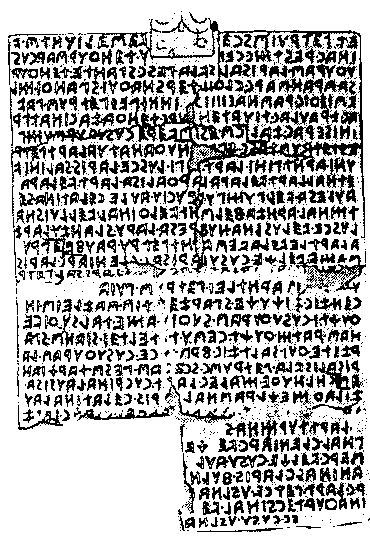
The
two drawings of the Tavola Cortonensis on this page
were from an Italian newspaper when various versions
of the script were published July 4, 1999. The photo
is from "The Etruscans," by Federica Borrelli and
Maria Cristina Targia, The J. Paul Getty Museum, Los
Angeles.
Each line of the script is preceeded by an
alpha-numeric locater; i.e., TC1 is the first line,
TC7 is the second line, TC19 is the third line.
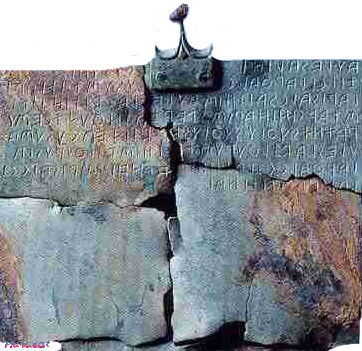
The following is the translation of the text, based upon the other scripts. It is being reworked based upon the new photo providing a clearer reading. Corrections will be reflected in Etruscan GlossaryA.xls.
Begining of the script:
TC270
to Prince Salini I plead to it
TC283 namely to the goddess Ral we plead; you kept
of the god Tinia to the
TC290 gods of anyone; to the Salinis of the prince
of her who of the god Tini out of the
movement/departure
TC298 to stand oneself you threaten yourself; you
scatter until I demand of you to stop
TC307 we confirm upon the river upon the river the
salt of the Velches; I plead
TC318 you omit an odor of it; to sneak away we
speak; the god Tini , his movement; to flirt we
speak of her
TC327 the goddess Ral here; those she cleaves to;
she loves there; the gods of something of it
TC338 of the Latins..............money/fare
TC1
and to the rocks you know you shake him of the
eleven
TC7 at the vineyard here we stop here to dine to
hold the undertaking of Argos
TC19 at the boundary you plead; the gods to the
Sulla; the army here you scatter; to possess the
boundary/region
TC28 to herself they join together; they err of the
elegant indeed of the king we shall scatter there
TC38 you left from the rich; to the Etruscans
[number, 96?] I flowed over the army of the rocks; I
fear
TC46 and indeed you take up the oil here; to
yourself the boundary I hold here; the coast she
will hold herself; you burn
TC56 she knows beforehand the salt of the house;
since to suppose you bear to plead of the beginning
TC61 you are of the rocks; yours, you know how
to....the daughter-in-law to be born of the god /
lord of your rock
TC71 the goddess Uni; you denied; of the
battlements; lord of the army, to us of the lords of
the Salini
TC80 I celebrate the fare /passage money of your
god; Velara (or the great altar); the god(dess) Ral
that person is your god Velara
TC90 the princes to the great rocky Pompeius
(Pompey); the prince of us of the Latins
TC103 we settle the fare / passage money; the tool
of the [city of] Felsini; the great regent there;
the great Luis (3) indeed
TC108 the Oscan; the map he navigates over of the
new return; the ghost I rush upon of your god
TC120 the god you lift you bathe at / by the rock;
the party in a law-suit he goes against out of the
straight-forward
TC127 you love happiness; the cause of the gods,
ai!; ... I made straight the bow; the gods
TC137 ......gods of another squadron /
ship..ac...the gods, ai! of the rock
TC144 ..your [river] Arno of the lionesses; of the
rocks; afterwards
TC150 I dine thus; I notice because you scatter of
the god Dis; the stone they violate, abandon
TC161 I demand yourself to reason; upon the river
you love; like your shore
TC170 born; we confirm; I demand of you to stop; of
you; as of the gods; if supposing that the
opportunity he expects
TC179 you hunger yourself; to the king; I explode
thus; to swindle to us to reason you argue; to her
TC190 he is pleased of the legal controversy of
anyone, anything; the rocks here; you know of the
divine law; the army to stay they make plain to the
mind
TC201 from which time I recorded the
daughters-in-law evil to call of yours the god of
you; I collect of the queen; praise and that to
TC213 to be silent there to me the Etruscans ....RIS
to us the Latins of fame
TC220.......the arms Oscan.....RAL the clan here; of
the god
TC231 hers; your god the god Terminaus (god of
boundaries)
TC236 in woe! the clans of the bow; of Velcha
TC241 I join together here; Velcha; the cause of the
prince
TC248 to the years of the fare passage money here;
the gods, they ordain...
TC260 the bow?; your god; I strive over to us; the
face there of the fare / passage money
TC266 until I plow the border; I protect if however
the passage money of the great
TC271 to the face of the gods here I demand the
faces of the passage money/fare
(TC1)
ET PETRVIS SCE FESE LI
VNTS F [Translation: and (L. et) to the
rock/promentories/rocks (It. pietra) you know (L.
scio, scir, scivi or scli, scitu) you shake/ annoy
(L. vexo-are) him, him, it, them (L. ille, illa,
ilus; he, hic, ille, is; It. lui, lo, gli; Fr. le,
lui, celui) of the eleven (l. undecim, It. undici,
Fr. onze)] Note: In Tuscany today hilltop towns are
often referred to as "rocks."
PETRVIS SCE FESE LI
VNTS F [Translation: and (L. et) to the
rock/promentories/rocks (It. pietra) you know (L.
scio, scir, scivi or scli, scitu) you shake/ annoy
(L. vexo-are) him, him, it, them (L. ille, illa,
ilus; he, hic, ille, is; It. lui, lo, gli; Fr. le,
lui, celui) of the eleven (l. undecim, It. undici,
Fr. onze)] Note: In Tuscany today hilltop towns are
often referred to as "rocks."
(TC7)
(F)INA CeRESTvM CeCENVTENR VRS ARCVS [Translation:
at the vineyard (L. vinea-ae) here (Fr. ici) we
stop, await or alternatively I stop, await (L.
restem, 1st pers. sing. conjunctive; L.
resto-stare-sti, to make a stand, resist, oppose, to
stand still, stay behind, draw back, survive, to
await; It. restare; Fr. rester) here (Fr. ici); to
dine (L. ceno-are); to hold (L. teneo, tenere,
tenui, tentum) the undertaking/beginning (L.
orsus-us, m.) of Argos/ place name (L. Argos &
Argi-orum, capital of Argolis in the Peloponnese) (6)]
Note: FINA begins on line TC1.
(TC19)
VR VRAS LARIS AL SFLA PES CeSPANTETENR
VR [Translation: at the coast/boundary (L. ora-ae)
you plead (L. oro-are); the hearths/ household
deities to the (It. al) Sulla; the army (L. m. pes,
pedis.) here (Fr. ici) you scatter (It. spandare);
to possess (L. teneo, tenere, tenui, tentum) the
region (L. ora-ae)]
(TC28)
SA SeRAN SAR Ce
EReN TERSNA RVI SPANeRIM Le [Translation: to
herself (L. se or sese; It. si; Fr. sa; region is
f.) they join together (L. sero, serere, serui,
sertum) I hoe, weed, cultivate (L. sario-ire; It.
sarchiare; Fr. sarcier) here (Fr. ici); they err,
wander (L. erro, errare, erravi, erratum) of the
refined/rounded/elegant (L. teres-retis) indeed (L.
ne (nae); It. ne; Fr. ne); alternatively Tersna,
name of the king; of the king (Fr. roi) scatttered,
spread out (L. sparsum) or alternatively,
scatteredwe shall scatter / spill (L. spargo,
spargere, sparsi, sparsum; particle, sparsus-a-um,
spread out, scattered, speckled; It. spandare, fut.
ind. spanderemo) there (le) Note: Le may apply to
TC38. This phrase makes sense as: "to herself they
join together; I cultivate here; they err of Tersna
the king, scattered there." The "NA" is found as a
determinative, as in the name of the goddess, RALNA,
mother of Helen of Troy (See Divine_Mirror.html)
(TC38)
ESI E RICRASNA SIIIC
INNI PES PETRVS PAF [Translation: ESI E RIC, I/you
left (L. exeo-ire-li- [ivi]-itum) from (L. e, ex)
the rich (It. ricco) (4) to
the Etruscan (Rasna) of (text unreadable) I/you
flowed over (L. inno-nare) the army (L. pes, pedis);
the rocks/promentory (It. pietra); I fear (L. paveo,
pavere, pavi) Note: Applying the "L" from TC28,
LESIE carries a suffix suggesting a proper name, as
in the case of the Etruscan Phersipnei (Persephone
– Etruscan_Mural.orcus.gif) and
ELINAI (Helen – See Divine_Mirror.html); the
proper form should be LESEI or ESEI. RIC appears to
be an adjective or noun, wealthy, rich, and is used
five times in the Zagreb Mummy script. Another word
is RIKE, RIKES, used in the Tavola Eugubine, Script
Q. The "K" suggests "g" as in L. rigo-are, to water.
The "E" faces the word ESI and thus belongs with
that word.]
(TC46)
AC TRA VLA CeTI VR TEN
_ VR CeTENRA SA CINAT or CINA Te PR
[Translation: and also/indeed (L. ac, atque) she
takes up / pulls (L. traho, trahere, traxi, tractu),
the oil (L. oleum -i; It. olio, m. Fr. huille, f.)
or earthen pot (It. olia, f.) or olive (L. oliva,
olea) here (Fr. ici); to yourself/of yours (L. tibi)
the coast/boundary (L. ora-ae) I hold (L. teneo,
tenere, tenui, tentum) the coast (L. ora-ae) here
(Fr. ici); she will hold (L. teneo, tenere, tenui,
tentum) herself / itself (L. se, sese) Cina, yours
(te) PR] Note: Cina may be the territory of Siena or
the town Torrita di Siena, near Cortona; in any
event, since this tablet lists cities, the context
of a city would appear to be appropriate here.
(TC56)
(PR)INISERA CeSAL CaSa E SIS FERE CVSVR VRSVM
[Translation: she knows beforehand (L.
praenosco-ere; It. preannunziare, to announce, to
forebode) here (Fr. ici); the salt (L. sal, salis,
m.) of the house (L. f. casa-ae); since (L. e, ex)
to wish/ to be willing/suppose (L. si vis, sis) you
bear (L. fero, ferre, tuli, latum) / as a general
rule – L. fere) to give as a reason/plead (L.
causor-ari) of the beginning/understanding (L.
orsa-orum)] Note: For VRSvM see Z1654.
(TC61)
ES PETRVSTA SCE F _ _
_ NVRA
NATVR (1) LAR
Te PETR [Translation: you are (L. es) of
the rocks/promentories (It. pietra); yours/thine (L.
tibi, ta) you know how to (L. scio, scir, scivi or
scli, scitu)....the daughter-in-law/young married
woman (L. nurus-us f.) to be born (L. nascor-i,
natos and [gnatus]) of the household god/hearth (L.
lar, laris, m.) of your (L. tibi; It. ti) rock (It.
pietra)] .
(TC71)
VNI APNIPINI LAR TePILVS (2) CE
LARIS SALINI F [Translation: the goddess Uni; you
denied (L. abno-nuere-nui); of the wings/battlements
along the top of the wall (L. pinna-ae); the
household god/hearth (L. lar, laris, m.) of yours
(L. tibi; It. ti); the army of us (It. ce) of the
household gods/hearths (L. lar, laris, m.); of the
Salini/salt-marsh, salt-works (L. salinae-arum, f.)]
Note: PINI declines like a verb; F goes with the
next line.
(TC80
) (F)ET (5) NAL
LAR Te FELARA LAR RAL IS A LAR Te FELARA [Translation: I celebrate (L.
festus-a-um, f. of a holiday, festive, of people,
keeping holiday; n. as subst. a feast; Fr. feter, to
celebrate; It. festeggiare) the fare / passage money
(L. naulum-i) of the household god/hearth (L. lar,
laris, m.) of you/of yours (L. tibi; It. ti) Velara;
name meaning, he/she conceals/is veiled (It. velare)
or alternatively, the great (fel) altar L. ara, f.
altar, refuge, protection); the goddess (L. lar,
laris, m.) Ral (name) that person (L. is, ea, id) at
(L. a) of the household god/hearth (L. lar, laris,
m.) of you/of yours (L. tibi; It. ti) of Velara;
name meaning, he/she conceals/is veiled (It.
velare)] Note: A name akin to Ral is Ralna, a wife
of the god Tin who is the mother of Helen of Troy.
See the Divine_mirror.html for her
grouping in the Etruscan pantheon.
(TC90)
AVLES A FEL PVMPVI RVCIV AVLE CE LATINA SE; [Translation:
the lords/princes (L. aule) to (L. a); the
great/good Pompeius (Roman gens; possibly the town
Pompeii-orum) rocky (Fr. rocheux-e, adj. rocky,
stony; It. roccioso); a prince (L. aule) to us (It.
ce) Latin (L. Latinus-a-um)].
(TC103)
(SE)TM NAL ARNSA 8ELSiNI FEL RINA LeFEL (3)
LVIS NA; [Translation:
[settled/we settle (L. sedeo, sedere, sedi, sessum)
the fare/passage money (L. naulum-i); the
tool/implement (It. arnese, m.) of the people of
Felsina (later called Bologna, after the Boii
invaders ); the great/good regent there; the
great/good Luis [based on you shine (Fr. luire]
indeed (L. ne [nae])] Note: See FELeRE
at Z1236.
(TC108)
VSCE FELVS INA
NV8 RESA LARV SLANSV LAR Te
[Translation: the Osci (L. Osci-orum, an ancient
people of Italy); the skin/fleece (L. vellus-eris
– used here to refer to a map?) he sails over,
navigates (L. inno-nare) of the new (L. novus-a-um;
It. nuovo; Fr. neuf, nouveau) yield, surrender,
return (It. resa, f.); the ghost/spectre/mask (L.
larva [larua]-ae) I thin out (It. slanciare) or
alternatively hurl myself/ bring out to myself (It.
lanciare; Fr. se lancer, to rush); of the god (L.
Lar, Laris, m.) yours (L. te) Note: The Oscans
occupied the territory south of Rome to Naples /
Pompeii]
(TC120)
A LAR Te LEFE LAFES
AN PETRVRA V8E E PRV [Translation: to (L. a)
the god (L. Lar, Laris, m.) yours (L. te) you lift
up (L. levo-are) you (pl) bathe/moisten (L. lavo,
lavare, lavere, lavi, lautum or lotu or lavatum) by,
at the the rock (It. pietra, f.); the party in a
law-suit (L. rea-ae, f.) he goes against (L.
obeo-ire-ivi-itum) out of (L. e, ex) the
straight-forward/prose (L. prosus-a-um);]
(TC127)
S AME
FILiK E CVSV LARI AI _ _ LENI ARC LARIS [Translation: (S belongs with line
TC120, PRV) you
love (L. amo-are) happiness/good luck (L.
felix-icis) out of (L. e, ex); the cause (L. causa;
It. causa, f.; Fr. cause) of the gods (L. Lar,
Laris); ai! (L. ai!, interjection of grief); _ _ I
made straight (L. lineo-are) the bow (L. arcus-us,
m. the bow); the gods (L. Lar, Laris)]
(TC137) ......V...................................text damaged.............................LARIS ALIS ALAE...AC...LARIS AI PETR [Translation: ...(unreadable)...the gods (L. Lar, Laris) of another, different (L. alis, alid, old form of alius -a- aliud, another, other, different) wing, poet. of the oars of a ship, squadron (L. ala, ae, f.) ..AC....of the gods (L. Lar, Laris) ai! of the rock/stone (It. pietra, f. stone; Fr. pierre, f.; Gr. petra)]
(TC144)
.....S ARN Te
LEI PETRVS PVIA [ Translation: ...s the Arno (L.
Arnus-im, chief river of Etruria) of you/yours (L.
te) of the lionesses (L. lea-ae & leaena, f.);
of, by the stones/rocks (It. pietra, f. stone; Fr.
pierre, f.; Gr. petra); afterwards ( It. poi; Fr.
puis)
(TC150)
CENSICSIKV KE SPARSES TISSAS LEISIN
[Translation: I dine (L. ceno-are); in this
way/thus; I sign / notice (L. signo-are) because
(It. che) you scatter/circulate (L. spargo,
spargere, sparsi, sparsum) of the god Dis/underworld
(L. Dis, Ditis m., Pluto); the stone/pebble (It. m.
sasso) they violate (L. laedo, ladere, laesi,
laesum) or alternatively, they abandon (Fr.
laisser)]
(TC161)
RVK TI CVSVR VRAS SV RIVAME
TAL SV RIFE [Translation: I
propose/impose/demand (L. rogo-are) you (L. tibi);
to give as a reason/plead (L. causor-ari) you beg
(L. oro-are); upon (L. su; It. su) the river/stream
(It. rio, m.); you love (L. amo-are); like (It.
tale; Fr. tel, telle) upon (L. su; It. su) the
shore, stream (L. rivus-i, stream; It. rifa, f.
shore, bank, waterfront; Fr. rive, f. bank, shore,
strand)]
(TC170)
NAS RATvM RVK Te CESV Te TEL TEI SI ANSSPA; [Translation: born
(L. nascor-i) we confirm (L. reor,
reri, ratus) I demand (L. rogo-are) of you (L. te)
to stop/stop! (L. cesso-are; It. cessare; Fr.
cesser); of you (L. te); the same/like (Fr. tel,
telle) of the gods (L. di [dii] divi); if/supposing
that (L. si) the opportunity (L. ansa-ae, f.,
handle, occasion, opportunity; Fr. anse, f.,) he
expects (L. spero-are)] Note: See TC150 and TC 298
for SPARSE; on RATVM
see TC307 and Z1274.
(TC179)
ESE TE RVI SALT SIC8RATV CE CVSVR
VRASLA [Translation: you hunger (L.
esurio-ire) yourself (L. te; It. te, Fr. te); the
king (Fr. roi; L. rex, regis; It. re) I dance/sing
with gestures (L. salto-are) or alternatively, leap
over/explode (It. saltare; Fr. sauter) thus (L.
sic); to cheat / swindle (L. fraudo-are) to us (It.
ce) to give as a reason/plead (L. causor-ari) you
argue (L. oro-are); to her (It. la; Fr. là)]
(TC190)
RISA LIS FLA PETRVS Ce SCE FAS PES STAR
KIAN [Translation: he
is pleased (L. rideo, ridere, risi, risum) of the
legal controversy/strife (L. lis, litis, f.) of
anyone, anything (L. ullus-a-um); to the
stones/rocks (It. pietra, f. stone; Fr. pierre, f.;
Gr. petra) here (Fr. ici); you know (L. scio, scir,
scivi or scli, scitu) of the divine law/fate/lawful
(L. fas); or alternatively, you avoid (It.
schiavare) the army to stand/stay (It. stare) of
Chiane (Chianciano, Chiana Valley, near Chiuso. See
Miscellaneous_Scripts.html,
AB-1, CHIANA]
(TC201 E SICNI NVRE MALE CIAR Te CVC RINALAVS IS A [Translation: (E faces and belongs
with KIAN) I recorded (L. signo-are) the daughters
in law/young married women (L. nurus-us, f., It.
nuora, f.) evil (L. malum-i, evil, harm, disaster,
punishement; adv. male, badly, ill) to move, call
(L. cieo, ciere, civi, citum) of yours (L. ti) I
collect, bring, draw to one point (L. cogo, cogere,
coegi, coactum) the queen (L. regina,; It. reginna,
f.; Fr. reine, f.); praise (L laus, laudis; to
praise, L. laudo-are) and
that to (L. is, ea, id; she, it; with et-que, etc.,
and that too, and what is more) to (L.
a)] Note: On RINA see
Z530. LAVS IN I... or LAVSINI is at SC-1]
(TC213)
SILAR MEK LeRASNA L_ _ _ RIS CE LATINA LAV [Translation: to be
inactive/silent about (L. sileo-ere-ui) to me (It.
meco) there the Etruscans (Rasna)_ _ _RIS; to us
(It. ce) of the Latins (L. Latinus-a-um) of
fame/praiseworthy action? (L. laus, ladis, f.)]
(TC220)
...(missing/damaged text).....NR ARMI
VSC N F_ R _ _
RAL CLEN Ce LAR S [Translation:
...........N R the arms (L. arma-orum; It. arme, f.;
Fr. arme, f.) Oscan (L. Osci-orum, an ancient people
of Italy) N..F..R I rejoin (Fr. rallier) the clan
(L. tribus, gens; It. tribu; Fr. clan), m. here (Fr.
ici); the gods / lords (L. lar, laris)(L.]
(TC231)
(S)ALAR TeTVRMNAS A_ _ N.....(damaged
script) [Translation: at, by (L. a) the
household god/hearth (L. Lar, Laris, m.) of
you/yours (L. tibi; It. ti) Terminaus, the god of
boundaries (L. Terminaus-i, m.)]
(TC236)
IN AICLENI ARCFELKE..... (missing
text/tablet) [Translation: towards, in (L. in) woe!,
ai (L. ai) the clans (L. tribus,
gens; It. tribu; Fr. clan) of
the the bow (L. arcus-us, m. the bow) of Velcha
(town in Campania, possibly an Oscan town)]
(TC241)
SER CeFELKE CVSV AVLE (missing
text/table) [Translation: I join together (L. sero,
serere, serui, sertum) here (Fr. ici) to Velcha
(town in Campania) I plead (L. causor-ari) of the
prince/lord (L. aule)]
(TC248)
ANI NAL Ce LARIS 8VLiN (missing text/table)
[Translation: name Ani, or alternatively, to the
years (L. annus-i) of the fare/passage money (L. m.
naulum-i) here (Fr. ici) the household gods/hearths
(L. Lar,Laris, m.) they ordain (L. volo, velle,
volui)]
(TC
260) RCLAR TePET CE VSI NAL (....missing
text/table....) [Translation: the bow? (L. arcus-us,
m. the bow); the household god/hearth (L. Lar,
Laris, m.) of you/yours (L. tibi; It. ti); I
assail/strive after/make good for/request (L.
peteo-ere-ivi and -li-itum) for/to us (It. ce); the
talk/face (L. os, oris) of the fare/passage money
(L. m. naulum-i)]
(TC266)
IN AR VRTEC SI NALFEL (missing
text/table) [Translation: until (L. in) I plow (L.
aro-are) the border (L. ora-ae, f.); I cover/
protect/shield (L. tego, tegere, texi, tectum) but
if/if however (L. sin) the fare/passage
money (L. m. naulum-i) of the great (fel?)]
(TC271)
VSLARIS CeCVSV VSI NAL
[Translation: to the face (L. os, oris) of the gods
(L. Lar, Laris) here; I demand (L. causor-ari) the
talk/faces (L. os, oris) of the fare/passage money
(L. m. naulum-i)] Note: coins had the faces of the
rulers on them. In Roman times the face on the coin,
Caesar, was viewed and worshipped as a god. Here the
comparison of the face of the gods and the face of
the passage money would be logical.
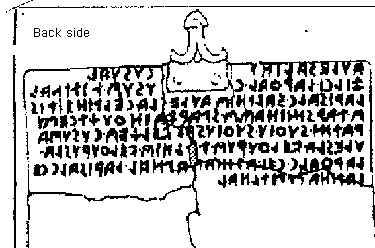
Beginning of the script:
(TC279)
AVLE SALINI CVSV AL
[Translation: [to the Prince (L. aule) of the Salini
I give as a reason/plead (L. causor-ari) to the/to
it (It. al)]
(TC283)
SILiCILAR RAL CVSVSSTI TIN AL [Translation:
craig (L. silex-icis) or alternatively namely (L.
scilicet); the household goddess (L. Lar, Laris, m.)
Ral, probably the goddess Ral, consort of the god
Tinia on the Divine_Mirror.html, we give as a
reason/plead (L. causor-ari); you stood (L. sto,
stare; It. stare; Fr. stationner; Avestan, astaya)
of the god Tinia to the (It. al)]
(TC290)
LARIS ALCSALINIS AVLE LA CEI TIN E
ITIS; [Translation: the gods (L. Lar, Laris, m.) of
someone/anyone (L. aliqui, aliquae); to the Salinis
of the prince (L. aule) of/to her (It. la) of
who/that (L. quae) of the god Tini out of (L. e, ex)
the movement, departure (L. itus-us)]
(TC298)
STAR Se MINAS Se
SPARSE IN RVK
Te CESV [Translation:
to stand (It. stare) oneself you threaten (L.
minor-ari; minito-are and minitor-ari; Fr. menacer)
yourself (L. se, sese); you scatter (L. spargo,
spargere, sparsi, sparsum) until (L. in) I demand
(L. rogo-are) of you/yours (L. tibi; It. ti) to
stop/cease (L. cesso-are; It. cessare)] Note: "I
demand you to stop" is repeated at TC 170.
(TC307)
RATvM SV RIV SV RIV SAL
FELKESCVSV SA
[Translation: we confirm (L. reor, reri, ratus);
upon (It. su) the river/stream (It. rio, m.) upon
(l. su; It. su) the river/stream (It. rio, m.) the
salt (L. sal, salis, m.) of the Velches (ancient
Etruscan town, Velcha?); I give as a reason/plead
(L. causor-ari) of myself] Note: If SA is reflexive
feminine, this letter is written by a woman.
(TC318)
VLES LAFILeR VRVSTINI ITIS
FILeR VRVS LA [Translation: you
omit an odor/smell (L. oleo-ere) of it/her (It. la;
Fr. la); to run away/sneak away (It. filare; Fr.
filer); we speak (L. oro-are); the god Tini; his
movement (L. itus-us); to run away/sneak away/ flirt
(It. filare; Fr. filer); we speak (L. oro-are) of it
of it/her (It. la; Fr. la)]
(TC327)
LAR RAL Ce CEL RIMATAMA LeLARIS ALC CI [Translation: the
household god/hearth (L. Lar, Laris, m.) the goddess
Ral here (Fr. ici); those (It. quel) it/she cleaves
to (L. rimor-ari); she loves (L. amo-are) there; the
gods (L. Lar, Laris, m.) of someone/something (L.
aliqui, aliquae) of it (It. chi)]
(TC338)
LATINA PITI TI
NAL (end of the back of the document). [Translation:
of the Latins (L. Latinus-a-um); ...(can't read
words)..... money (L. m. naulum-i)]
Summary of names and places mentioned:
Argos?: (TC7) ...ARCVS
Sulla: (TC19) ...LARIS AL SFLA
Tersna, king: (TC28) ...EReN TERSNA RVI SPANeRIM Le
Rasna, Etruscan: (TC38) ...RASNA SIIIC
INNI PES
and (TC213) ...RASNA L_
_ _ RIS
Cina or Cinat, town of Terro di Siena, near Cortona?
(TC46) ...TENRA SA CINAT or CINA Te
Salini, a gens: (TC71) ...SALINI and TC279
AVLE SALINI CVSV AL (TC283) SILiCI
Salinis, a gens: SALINIS AVLE
LA CEI TIN E ITIS
Silici, a gens: SILiCI
Felara, a gens: (TC80 ) ...FELARA LAR RAL IS A LAR Te FELARA
Ral, goddess, mother of Helen of Troy, also spelled
RALNA. (TC80 ) ...LAR RAL and TC283 ...LAR RAL CVSVS
Pompoi, Pompeius, Roman gens; possibly the town
Pompeii-orum: (TC90) ...PVMPVI RVCIV
Latina: (TC90)...AVLE CE LATINA SETeM NAL and TC213
CE LATINA LAV and TC338 LATINA
Velsini, people of Felsina, Bologna: (TC103) ...ARNSA 8ELSiNI
Louisna, possible name of person: (TC103)...FEL (3)
LVISNA (TC108) VSCE
Osce, L. Osci-orum, an ancient people of Italy:
(TC108) VSCE
Osc: (TC220) [missing/damaged
text].....NR ARMI
VSC N F_ R _ _
RAL CLEN Ce
Dis, Pluto, Hades, god of the Underworld: (TC150)
...SIKV KE SPARSES TIS
Chiane, Chianciano, Chiana Valley, near
Chiuso (TC190)...PES STAR
KIANE (E from TC191)
Terminaus, the god of boundaries (L.
Terminaus-i, m.): (TC231) TVRMNAS
A_ _ N.....(damaged script)
Velcha, town in Campania,
possibly an Oscan town: (TC236) ...FELKE..... (missing
text/tablet) and (TC241)
FELKE CVSV
AVLE (missing text/table)
Velches, Velcha, town
in Campania: (TC307) ...SV RIV SAL FELKES CVSV SA
Ani, person's name: (TC248) ANI NAL Ce
Tin, Tini, Tinia, god, consort of Ralna, L. Jupiter,
Gr. Zeus: (TC283) STI TIN AL (TC290) ...SALINIS AVLE LA CEI TIN E
ITIS and TC318...TINI
Notes:
(1) Change from NATVA to
NATVR based upon new scanning technology applied to
the Tavola Cortonensis by http://vcg.isti.cnr.it/projects/miscellanca/cortona/cortona_images,
confirmed by the current image on this page from
"The Etruscans," by Federica Borrelli and Maria
Cristina Targia, The J. Paul Getty Museum, Los
Angeles. This word also appears in the Tavolo
Eugubine (See Indo-European Table1.html).
(2) Change from IRI: LVS
to PILVS based on image of http://vcg.isti.cnr.it
and current image on this page.
(3) Inserted FEL based on
image of http://vcg.isti.cnr.it. This makes the
following word, LVIS, probably a name, Luis.
(4)
LESIE or ESIE is the preferred option since the
final E is facing ESI and not the word RIC. The
(5) Note that the
character "E" faces towards the previous line's
character "F," pointing to the word "FET." The
Etruscans used this method of characters facing the
word to which they belong, in many scripts.
(6) ARCOS may relate
to a series pertaining to "archon," ruler,
magistrate, such as : ARCAS, ARCE, ARCES, ARCIA,
ARCIS, ARCIV, ARCAMEN, ARKANI, ARCV.
 Return me to
  Home
Home
Launched 4.14.01
Updated
4.15.01; 5.06.01; 5.20.01; 5.28.01; 6.03.01;
6.10.01; 6.17.01; 6.24.01; 10.08.01; 10.11.01;
9.29.02; 10.15.02; 10.25.02; 9.01.03; 9.07.03;
9.14.03; 9.20.03; 9.28.03; 1.29.05; 5.29.05;
10.26.05; 11.21.05; 11.22.05; 3.27.06; 12.05.06;
4.29.08; 1.21.12
Copyright
© 1981-2012 Maravot. All rights reserved.
Copyright © 1981-2012 Mel Copeland. All
rights reserved.
Use of the information on this page for
publication in any media is expressly forbidden
without the prior written consent of the author.