Etruscan Phrases Grammar
Declension Tables (-A, -NE, -NA, -FA)
by Mel Copeland
(from a work published in 1981)
The following are preliminary
declension tables of the Etruscan language. As the
glossary, grammar and declension tables are studied
they will be corrected. For reference purposes we
have included the Latin cases which may or may not
apply. This document is to be used in connection
with "Etruscan Phrases" spreadsheet Etruscan_GlossaryA.xls,
which is our working document that most easily
displays the data we need to examine and refine.
Word definitions and their specific locations in the
texts are in the spreadsheets — some definitions are in the Declension
Table. Women's names from mirrors or paintings are
highlighted in blue; men's names are red. The name
TARKONOS is quite revealing, since it refers to
Tarquin, a king from Tarquinia. The suffix, "os," is
also in the name of Tarquin's wife, THANIKOILOS. Her name is in a short text, Script A, indicating the place
of her tomb. His name is on a mirror, Script
DL, that shows several people examining a
liver. The script refers both to Tarkonos and the
Tarquins (TARKIE) — a plural suffix. The suffix, "ei,"
is common to other words that probably are of
feminine gender, such as Helen of Troy's name,
ELENEI and the name of Persephone (Etr. PERSIPHNEI)
The suffix "os or us" is neuter singular, whereas
"ei" appears to be feminine singular. "os" and "on"
are suffixes that mark the Second Declension of
Greek; and "us" marks the Second and Fourth
Declensions, nominative and genitive singular, in
Latin.
Empirical investigation versus the Pallottino School
The Etruscan Glossary spreadsheet
and the Declension Tables contain not only words — the words are data. And everyone, who
chooses to do so, can independently, scientifically
verify that the words are words (not particles of
other words, etc.). To maximize this feature we
include images of the original texts, whose words
are assigned alphanumerical locators and cataloged
through the "Etruscan Phrases" Glossary spreadsheet.
One can open the "Etruscan Phrases" website and the
Etruscan_GlossaryA.xls and check every word location listed in
the spreadsheet against the texts where the word is
used. Critical to this process is the presentation
on each text page an image of the original text. If
an investigator cannot examine an image of the
original text, then corroboration of a transcription
of a text cannot be accomplished, and science then
rests upon the credibility of the transcriber(s)
(i.e., accepting their word on faith. The "Etruscan Texts Project" by the
University of Massachusetts illustrates the problem
of relying on an Etruscologist's transcriptions
alone, since its transliterations are not supported
by images of the original texts.).
Our objective, of course, is to identify the
grammatical relationships and meaning of the words.
To do this we need images of the original texts and
I thought that leading scholars including those
particularly affiliated with the "Etruscan Texts
Project" might facilitate this process. I thus
contacted Rex Wallace, University of Massachusetts,
who runs the "Etruscan Texts Project." There was a
problem in obtaining his support from the outset,
however, since Wallace propounds the theory that the
Etruscan language is not Indo-European and an
isolate, unlike any language known to man. An
October 5, 2006 press release from the University of
Massachusetts on grants Wallace had received says:
"According to Wallace, the Etruscan language, which
was spoken during the 1st millennium BCE in ancient
Etruria (modern Tuscany), was the most important
non-Indo-European language of ancient Italy." [umass.edu]
Wallace's foundations on the nature of the Etruscan
language are not original and follow an example of
what has been expressed in an email to me (by an
Italian journalist, Paolo Campidori) as the
"Pallottino School" theory. The essence of the
"Pallottino School" theory, though not identified as
such on the site, is documented at wikipedia.org. We wonder who
posted the erroneous data on the Etruscan language
at wikipedia, with the comment: "The value of some
words attested in many short inscriptions are known
with certainty because the correctness of their
meaning can be so easily cross-verified." It
presents links to Wallace's site, "Etruscan Texts Project," as
an authority for the wikipedia data, as well as
Wallace's "Etruscan News Online." Thus,
since Wallace and his associates are locked into
what can be called the "Pallottino School" theory,
prospects that he would cooperate with "Etruscan
Phrases" were not auspicious. As it turns out other
famous scholars whom I contacted fell into the same
mold, of protecting their own investment in their
erroneous theory, offering no help.
Although
Wallace wrote in his correspondence with me that the
"Etruscan Texts Project" "does not attempt to
translate the texts," his "categories" (1)
and his publications attempt to read and translate the
texts. In his email of July 2006, in response to my
inquiry, whether he was familiar with / had seen the
"Etruscan Phrases" site he said:
Rex
Wallace
July 12, 2006
"I have. Etruscan Texts
Project is, I suppose, less ambitious. We make texts
available to the scholarly community. We leave it to
the community to do linguistic analysis."
And in his email in response to my
inquiry to obtain photos of the texts upon which he
bases the "Etruscan Texts Project" Wallace said:
"I do not
have photographs of inscriptions on the ETP
database."
Wallace (who is also the
language editor for Etruscan News, according to
its editor, Larissa Bonfante, author of "Etruscan Language,") asks the
scholastic world to accept his offerings in
translating the texts and his foundation that the
Etruscan language is not Indo-European and unlike
any language known to man. His "non-Indo-European
Etruscan language, an isolate," theory of the
"Pallotino School," can be traced to Massimo
Pallottino's work, "The Etruscans," (first published
by Ulrico Hoepli, 1942). I found Pallottino's work
to be a good resource on the Etruscans, but his
theory on the Etruscan language suffers from a lack
of understanding of grammar; and his "translations,"
that have set standards for modern scholars, have no
relationship to the grammatical data recorded in
"Etruscan Phrases." Another scholar, Romolo Augusto
Staccioli, "La Lingua degli Etruschi," 1970, etc.,
continued the same half-baked "translations," all of
which claim to involve a few hundred words that can
best be described as gibberish. Since their work is
based upon Etruscan not being Indo-European, an
isolate unlike any other language, their conclusions
can never be verified, nor audited against any
linguistic foundation. Contrary to theirs, "Etruscan
Phrases" can be easily audited since it can be
measured against known languages, such as Latin,
Italian, French and Romanian, their declensions and
the shifts between them and Etruscan, i.e., suffix
"us" to "o": Latin Titus shifts to Italian Tito and
Etruscan Tito (TITV).
My first disappointing experience with the
"Pallottino School" relates to Staccioli. In my
first work, "Catalogue of Etruscan Words," 1981, I
made comparisons between the "translations" of
Staccioli to my data — updated and republished as "Etruscan
Phrases." I sent and delivered the catalogue to
several museum curators in the US and Europe and
received from a cardinal in the Vatican a letter
saying, "How dare you criticize my friend
Staccioli..." This explains the principal problem I
have seen in my inquiries with "Pallottino School"
scholars. Their pride of authorship has gotten in
the way of honest scholarship. One can hope that one
of them will break rank, seeing that "Etruscan
Phrases" can be of great scholastic and monetary
benefit to them. After all, the data in "Etruscan
Phrases" offers opportunities for new books and an
abundance of articles, at least with the same vigor
sent to the presses these past two hundred years.
The empirical data and its implications foster new
questions and new studies in many spheres.
That these proponents
advertise that they have compiled and translated a
vocabulary of several hundred words — without having any bearing to
grammatical relationships — can only be described as simple
guesswork. One cannot identify declension patterns
based upon a few hundred words, nor can one identify
verbs and their conjugations. In fact, anyone who
has taken a language course will learn that a
vocabulary of 1,200 - 1,500
words will allow one to acquire a proficiency of
basically being able to read a newspaper, and most
students would confess that a vocabulary of only 200
words would not facilitate any ability to converse.
An American, for instance, who learns French,
Spanish or Italian as a second language, will
probably have two things handy when he/she acquires
a basic 1,200 word vocabulary: (1) A dictionary with
basic grammar, including declension tables, some
commentary on verb conjugation, articles, pronouns,
adverbs and prepositions etc.; and (2) a book on
verb conjugation — 500 word editions are popular —,
"fully conjugated in all the tenses." This, of
course, is what "Etruscan Phrases" intends to
produce, using the growing 2,300 word vocabulary
identified to date, half of which appears to be
verbs.
We need more texts to reconcile to the "Etruscan
Phrases" Etruscan Glossary and its Declension and
Conjugation Tables on this site. I attempted to get
the support of Wallace and Bonfante in this regard,
without success. It's a sad situation, I confess,
since the advertisements for Bonfante's book, "Etruscan Language," say:
Those of you who have examined "Etruscan Phrases" and reached this point may wonder about this comment from Bonfante in response to my appeal:"...Originally published in 1983 and translated into a number of other languages, the book is a standard historical reference and a popular textbook for students of languages, linguistics, ancient civilization and Etruscan studies.
This informative, scholarly and well-illustrated volume provides the best collection of Etruscan inscriptions and texts currently in print. The Etruscans were highly literate: approximately 13,000 Etruscan inscriptions have been researched and they, far from having to be deciphered, can be easily read. One reason for this accessibility is because the Etruscans used the Greek alphabet, and they in turn passed it onto the Romans. The language is, however, idiosyncratic, being non-Indo-European, and different in structure from any other known language, ancient or modern.
A substantial archeological introduction sets language and inscriptions in their historical, geographical and cultural context. The overview of Etruscan grammar, the glossary and chapters on mythological figures all incorporate the latest scholarship and innovative discoveries."
November 26, 2006
Dear Etruscan enthusiast, I am sorry, the only help I can offer is Etruscan News, where we have a Language Editor, Rex Wallace.
I replied to her email as follows:
November 28, 2006
Dear Professor Bonfante,
Thank you for your reply. I am sorry you didn't check out the Etruscan Phrases website, since it contributes to the history of the Etruscans and you, as an Etruscan enthusiast, are so well recognized for your contributions to that history (though my work contradicts some of yours).
Etruscan Declensions
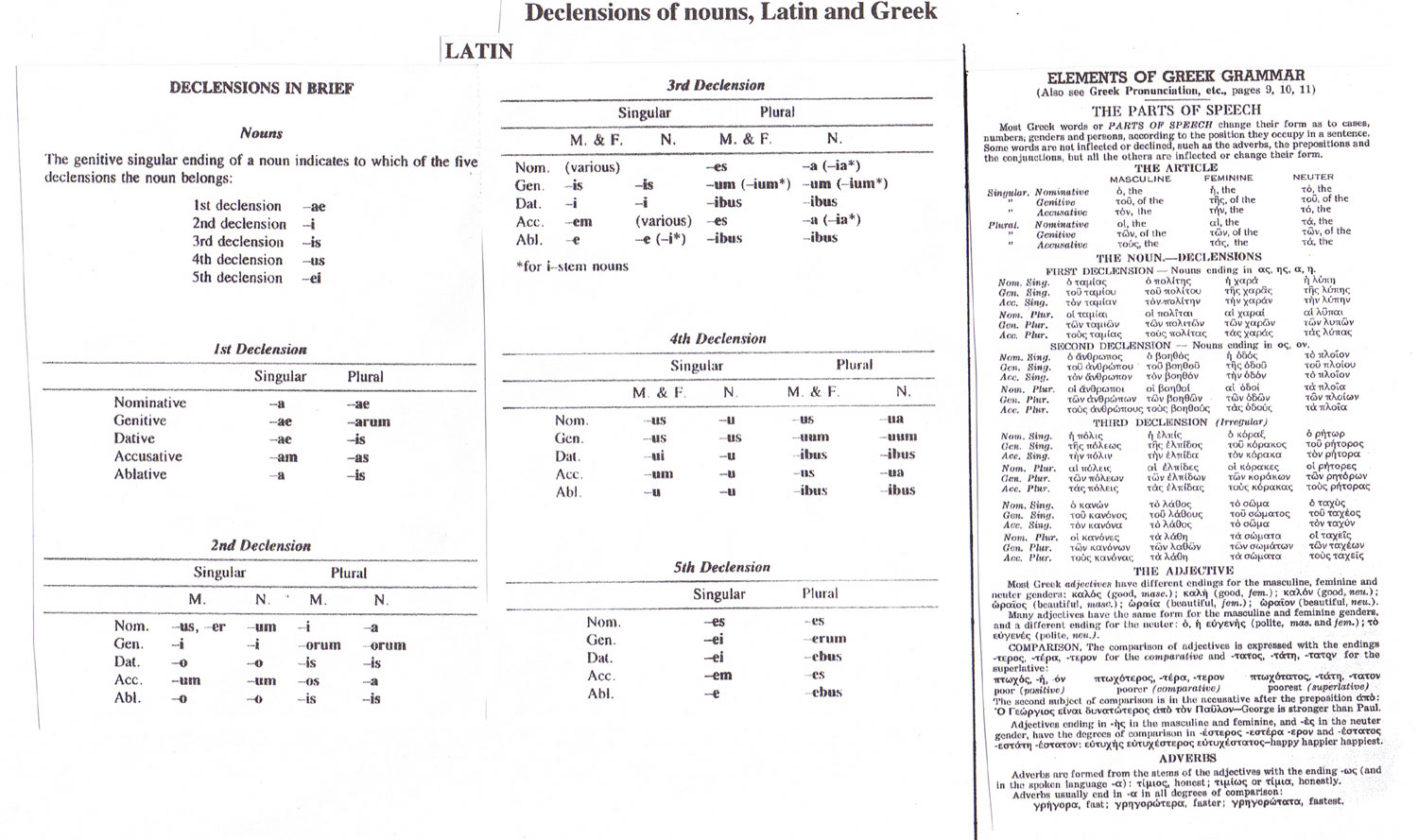 |
| The Latin
and Greek Declension Tables above were
taken from Cassell's and Divry's
dictionaries respectively. Click on
image for a larger view. We hope to meet
these standards with regard to the
"Etruscan Phrases" presentation on
grammar. — Nominative case: Of or designating a grammatical case that indicates the subject of a verb. — Genitive case: Of or designating a grammatical case that indicates possession or source. — Dative case: Designating or belonging to a grammatical case that principally marks the indirect object of a verb. — Accusative case: Of or pertaining to the grammatical case of a noun, pronoun, adjective or particle that is the direct object of a verb or the object of certain prepositions. — Ablative case: Designating a grammatical case indicating separation, direction away from, and sometimes manner or agency. |
As noted above, people who study a
new language get introduced to the empirical process
of grammar, particularly its declension and
conjugation patterns. An American that only knows
English will not in all probability know what I am
talking about, so I enclose the Latin and Greek
Declension charts for clarification. We can point
out some common American grammatical errors to
illustrate what's governed by such charts that set
noun declensions:
— Agreement in number problem: One
can think that they are...Correction: One
can think that one is, he/she is.
— Improper verb in
subjunctive case: If I was you I would not
think that way. Correction : If I were you I
would not think that way.
— Incorrect use of
objective case, adverb used instead of adjective:
They bought the gift for him and I and we
gave it to there kids. Correction: They
bought the gift for him and me; i.e., it is
for him, it is for me, and we gave it to their kids.
— Incorrect verbs,
use of double negative, wrong adjective and case:
They says he don't know nothing about this data
(They say he doesn't know anything about those data,
or this datum). The double negative is common among
rural Americans.
— Incorrect number.
Subject does not agree with verb: The value
of some words attested in many short inscriptions are
known. Correction: The value of some words..is
known.
These rudimentary grammatical errors and more can be
pointed out as errors because English has rules
(declension tables, etc.) and the violation of a
rule can be empirically measured. Over time,
languages relax their rules and errors can become
commonplace and accepted. Vowels change, consonants
are added and dropped and eventually a new dialect
forms. As in the case of English and French, for
example, words shift in pronunciation and no longer
resemble the spelling. Foreigners may not know the
proper pronunciation of a word and can mispronounce
what they see written.
Words can be added to a language through commerce
with foreign nations and other social intercourse.
The English language is perhaps the best example of
this characteristic of word acquisition. The reader
may recall our comparison of the English vocabulary
to that of French in the introduction of our Etruscan
Grammar. And most importantly each of our
readers has participated in the creation and
addition of a new word, google, to the world
dictionaries. When the search engine became popular
conversations relating to web searches more than
likely included such phrases (in most languages) as
: Google it!, I am googling, I will google it, I
googled it, I should have googled it, she googles
it, actually, he and she google it and there are
many googlers around the world. Notice how the new
word, google, declines in English.
Two thousand three hundred years ago the Etruscans
applied a grammar similar to that of Latin. In
Indo-European languages such as Latin the
"suffix" indicates the meaning of a word together
with the context in which it is used. The words
decline. With this said, we can examine the
declination of Etruscan words.
Straight away we can see an abundance of the
following suffixes which we believe to be nouns or
adjectives: as, ai, em, ia, ias, um, is, os (or us),
er, o, ie, ei, ies, or, es, a, e, i, and some
curious ones, A8 (au, ao?) ov, ev, and au (AF). The
value of "V" versus "F" is curious, and the two
vowels might be revealed in the word OSUIS (VSFIS).
Before we can pursue this value we have to verify
that OSUIS is a word, and this can be done by
finding the locater in the Etruscan_glossaryA.xls.
The glossary records these locators: Z47, Z681,
Z834, TC201. Script Z, the Zagreb Mummy, and TC, the Tavola
Cortonensis are listed. At first glance OSUIS
looks like a word because of the several locators.
The reader can ascertain the viability of this word
for himself / herself. As for the "V" and "F," it
appears that the "V" as a vowel has a value of "o"
and "u." The "F" is a "u" when used as a vowel. We
tend to render "V" as an "o." It's a problem of
distinction, as in pronouncing the English
words,such as put, foot, could, hood, shoot, chute,
mute, debut, moat, note, cause, gnaws, laws, loss,
boss, gauze, faucet, etc. We do hope, however, that
the Etruscan spelling convention was a bit more
rational. So far it seems to be so.
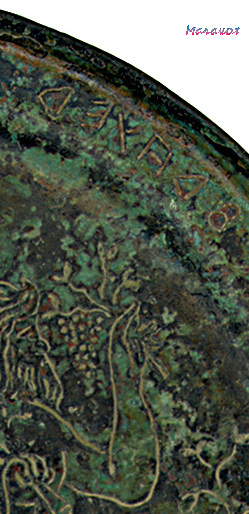 |
| Section of Schøyen Collection mirror, MS565/2 showing the word 8RATER, frater. |
Note how the Etruscans made
distinctions between ai and ia and ie and ei. The
word FRATER (8RATER) seen in the Tavola Eugubine Script , and the Schøyen mirror MS 565/2, Script MS,
is important, because of the suffix, os, and the
consonant "8" which we usually render as "B" but in
this case have applied the value of "F." The word
"frater," of course is "brother" and we can see in
the Indo-EuropeanTable.html that
the word shifts from Sanskrit, bhratar and Persian
baradar, to Greek phrater and Latin frater, French
frère, Welsh friar, pracar in Tocharian, brathair in
Irish, breudeur in Breton, brothor in Old English,
and brother in modern English. We note that the "8"
in most Etruscan words appears to be "V," as in
vario, and is distinctly not an "F." This leads us
to suspect that the Irish pronunciation, brathair
(pl.), may be closer to the Etruscan pronunciation,
which appears to be brater. Furthermore, if this
indicates a trend or shift it may indicate a closer
affinity of the Gaelic language(s) to Etruscan than
found in that between Latin and Gaelic. Our
investigation through the Indo-European Table,
however, shows that the Etruscan language is closest
to Latin, of all the Indo-European languages.
Because of its declension characteristics
— with its age, being of a people that are
antecedent to the Romans / Latins — the Etruscan language may be in the
nexus where Latin, Gaelic and Greek meet or began to
differentiate.
Codes in the Declension Table are as follows: Words
with question marks next to them may be verbs. Words
with a "PL" number are probably nouns, found in the
Picacenza Liver. Words in parentheses refer to a
separate listing of the same word group in another
declension. Colored characters, such as the green "S," are described in the first page of this grammar. As the
"Etruscan Phrases" Glossary acquires more words so
will our visibility of the Etruscan declensions
improve. We expect in general that the Etruscan
declensions will resemble the Latin declensions,
though we can't rule out any resemblance to the
Greek, such as the "os" suffix.
Like Latin, Etruscan does not use the article. Thus,
gender and number would be indicated through the
suffix, just as the specific case would also be
identified through the suffix. As we sift the data
in these tables, we will also prepare separate
Conjugation Tables for Etruscan verbs. The Etruscan_grammar.xls,
of course, provides the essence of Etruscan
conjugation, but I am anxious to see what the
Conjugation Table will look like. I anticipate that
it will have all of the Latin conjugation voices,
Active and Passive: indicative, subjunctive,
imperative, the infinitive and the participles. I
believe that most of the verbs are Active, in the
present, imperfect, perfect, future and a few of the
words appear to be in the pluperfect tense. In any
event the Conjugation Table and the process by which
it will emerge has a life of its own, as it were,
and it will take whatever form that is found in it.
After all, we can't make up words to fit a theory,
as the process compels us to understand the words as
they fit within their bounds of grammatical rules.
Though a bit harsh, my complaint against the
"Pallattino School" scholars is appropriate, since
it has to do with the future of Etruscan studies and
the credibility of those teaching Etruscology.
Students who invest their time and lives in the
studies, and the people who have provided financial
grants for research, should expect more than the
"Pallattino School" promise "that Etruscan is like
no language dead or living." On the contrary, its
grammatical forms are akin to Latin and for starters
we have ~2,300 words to prove it (and the glossary
is growing). Those who have been funding "Pallottino
School" research are also impacted in the prospect
that Etruscan is very much Indo-European, that it
has been refined as such at "Etruscan Phrases" since
1998, contrary to what their beneficiaries claimed.
"Pallottino School" scholars have asked the
world to believe their translations of several
hundred words — from the
corpus of a language they cannot identify — without giving us the ability to audit
their data. The concept is quite bothersome to me
and no doubt offensive to the very meaning of
scientific inquiry. This work is fully auditable.
Mel Copeland
Berkeley, CA
February 11, 2007
(Updated 10.25.11)
This page reflects names shown in Etruscan mirrors,
such as HERCLE (Heracles), etc.
| |
|
|
|
|
|||
|
Nominative |
Genitive |
Accusitive |
Dative |
Ablative |
Etr. dec 1 |
Etr. dec 2 |
Plural |
|
x |
RAS |
x |
x |
x |
RASNA* |
RASNE* |
RASNES |
|
x |
ROM |
ROMA |
x |
x |
ROMNA* |
ROMNE* |
ROMI |
|
x |
x |
x |
x |
x |
AVONA |
x |
AVONAS, AVONES |
|
x |
x |
x |
x |
x |
PETiNA (L pecten) |
x |
x |
|
x |
x |
x |
x |
x |
SENTINA* |
x |
x |
|
x |
x |
x |
x |
x |
SATINA* |
SATANE* |
x |
|
x |
x |
x |
x |
x |
SARINA* |
x |
x |
|
x |
x |
x |
x |
x |
RINA |
x |
x |
|
x |
RAL |
x |
x |
x |
RALNA* |
x |
x |
|
x |
x |
x |
x |
x |
TARENA |
x |
x |
|
x |
x |
x |
x |
x |
TALENA |
x |
x |
|
x |
x |
x |
x |
x |
THENA |
x |
x |
|
x |
x |
x |
x |
|
TESENA |
TESeNE |
TESeNS |
|
x |
x |
x |
x |
|
CHAINA (KAINA) |
CHIANE (KIANE) |
x |
|
x |
x |
x |
x |
x |
x |
FELTONE* |
x |
|
x |
x |
x |
x |
x |
x |
HERMNE* |
x |
|
x |
x |
x |
x |
x |
x |
ARMONE* |
x |
|
x |
x |
x |
x |
x |
x |
AKRARE or AKRATHE (Agrius, a giant?) |
x |
|
x |
TAL |
x |
x |
x |
x |
x |
TALI |
|
x |
TEL (L. tela) |
x |
x |
x |
x |
x |
x |
|
x |
x |
x |
x |
x |
x |
RESANE |
x |
|
x |
SATAN |
x |
x |
|
x |
SATANE |
x |
|
x |
x |
x |
x |
|
x |
SATENE |
x |
|
x |
TORAN, TURAN |
x |
x |
x |
x |
x |
x |
|
x |
MEAN |
x |
x |
x |
x |
x |
x |
|
x |
EFAN |
x |
x |
x |
x |
x |
x |
|
x |
x |
x |
x |
x |
x |
TORONE, TURONE (Turin?) |
x |
|
x |
x |
x |
x |
x |
x |
x |
TORINES, TURINES (L. Taurinus) |
|
x |
x |
x |
x |
x |
x |
NATINE |
x |
|
x |
x |
x |
x |
x |
x |
RISINE* |
x |
|
x |
RESiN |
x |
x |
x |
x |
RESINE* |
RESiNS |
|
x |
x |
x |
x |
x |
x |
x |
TEVNS |
|
x |
x |
x |
x |
x |
x |
x |
TENS |
|
x |
x |
x |
x |
x |
x |
x |
MENS |
|
x |
x |
x |
x |
x |
x |
ELCHINTRE ELACHSNTRE ELCHSUNTRE |
x |
|
x |
x |
x |
x |
x |
x |
ATNE |
x |
|
x |
SIK |
x |
x |
x |
x |
SIKNE |
x |
| x | x | x | x | x | x | ACILVNE | x |
|
x |
x |
x |
x |
x |
x |
LUNE |
x |
|
x |
x |
x |
x |
x |
x |
CATNE* |
CATNIS |
|
x |
x |
x |
x |
x |
LATINA |
x |
x |
|
x |
x |
x |
x |
x |
ACNINA |
x |
x |
| x | x | x | x | x | AKNINA | x | x |
|
x |
x |
x |
x |
x |
HENNA |
x |
HENNI |
|
x |
x |
x |
x |
x |
x |
x |
SALINI, |
|
x |
x |
x |
x |
x |
x |
x |
SANTI, |
| x | x | x | x | x | x | x | ALENI |
|
x |
TAM (L. tam) |
x |
x |
x |
x |
x |
x |
|
x |
TOM (L. tum) |
x |
x |
x |
x |
x |
x |
|
x |
TORM (L. turm) |
x |
x |
x |
x |
x |
x |
|
x |
LEM |
x |
x |
x |
x |
x |
x |
|
x |
x |
x |
x |
x |
LEMNISA |
x |
x |
|
x |
x |
x |
x |
x |
RALISA |
x |
x |
|
x |
x |
x |
x |
x |
LARISA |
x |
x |
|
x |
x |
x |
x |
x |
SORISA |
x |
x |
|
x |
x |
x |
x |
x |
FELRA |
FELRE |
x |
|
x |
LES (L. les) |
x |
x |
x |
x |
x |
x |
|
x |
LIS (L. lis) |
x |
x |
x |
x |
x |
x |
|
x |
LUS (L. lux) PL29 |
x |
x |
x |
x |
x |
x |
|
x |
x |
RA |
x |
x |
x |
RAE, PL31 |
x |
|
x |
x |
RaKSA |
x |
x |
x |
x |
x |
|
x |
x |
AVA (L. avia) |
x |
x |
x |
x |
x |
|
x |
AVO (L. avus) |
x |
x |
x |
x |
x |
x |
|
x |
OV (L. ovum-i) |
x |
x |
x |
x |
x |
x |
|
x |
OK (It. oggia?) |
x |
x |
x |
x |
x |
x |
|
x |
OT, VT (L. ut) |
x |
x |
x |
x |
x |
x |
|
x |
LaTO |
x |
x |
x |
x |
x |
x |
|
x |
x |
x |
x |
x |
ORKA |
x |
x |
|
x |
x |
x |
x |
x |
SICA (L. sica) |
x |
x |
|
x |
x |
x |
x |
x |
PESCA |
x |
x |
|
x |
NASC |
x |
x |
x |
x |
x |
x |
|
x |
MAS |
x |
x |
x |
x |
x |
x |
|
x |
NAS |
x |
x |
x |
x |
x |
x |
|
x |
SAS |
x |
x |
x |
x |
SASE |
x |
|
x |
SEOS, SEUS |
x |
x |
x |
x |
x |
x |
|
x |
PES |
x |
x |
x |
x |
x |
x |
|
x |
x |
x |
x |
x |
SFERA or SeVERA? |
x |
x |
|
x |
x |
x |
x |
x |
SOVERA |
x |
x |
|
x |
x |
x |
x |
x |
SOBRA, SOVRA (It. sopra, sovra) |
x |
x |
|
x |
PONIG (Punic?) |
x |
x |
x |
x |
x |
x |
|
x |
NES? (L. nex) |
x |
x |
x |
x |
x |
x |
|
x |
LAUS (L. laus) |
x |
x |
x |
x |
x |
x |
|
x |
CIVAS |
CIVA |
x |
x |
x |
x |
x |
|
x |
MAF |
x |
x |
x |
x |
x |
x |
|
x |
x |
x |
x |
x |
MANTRA |
x |
x |
|
x |
x |
x |
x |
x |
CATRA |
x |
x |
|
x |
TER (L. ter) |
x |
x |
x |
x |
x |
x |
|
x |
TERS |
x |
x |
x |
x |
x |
x |
|
x |
VER |
x |
x |
x |
x |
x |
x |
|
x |
VERI |
x |
x |
x |
x |
x |
x |
|
x |
SALT |
x |
x |
x |
x |
x |
x |
|
x |
FET (L. festus) |
x |
x |
x |
x |
x |
x |
|
x |
RET (L. rete) PL11 |
x |
x |
x |
x |
x |
x |
|
x |
MONICLET |
x |
x |
x |
x |
x |
x |
|
x |
RIMAT? |
x |
x |
x |
x |
x |
x |
|
x |
SEROT? |
x |
x |
x |
x |
x |
x |
|
x |
TeP? (L. tepeo) |
x |
x |
x |
x |
x |
x |
|
x |
THvS? (L. tus) |
x |
x |
x |
x |
x |
x |
|
x |
TUS, TFS (L. tus) |
x |
x |
x |
x |
x |
x |
|
x |
TRIS (L. tristis) |
x |
x |
x |
x |
x |
x |
|
x |
TOSK |
x |
x |
x |
x |
x |
x |
|
x |
FUFLUNS |
x |
x |
x |
x |
x |
x |
|
x |
LANTS |
x |
x |
x |
x |
x |
x |
|
x |
ONT (It. onta) |
x |
x |
x |
x |
x |
ONTS |
|
x |
SAIN? |
x |
x |
x |
x |
x |
SAINS |
|
x |
LONS (PL28) |
x |
x |
x |
x |
x |
x |
|
x |
NERONS (NERVNS) |
x |
x |
x |
x |
x |
x |
|
x |
CENKVN (CENCHVN) |
x |
x |
x |
x |
x |
x |
|
x |
SAM |
x |
x |
x |
x |
x |
x |
|
x |
MUR (MOR?) |
x |
x |
x |
x |
x |
MURS |
|
x |
SOL (L. sol) |
x |
x |
x |
x |
x |
SOLS |
|
x |
x |
x |
x |
x |
x |
x |
SABELS |
|
x |
LIAL |
x |
x |
x |
x |
x |
x |
|
x |
RIAL |
x |
x |
x |
x |
x |
RIALS |
|
x |
OP (L. Ops) |
x |
x |
x |
x |
x |
x |
|
x |
OPH |
x |
x |
x |
x |
x |
x |
|
x |
ROPH |
x |
x |
x |
x |
x |
x |
|
x |
PERSON |
x |
x |
x |
x |
x |
x |
|
x |
CLAN |
x |
x |
x |
x |
x |
x |
|
x |
NON (L. non) |
x |
x |
x |
x |
x |
x |
|
x |
OMEN |
x |
x |
x |
x |
x |
x |
|
x |
TRETEN? |
x |
x |
x |
x |
x |
x |
|
x |
KOLEM |
x |
x |
x |
x |
x |
x |
|
x |
EPE OR |
x |
x |
x |
x |
x |
x |
|
x |
EPH |
x |
x |
x |
x |
x |
x |
|
x |
PHA |
x |
x |
x |
x |
x |
x |
|
x |
PHO |
x |
x |
x |
x |
x |
x |
|
x |
SERPHO |
x |
x |
x |
x |
x |
x |
|
x |
EPIC (L. epicus) |
x |
x |
x |
x |
x |
x |
|
x |
OMERIC |
x |
x |
x |
x |
x |
x |
|
x |
x |
x |
x |
x |
SULA, SFLA |
x |
x |
|
x |
RIP |
x |
x |
x |
x |
x |
x |
|
x |
RUV |
x |
x |
x |
x |
x |
x |
|
x |
SKAL |
x |
x |
x |
x |
x |
x |
|
x |
SICAL |
x |
x |
x |
x |
x |
x |
|
x |
FIAUL |
x |
x |
x |
x |
x |
x |
|
x |
NIUL (L. nihil) |
x |
x |
x |
x |
x |
x |
|
x |
SCOL |
x |
x |
x |
x |
x |
x |
|
x |
FOLC |
x |
x |
x |
x |
x |
x |
|
x |
x |
x |
x |
x |
x |
x |
PEORI? |
|
x |
x |
x |
x |
x |
x |
x |
CLENSI |
|
x |
x |
x |
x |
x |
x |
x |
CERNI |
|
x |
x |
x |
x |
x |
x |
x |
COMNI |
|
x |
x |
x |
x |
x |
x |
x |
MIMNI |
|
x |
x |
x |
x |
x |
x |
x |
FELSI |
|
x |
x |
x |
x |
x |
x |
x |
POLESI |
|
x |
x |
x |
x |
x |
x |
x |
NETI |
|
x |
x |
x |
x |
x |
x |
x |
SCORPI |
|
x |
x |
x |
x |
x |
x |
x |
SOTHI |
|
x |
FELS |
x |
x |
x |
x |
x |
FELI |
|
x |
VELS |
x |
x |
x |
x |
x |
VELI |
|
x |
SAVELS |
x |
x |
x |
x |
x |
x |
|
x |
FILiK (L. felix) |
x |
x |
x |
x |
x |
x |
|
x |
VILiK (L. felix) |
x |
x |
x |
x |
x |
x |
|
x |
FOST (It. fusto) |
x |
x |
x |
x |
x |
x |
|
x |
VOST |
x |
x |
x |
x |
x |
x |
|
x |
RUCE, RFCE |
x |
x |
x |
x |
x |
x |
|
x |
CULAN |
x |
x |
x |
x |
x |
x |
|
x |
KROFE |
x |
x |
x |
x |
x |
x |
|
x |
OFE (L. offa-ae) |
x |
x |
x |
x |
x |
x |
|
x |
MORFE (L. Morpheus) |
x |
x |
x |
x |
x |
x |
|
x |
OReSTE, OROSTHe |
x |
x |
x |
x |
x |
x |
|
x |
POLPE |
x |
x |
x |
x |
x |
x |
|
x |
x |
x |
x |
x |
URTHEA |
x |
x |
|
x |
x |
x |
x |
x |
MANRIFA, MANRFA, MENRFA |
x |
x |
|
x |
x |
x |
x |
x |
ATLENTA (Atalanta) |
x |
x |
|
x |
x |
x |
x |
x |
ATHRvPA (Atropos) |
x |
x |
|
x |
x |
x |
x |
x |
CLUTHUMUSTHA (Clytemnestra) |
x |
x |
|
x |
x |
x |
LAS? |
x |
LASA |
|
x |
| x | x |
x |
x |
x |
IKRA |
x |
x |
|
x |
x |
x |
x |
x |
LATFA |
x |
x |
|
x |
LEINR or LEINTH |
x |
x |
x |
x |
x |
x |
|
x |
x |
x |
x |
x |
NAKFA |
x |
x |
|
x |
x |
x |
x |
x |
NOCTFA |
x |
x |
|
x |
x |
x |
x |
x |
METFA |
x |
x |
|
x |
x |
x |
x |
x |
PILEKA |
x |
x |
|
x |
x |
x |
x |
x |
TELETA |
x |
x |
|
x |
AMPHIARE |
x |
x |
x |
x |
x |
x |
|
x |
TUTE |
x |
x |
x |
x |
x |
x |
| x | TVTHE (Script ON) |
x |
x |
x |
x |
x |
x |
|
x |
ADaRSTE |
x |
x |
x |
x |
x |
x |
|
x |
PReSSE |
x |
x |
x |
x |
x |
x |
|
x |
DIONE |
x |
x |
x |
x |
x |
x |
|
x |
PROPE (L. prope, adv.) |
x |
x |
x |
x |
x |
x |
|
x |
TAVLE (L. tabella) |
x |
x |
x |
x |
x |
x |
|
x |
ITALE |
x |
x |
x |
ITALA |
x |
x |
|
x |
ISLE (L. insula) |
x |
x |
x |
x |
x |
x |
|
x |
HERCLE |
x |
x |
x |
x |
x |
x |
|
x |
COCLe |
x |
x |
x |
x |
x |
x |
|
x |
EUPLE (Euippe?) |
x |
x |
x |
x |
x |
x |
|
x |
x |
x |
x |
x |
ACILA (L. ancilla-ae?) |
x |
x |
|
x |
AKL, AKLE (Achilles) |
x |
x |
x |
x |
x |
x |
|
TUNTLES |
TUNTLE (Tyndareüs) |
x |
x |
x |
x |
x |
x |
|
x |
PHERSE (PERSEUS) |
x |
x |
x |
x |
x |
x |
|
x |
ATHLE (Atlas) |
x |
x |
x |
x |
x |
x |
|
x |
SEMLE (Semela) |
x |
x |
x |
x |
x |
x |
|
x |
VOSLE |
x |
x |
x |
x |
x |
x |
|
x |
MENLE (Menelaus) |
x |
x |
x |
x |
x |
x |
|
x |
NEPLE |
x |
x |
x |
x |
x |
x |
|
x |
PELE |
PELION (PELIVN) |
x |
x |
x |
x |
x |
|
x |
x |
OCTITO |
x |
x |
x |
x |
x |
|
x |
x |
PLATO |
x |
x |
x |
x |
x |
| x | VIRIN (L. vir) |
x |
x |
VIR |
VIRA |
x |
x |
| x | KULIN |
x |
x |
x |
x |
x |
x |
|
x |
OFLIN (L. ovile-is) PL-1 |
x |
x |
x |
x |
x |
OFELI |
|
x |
PLOTIN (L. pluteus) |
x |
x |
x |
x |
x |
x |
|
x |
CANIN |
x |
x |
x |
x |
x |
x |
|
x |
ACHMEMNON |
x |
x |
x |
x |
x |
x |
|
x |
AEITHEON (Jason) |
x |
x |
x |
x |
x |
x |
|
x |
CERON (Geryon) |
x |
x |
x |
x |
x |
x |
|
x |
RACON |
x |
x |
x |
x |
x |
x |
|
x |
HEUN (L. Euhan) |
x |
x |
x |
x |
x |
x |
|
x |
NAKUS, NAKFS |
x |
x |
x |
x |
x |
x |
|
x |
x |
x |
x |
x |
FEIRA (It. Fiora) |
x |
x |
|
x |
PEL |
x |
x |
x |
x |
x |
x |
|
x |
PEN |
x |
x |
x |
x |
x |
x |
|
x |
NAL |
x |
x |
x |
x |
x |
x |
|
x |
ROK |
x |
x |
x |
x |
x |
x |
|
x |
EREK? |
x |
x |
x |
x |
x |
x |
|
x |
OS (L. os-oris, os ossis) |
x |
x |
x |
x |
x |
x |
|
x |
ARC |
x |
x |
x |
x |
x |
x |
|
x |
AKS |
x |
x |
x |
x |
x |
x |
|
x |
ANS (L. ansa) |
x |
x |
x |
x |
x |
x |
|
x |
SOS |
x |
x |
x |
x |
x |
x |
|
x |
EOS (L. Eos) |
x |
x |
x |
x |
x |
x |
|
x |
APH |
x |
x |
x |
x |
x |
x |
|
x |
ARS |
x |
x |
x |
x |
x |
x |
|
x |
x |
x |
x |
x |
IPA |
IPAE* |
IPEI |
* Old Latin, "Dueonos Vase." (See Etruscan_Phrases_a.html)

Notes:
(1) Wallace's "Etruscan Texts Project" categories: Abecedaria, Artisans' Texts, Boundary Markers, Construction Texts, Dedications, Didaskalia, Funerary Texts, Legal Texts, Other/Unclear Texts, Prohibitions, Proprietary Texts, Religious Texts, Tesserae Hospitales


 Please beam
me up to Etruscan Glossary
Please beam
me up to Etruscan Glossary
Etruscan_Grammar.xls
Please beam me up to Etruscan_Phrases
home
Please beam me up to Maravot's_Index.html
— Launched 7.27.06
Updated: 7.28.06; 7.29.06; 7.30.06;
7.31.06; 8.01.06; 8.02.06; 1.28.07; 2.07.07;
2.08.07; 2.09.09; 2.10.07; 2.11.07; 2.12.07;
2.14.07; 2.25.07; 4.15.07; 5.23.09; 10.22.10;
10.25.11
Copyright © 1981-2011 Maravot. All
rights reserved.
Copyright © 1981-2011 Mel Copeland. All rights
reserved.